



DILI, 03 february 2022 (TATOLI)-The European Union (EU) and Timor-Leste unveiled on the 3 february 2022 priorities for a new programme of EU/Timor-Leste cooperation. The EU will provide funding amounting to EUR 55 million for the period until 2024 to support a range of initiatives for the development of Timor-Leste and to promote mutually beneficial cooperation.
With this new strategic document, the EU commits to provide support for the priorities defined in consultation with the Timor-Leste authorities . Other key stakeholders were consulted, in particular Civil Society Organizations, including women and youth organizations, local authorities, representatives from the private sector, the UN and other development partners of Timor-Leste.
The new programme has two main priorities: Priority 1 – Green and sustainable economic recovery and development; Priority 2 – Good governance for sustainable development. For the first phase, from 2021 – 2024, the EU will dedicate a contribution of EUR 55 million (approximately USD 61 million). The financial allocation for 2025-2027 will be determined following a mid-term review in 2024.
“The European Union has a long standing partnership with Timor-Leste, based on the shared values of democracy, human rights, and the rule of law. Today, we are marking a step in our cooperation, by committing ourselves to long-term support for green and sustainable economic recovery and development (a “Green Deal”) and for good governance for sustainable development. I am particularly pleased that we intensify support to Timor-Leste in the diversification of the economy, and in its efforts at regional economic integration, including preparations for possible ASEAN accession.” Ambassador Andrew Jacobs told reporters in the Meeting room of the Ministry of Foreign Affairs and Cooperation, Praia dos Coqueiros, Dili, today
The Minister of Foreign Affairs and Cooperation Adaljiza A.X.R. Magno stated: “I acknowledge that the European Union programs within the framework of the new partnership of the European Union will complement the government’s efforts for the well being of the people of Timor-Leste”.
She added: “I urge my fellow government members of the relevant sectors to seize the opportunity and carry out the implementation of the government’s plan to serve our people.
“And, I congratulate the European Union as the EU was the first development partner in Timor-Leste that is at the forefront of supporting Timor-Leste and implementing the principles of “Country-Owned, Country-Led and Use Country System”. For this, I keep holding the annual political dialogue and regular public policy dialogues to be continued as the most valuable instruments to strengthen and maintain our cooperation”
The adoption of the Multiannual Indicative Programme is an important step in reinforcing the EU’s cooperation with Timor-Leste. It will enable the EU and Timor-Leste to continue working together on programmes and projects that are built on shared objectives, principles and values. It comes at a time when the EU is starting to implement a new strategy for cooperation in the Indo-Pacific.
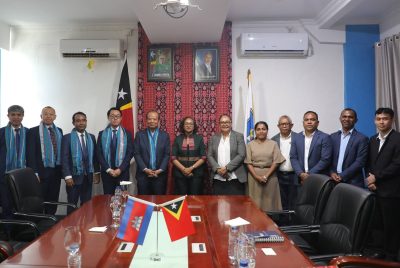
The EU Multiannual Indicative Programme for Timor-Leste for 2021-27 was officially launched by the Minister of Foreign Affairs and Cooperation, Adaljiza A.X.R. Magno and the Ambassador of the European Union (EU) to Timor-Leste, Andrew Jacobs.
Previously the Multiannual Indicative Programmes MIPs help secure financing for projects of common interest on a multi-annual basis in the context of Global Europe.
The Global Europe programming, officially launched in November 2020, addresses the overarching Commission priorities, promotes the post-Covid-19 green, digital, inclusive and sustainable recovery and fully respects the commitments contained in the new instrument, particularly on climate action, social inclusion and human development, migration and forced displacement, and gender equality.
The country and regional Multiannual Indicative Programmes are adopted by the Commission after consultation with the partner country/regional organisations, EU Member States and all relevant stakeholders. These documents establish the main priority areas for cooperation, specific objectives, expected results as well as the indicative allocations for the EU cooperation with partner countries and regions covered by Global Europe, i.e. the Neighborhood, Sub-Saharan Africa, Asia and the Pacific, and the Americas and the Caribbean. These Multiannual Indicative Programmes therefore constitute the long-term plans for the implementation of Global Europe in these countries and regions.
Global Europe and its Multiannual Indicative Programmes are implemented through a Team Europe approach. Team Europe brings together the EU, Member States with their respective financial and development institutions, including the European Investment Bank, and the European Bank for Reconstruction and Development, and seeks to mobilize the private sector in order to leverage investments for a greater impact. By pooling experience, expertise and resources from partners, it provides an opportunity to combine the most appropriate mix of implementing modalities to achieve objectives and obtain maximum results in programming, including through Team Europe Initiatives that underpin the implementation of Global Gateway strategy.
Journalist: Camilio de Sousa
Editor: Rafy Belo