


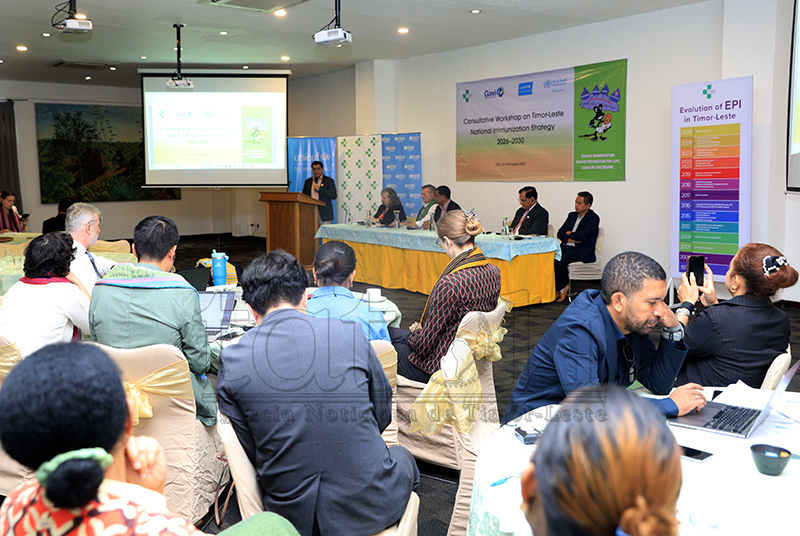
DILI, 12 August 2025 — The Ministry of Health, with the support from the World Health Organization (WHO), UNICEF, Gavi, the Vaccine Alliance, and development partners, convened a three-day public consultation on the development of the National Immunization Strategy 2026–2030.
Vice-Minister for Institutional Strengthening in Health, José dos Reis Magno, said vaccination is not only a public health intervention but also “a foundation for equity, resilience, and national development.”
He said that immunization has had a significant impact on public health, recalling that it enabled Timor-Leste to eliminate tetanus, measles, and rubella.
The workshop, held at Hotel Timor, brought together senior government officials, health directors, program managers, technical experts, and representatives from Gavi, the Vaccine Alliance.
WHO Country Representative Dr Arvind Mathur described the workshop as “a pivotal workshop to shape Timor-Leste’s next National Immunization Strategy, a blueprint that will strengthen immunization services and protect every Timorese child.”
Dr Mathur commended the Ministry of Health for leading the development of an integrated, costed NIS aligned with the recent Expanded Program on Immunization (EPI) review, the Effective Vaccine Management (EVM) assessment, and the Immunization Agenda 2030.
“This plan will also align with GAVI’s strategic mission of ensuring sustainable vaccine coverage, closing equity gaps, and building resilient immunization systems that leave no one behind,” Mathur said in his remarks at the national workshop held at Hotel Timor in Dili on Tuesday.
He stressed that the NIS will serve as a roadmap for 2026–2030, guiding priorities, linking with the Integrated Health Program, identifying funding gaps, and mobilizing resources from both domestic and partner sources.
“Timor-Leste’s immunization achievements, such as being polio-free, eliminating measles, rubella, and maternal and neonatal tetanus, must be preserved. A costed NIS will sustain these gains and prepare the country for future challenges,” he said.
UNICEF Country Representative Patrizia DiGiovanni called the strategy “a roadmap for protecting the health of every child and every citizen through equitable and resilient immunization services.”
UNICEF has supported vaccine procurement, cold chain strengthening, health worker training, and community engagement. The agency also helped conduct the 2024 EVM assessment, which showed national performance improved from a score of 43 in 2015 to 63 in 2024.
DiGiovanni emphasized that the NIS offers an opportunity to address remaining challenges, including variations in service performance, lack of updated guidelines, and the need for regular microplanning and refresher training.
“UNICEF remains committed to supporting the costing of the National Immunization Strategy—ensuring that the final document becomes a powerful tool for advocacy, resource mobilization, equitable resource allocation, effective program monitoring, and, ultimately, delivering measurable results,” she said.
DiGiovanni thanked the Ministry of Health, WHO, and donors — particularly Gavi — for their continued investment in immunization over the past 14 years.
The NIS 2026–2030 is expected to be finalized following the workshop, serving as the country’s guiding framework to sustain immunization gains and prepare for emerging public health threats.
Journalist: Camilio de Sousa
Editor: Filomeno Martins