



DILI, 19 August 2025 (TATOLI) – Prime Minister Kay Rala Xanana Gusmão has welcomed Indonesia’s renewed commitment to resolving maritime boundary issues with Timor-Leste, emphasizing that negotiations must strictly adhere to international law.
He stressed that the process should be guided by the principles of international law, including the United Nations Convention on the Law of the Sea (UNCLOS).
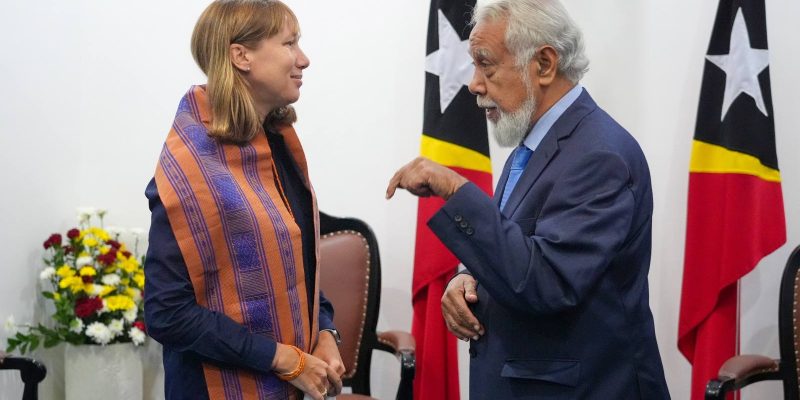
“We are beginning. The Indonesian government has sent a large team here, and they are going to start. We tried formal negotiations many years ago, but Indonesia always said that under international law, the land commands the sea,” the Prime Minister told the press on the sidelines of the official opening of negotiations held at the Palm Spring Hotel on Tuesday.
Gusmão acknowledged the openness of Indonesian President Prabowo Subianto, who expressed his willingness to initiate the process.
International law is the body of legal rules, norms, and standards that governs relationships between sovereign states and other entities recognized as international actors, such as international organizations and, increasingly, individuals. It operates primarily through consent, meaning that states agree to be bound by treaties, conventions, and customary practices that shape their conduct in areas such as diplomacy, trade, human rights, and conflict resolution.
And, the United Nations Convention on the Law of the Sea (UNCLOS), adopted in 1982 and entering into force in 1994, serves as the foundational legal framework governing all aspects of ocean space. Often referred to as the “constitution of the oceans,” UNCLOS outlines the rights and responsibilities of nations in their use of the world’s seas and marine resources. It establishes territorial waters extending 12 nautical miles from a coastal state’s baseline and grants Exclusive Economic Zones (EEZs) up to 200 nautical miles, within which states have rights to explore and exploit marine resources. The convention also allows for extended continental shelf claims under specific geological conditions.
However, he also reminded the public that boundary issues –particularly in the Oe-Cusse region –still need to be resolved comprehensively.
“I asked them to remind their government that we have to finish that one. But yes, the chief of the Indonesian delegation said in his remarks that they came with full commitment to act under international law. We said this kind of negotiation requires mutual trust and mutual respect, and that’s why we believe Indonesia is very committed to solving the maritime issue,” he said.
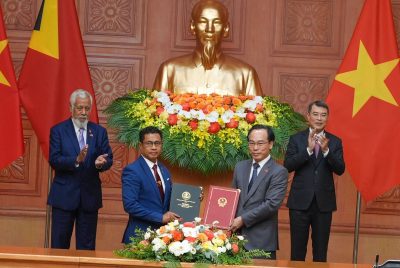
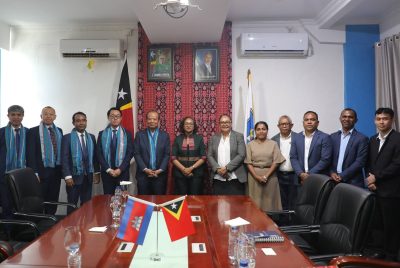
Official maritime boundary negotiations between Timor-Leste and the Republic of Indonesia took place from Tuesday, August 19 to Wednesday, August 20, 2025, bringing together high-level delegations from both countries.
The Timor-Leste delegation was led by Elizabeth Exposto, Chief of Staff to the Prime Minister and Director General of the Land and Maritime Border Office (GFTM), accompanied by Timor-Leste’s Ambassador to Indonesia, Roberto Sarmento de Oliveira Soares.
The Indonesian delegation was led by Laurentinus Amrih Jinangkung, Director General of Law and International Treaties (HPI) at the Ministry of Foreign Affairs, along with 24 delegates from various ministries and technical institutions, including Indonesian Ambassador Okto Dorinus Manik.
These negotiations build on years of informal dialogue, exploratory meetings, and technical exchanges, with the ultimate goal of establishing a permanent maritime boundary between the two nations.
Xanana emphasized that the process is not simply about drawing a line in the sea, but a complex undertaking that must be carefully considered in accordance with international law.
“I hope so, but I cannot say that for sure because it’s not easy – it’s not just making a line in the sea. It’s under international law, and it will take time. But I believe it won’t take too long, because the chief of the delegation said, ‘We are here, we are committed to working together,’” he said.
The Timor-Leste government reiterated its commitment to resolving maritime boundaries peacefully, transparently, and legally.
This effort is crucial to ensuring the country’s maritime sovereignty, supporting the sustainable management of marine natural resources, and strengthening national security and good neighbourly relations.
For context, Timor-Leste concluded a maritime boundary agreement with Australia in 2018 through the Compulsory Conciliation process under UNCLOS. By initiating formal negotiations with Indonesia, Timor-Leste hopes to finalize all aspects of its national maritime boundaries before becoming a full member of ASEAN.
Journalist: Cidalia Fátima
Editor: Rafael Ximenes de A. Belo