


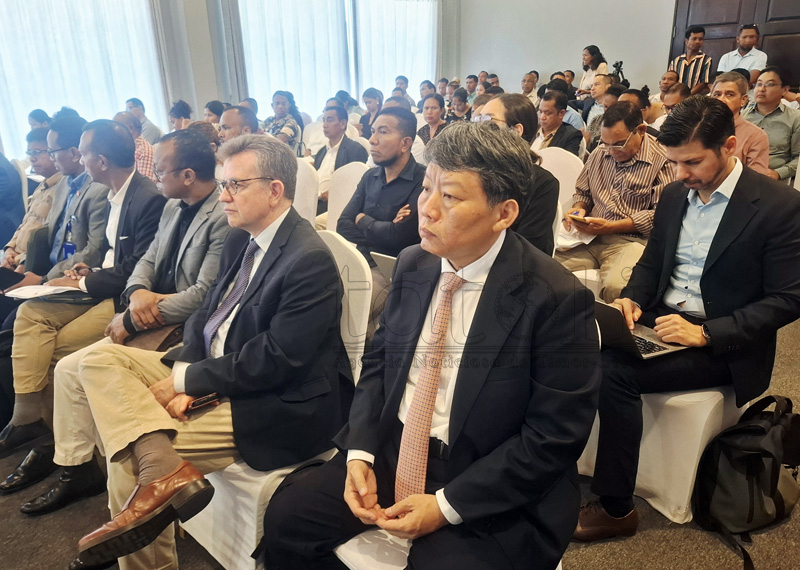
DILI, 13 November 2025 (TATOLI) — The Government of Timor-Leste, through the Ministry of Commerce and Industry (MCI), held a workshop to validate the Manufacturing Action Plan—a strategic framework aimed at enhancing the country’s competitiveness within the ASEAN region and meeting its commitments under the World Trade Organization (WTO).
In his opening remarks, Minister of Commerce and Industry, Filipus Nino Pereira, said the plan serves as a roadmap to transform the nation’s economic potential into productivity and long-term value creation.
“This plan reflects our shared ambition to transform potential into productivity, and vision into value,” said Minister Pereira.
He emphasized that the manufacturing sector, though still developing, plays a vital role in driving inclusive growth, job creation, and regional competitiveness, adding that innovation and resilience must go hand in hand.
“Transforming Timor-Leste’s industrial structure away from dependence on oil and gas revenues is an urgent priority. The Manufacturing Action Plan provides an institutional design that enables all relevant agencies to coordinate and take concrete action,” he explained.
The workshop featured presentations on the National Industrial Development Policy and the draft Manufacturing Action Plan, which outlines the government’s strategy to promote sustainable industrialization, empower the private sector, and advance ASEAN integration.
Minister Pereira also announced that the plan will be submitted to the Council of Ministers for approval before being formally presented to the WTO, as part of the country’s obligations following its accession last year.
“Validation requires more than endorsement. It demands scrutiny, ownership, and commitment. That is why your participation today—from government, industry, academia, and civil society—is so essential,” the Minister added.
The workshop also included a guest lecture by Mr. Keola from the Economic Research Institute for ASEAN and East Asia (ERIA), who discussed the importance of export-oriented manufacturing in strengthening economic resilience.
In closing, Minister Pereira expressed his appreciation to the Government of Japan, ERIA, and the Japan International Cooperation Agency (JICA) for their continuous support in developing the Manufacturing Action Plan.
“This is not a plan for the Ministry alone. It is a national commitment that must be translated into action across institutions, sectors, and communities,” he affirmed.
Chief Representative of JICA in Timor-Leste, Daisuke Fukumori, reaffirmed JICA’s commitment to supporting the Ministry of Commerce and Industry in developing the manufacturing sector as part of Timor-Leste’s post-accession initiatives following its entry into the WTO.
“First, I would like to congratulate Timor-Leste for joining ASEAN and the WTO last year. The program we support is a kind of follow-up project to the WTO accession,” Fukumori said in an interview with TATOLI.
He explained that JICA expert Nakazato has been assisting the Ministry in identifying key actions required to fulfill WTO membership obligations.
“In his presentation today, we shared a kind of long list—a to-do list—to meet WTO requirements. We expect these efforts will also expand the benefits of ASEAN membership,” said Fukumori.
He added that JICA will continue to collaborate with the Ministry to develop a detailed checklist and roadmap for implementation, as well as to identify priority areas for future cooperation.
Director General of Trade and Industry, Martins Magno, said the workshop is part of the government’s broader industrial development plan implemented in partnership with JICA to strengthen Timor-Leste’s manufacturing base.
“We partnered with JICA to conduct a study on the manufacturing industry in Timor-Leste. We hope to increase GDP’s contribution from this sector because, based on our data, our participation in manufacturing remains very low,” he explained.
Magno added that the Ministry continues to provide training and capacity-building programs to help small industries diversify their products and enhance competitiveness.
“From 2023 until now, about 50 percent of manufacturing investments have focused on training small industry groups in remote areas. We have also supported around 400 micro and small enterprises to become innovative entrepreneurs,” he noted.
According to Magno, local industries have begun producing value-added products such as virgin coconut oil, some of which have already entered international markets.
“These include coconut oil and other products that reflect the growing potential of our local manufacturing sector,” he concluded.
Journalist: Camilio de Sousa
Editor: Filomeno Martins