


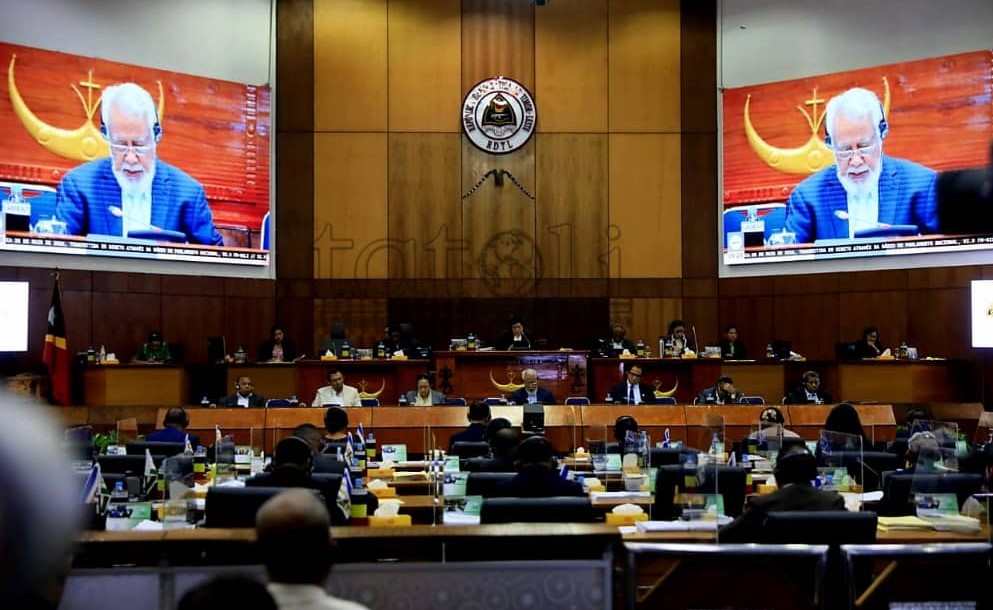
DILI, 28 May 2026 (TATOLI) — Prime Minister Kay Rala Xanana Gusmão, members of the Ninth Constitutional Government and members of parliament on Thursday began debate regarding the supplementary 2026 General State Budget.
The discussion on the supplementary General State Budget began with an intervention by the Prime Minister, followed by the presentation of the report by Parliamentary Committee C, responsible for Public Finance Affairs.
During the debate, members of parliament from each parliamentary bench were given the opportunity to intervene, raise questions, and present their views, with the Government responding to the issues and observations raised.
In his intervention, the Prime Minister stated that “the budget discussion is not limited to numbers, percentages, and financial data,” emphasizing that “its ultimate purpose is to promote the country’s development and the well-being of its citizens.”
Gusmão justified the need for the budget amendment by referring to the current international context, which continues to be shaped by geopolitical instability and its impact on global energy markets. He noted that “the world is currently facing a period of unpredictability and insecurity, with harmful consequences that are felt most severely in developing countries such as Timor-Leste.”
He warned that Timor-Leste remains highly dependent on imports and is therefore particularly vulnerable to external shocks, which could potentially lead to social instability. He stressed that it is the shared responsibility of both the Government and the National Parliament to safeguard national security and protect the Timorese people.
The main measure proposed under the rectified budget is the establishment of a national strategic fuel reserve valued at US$174.3 million. According to the Prime Minister, this is a strategic decision aimed at ensuring the continuity of fuel supply in Hera, Betano, RAEOA, and Ataúro, while also protecting the operation of essential public services during a period of global uncertainty.
The Head of Government explained that the reserve would be sufficient to cover approximately seven months of the country’s fuel requirements for electricity generation. He described the measure as essential to strengthening national energy security and ensuring stability in the supply of electricity nationwide.
The proposal also includes a US$42 million fuel subsidy programme intended to reduce the impact of rising international fuel prices on households and businesses. The Prime Minister said the measure seeks to limit the direct effects of global fuel price increases on the cost of living and economic activity.
During his address, the Prime Minister further explained that the budget amendment was prepared through the reallocation of funds from projects considered less urgent toward areas of immediate national priority.
He stressed that reallocating resources from lower-priority projects to urgent sectors does not represent a step backward, but rather reflects a responsible and honest exercise in redefining national priorities in response to current challenges.
The Prime Minister further underlined that the proposed budget amendment is designed to respond to the current situation without placing immediate additional pressure on the Petroleum Fund. He stated that the Government is addressing an urgent crisis while seeking to avoid further immediate withdrawals from the Fund.
In his address to Members of Parliament, Gusmão reaffirmed the Government’s commitment to its key national development priorities. He stressed that the Executive remains firmly focused on national transformation, regional integration, and inclusive development.
He added that the Government will continue investing in roads and bridges, improving schools and healthcare services, supporting agriculture and tourism, strengthening the private sector, and creating greater opportunities for young people across the country.
The Prime Minister also highlighted Timor-Leste’s continued commitment to regional integration and active participation in international organisations. He stated that the Government will continue working to ensure that Timor-Leste fulfils its responsibilities as a member of ASEAN.
Referring to Timor-Leste’s international positioning, he said that ASEAN integration, accession to the World Trade Organization, cooperation within the Community of Portuguese Language Countries (CPLP), and partnerships with neighbouring countries and development partners are not merely symbolic, but strategic pathways for national development, stability, and stronger bilateral and regional cooperation.
He also noted that, despite the challenging international environment, Timor-Leste’s economy has remained resilient. He said the country continues to move forward, with people working, businesses investing, public programmes supporting economic activity, and ongoing reforms helping to strengthen the foundations of the national economy.
At the same time, the Prime Minister acknowledged that Timor-Leste remains vulnerable to external pressures. While recognising recent positive progress, he stressed that the country continues to face exposure to global shocks and that the Government has a duty to adopt all necessary measures within its capacity to safeguard the nation and protect the well-being of the Timorese people.
Concluding his intervention, the Head of Government called on all sovereign institutions to demonstrate a strong sense of responsibility throughout the parliamentary debate on the proposed budget amendment. He said the proposal had been presented with seriousness and confidence—confidence in the resilience of the Timorese people, in the dedication of national institutions, and in the responsibility of the State’s sovereign bodies.
He concluded by stating that the Government stands ready to debate a budget amendment that is carefully considered, balanced, and pragmatic—an amendment aimed at strengthening national security and protecting the people of Timor-Leste.
The supplementary budget, approved by the Council of Ministers on May 13, provides for adjustments to the 2026 General State Budget to address rising international fuel prices linked to the conflict in the Middle East, costs associated with Timor-Leste’s assumption of the Pro Tempore Presidency of the Community of Portuguese-Speaking Countries (CPLP), and expenditures related to the Special Administrative Region of Oe-Cússe Ambeno (RAEOA).
The proposal for the first amendment to Law No. 8/2025 of Nov. 27 on the 2026 General State Budget was submitted by Prime Minister Gusmão to House Speaker Maria Fernanda Lay on May 15.
The rise in the budget is not due to an increase in transfers from the Petroleum Fund, but rather to a realignment of the government’s funding sources, using operating surpluses, available balances in non-operating bank accounts, and higher domestic revenue.
The proposal also aims to mitigate the economic impact of rising international fuel prices, given the country’s heavy reliance on imports—particularly of fuel and food products—which directly affects transport costs and domestic inflation.
Before Thursday’s plenary debate, the National Parliament held a series of public hearings on May 21, 22 and 25 to review the proposed adjustments to the 2026 budget.
TATOLI