



MoH, UNFPA launch geospatial training to optimize emergency obstetric and newborn care across Timor-Leste
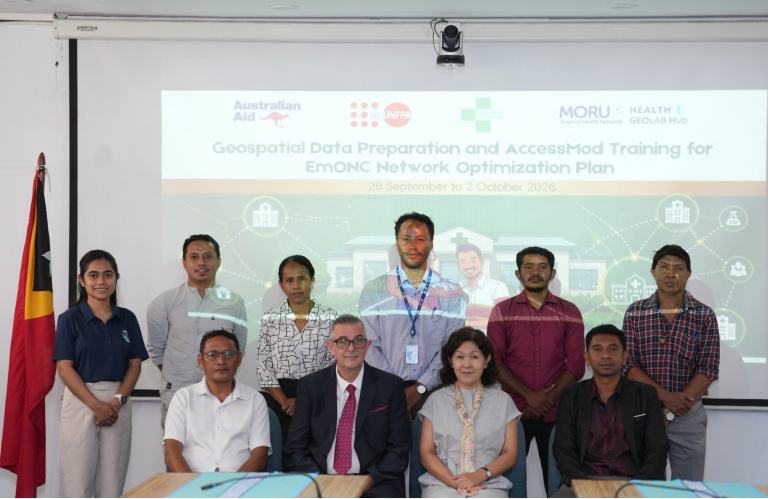
DÍLI, 28 September 2026 (TATOLI) — The Ministry of Health (MoH) of Timor-Leste and the United Nations Population Fund (UNFPA) today officially kicked off a five-day technical workshop on Geospatial Data Preparation and AccessMod Training for the Emergency Obstetric and Newborn Care (EmONC) Network Optimization Plan. The training runs from September 28 to October 2, 2026, bringing together key technical specialists across government departments and line ministries, such as the National Statistics Office, alongside development partners including the youth-led NGO G-SIG.
The opening ceremony featured remarks by Edigardo Alves, Head of Policy Section, representing Florindo Pinto Gonzaga, the Director General for Policy Planning and Health Development Cooperation. He was joined by Navchaa Suren, UNFPA Representative in Timor-Leste and technical lead for this critical initiative, which will inform the progress of the Government’s EmONC Plan of Action to improve maternal and child health outcomes across Timor-Leste.
This week’s intensive technical session serves as the foundation for the upcoming high-level EmONC Network Optimization Workshop, scheduled for October 6–8, 2026. The high-level workshop will convene national and municipal stakeholders, decision-makers, and representatives from EmONC centers across the country. Together, participants will review and validate patient travel scenarios to clarify current needs, generate evidence for decision-making, and help reduce preventable maternal mortality.
In Timor-Leste, mountainous terrain, dispersed populations, and road infrastructure challenges create significant barriers to timely medical care. Delays in transferring pregnant women and newborns facing obstetric emergencies to equipped health facilities can lead to tragic, preventable loss of life.
To address these spatial barriers, the training equips technical staff from the Ministry of Health (MCH, HMIS, and M&E departments), the National Statistics Office (INETL), and the youth-led Geographic Information System Group (G-SIG) with specialized skills in Geographic Information Systems (GIS) and AccessMod analytical software.
The primary objective of the five-day training is to apply GIS modeling to measure physical travel times and geographic coverage for essential health services. Using population projection data, participants will evaluate the proportion of the national population able to access a functioning EmONC facility within timeframes that minimize maternal mortality risks during referral. The workshop assesses health facility accessibility and functionality across surveyed sites to map service delivery gaps and supply rigorous geospatial evidence for national strategies, including the Government’s EmONC Plan of Action, the Health Sector Strategic Plan 2020–2030, and the National RMCNAH Strategy 2026–2030.
This initiative is funded by the Australian Department of Foreign Affairs and Trade (DFAT) and the Government of Timor-Leste, with support from Japan, Thailand, and Portugal—key partners in establishing the national EmONC centers. Dr. Steeve Ebener (Mahidol-Oxford Research Unit) and Ms. Federica Maurizio (UNFPA Asia-Pacific) co-lead the technical facilitation.
“UNFPA is committed to advancing demographic intelligence to guide evidence-based policy making in the health sector,” stated Navchaa Suren, UNFPA Representative in Timor-Leste. “By focusing on EmONC accessibility and functionality, this training will prepare technical participants to generate accessibility analyses and travel-time indicators, ensuring that no woman or newborn dies from preventable causes during pregnancy or childbirth.”
Representing General Director Florindo Pinto Gonzaga, Edigardo Alves noted: “Recent survey findings demonstrate significant progress, with skilled birth attendance rising to 78%. However, in an emergency, time is the difference between life and death. The accuracy and rigor of the geospatial modeling produced this week will directly inform strategic investments when national leadership and health directors convene next week.”
The travel-time indicators, accessibility maps, and zonal statistics generated during this training will be presented to high-level leadership from the Ministry of Health, municipal health authorities, and facility managers during the EmONC Network Optimization Workshop on October 6–8, 2026. Together, these efforts align with global targets under the Ending Preventable Maternal Mortality (EPMM) initiative, driving Timor-Leste toward a robust, well-coordinated health network where every mother and newborn can access lifesaving care within critical referral windows.
TATOLI