


DILI, 07 march 2022 (TATOLI) – The Ministry of Health (MoH), together with the World Health Organization (WHO) jointly launched the National Guidelines for Clinical Management of Dengue.
In her opening remarks, Minister of Health, Odete Maria Freitas Belo emphasized that the launching of the handbook aimed to assist the healthcare workers at all levels to better and effectively manage dengue.

“We do have the previous handbook on clinical management of dengue, but we definitely need an updated version in order to help our medical workers to properly manage the dengue in the country. Hence, together with WHO, today we launched the updated version of this handbook on clinical management of Dengue,” Belo told reporters at Novo Turismo hotel, in Dili, on monday.
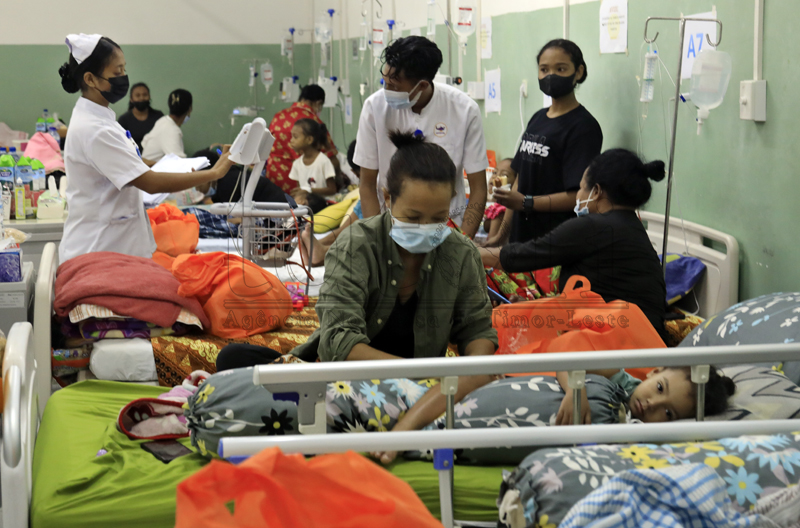
She said as dengue cases continue to rise in Dili and several municipalities, therefore, the handbook was launched in order to make uniformity in the management and treatment of dengue cases across health care centers, referral hospitals, and the National Hospital of Guido Valadares (HNGV).
“In order to make uniformity in the treatment of dengue cases, it was important to harmonize the case classification and treatment at all levels. This handbook is to ensure a comprehensive and well-coordinated response among health workers and partners. Thus, this handbook is not only useful for the local and national medical workers, but also for the international doctors who are currently working in Timor-Leste,” she said.
Minister Belo called on communities to clean their houses, water tanks, flower vases, and drainages to prevent mosquito breeding: “If we keep doing these healthy practices, then we don’t need to purchase larvicide products for mosquito breeding control.
She urged communities to seek medical advice and treatment if they experience dengue-related symptoms.
Belo thanked WHO for its immense contribution by coordinating with the Ministry of Health to tackle dengue in Timor-Leste.
WHO has been working closely with the Ministry of Health to combat and prevent the disease in Timor-Leste.
Last month, WHO, through its Representative to Timor-Leste, Arvind Mathur, handed over 200 liters of Malathion, 650 kilograms of Abate, and 50.000 different Information, Education, and Communication (IEC) materials to the Ministry of Health (MoH) to combat dengue in Timor-Leste.
Mathur said in addition to the 10.000 dengue kits that WHO had delivered earlier to MoH, another 40.000 dengue kits would be available soon as well.
“WHO facilitated engagement of Professor Biswas, the world-renown researcher, scientist, and clinician on dengue, which coordinated with the National Dengue Clinical Management Committee of local experts for the finalization of Timor-Leste’s Clinical Management Guidelines which was based on the robust review and sound scientific evidence,” said Mathur.
He said as a reliable and trusted partner, WHO is committed to ensuring high-quality technical support to the Ministry of Health in realizing the vision of the nation free of vector-borne diseases: “WHO team will work shoulder to shoulder with MoH and the people of Timor-Leste to realize the vision of healthy Timorese and healthy Timor-Leste.”
As of march 6, Timor-Leste has recorded 2772 cases of Dengue with 33 deaths. The majority of the cases were detected in Capital Dili with a total of 1805 cases, followed by 153 cases in Manatuto, 125 cases in Baucau, 120 cases in Manufahi, 100 cases in Lautem, 92 cases in Covalima, 90 cases in Ermera, 85 cases in Liquiça, 69 cases in Aileu, 53 cases in Viqueque, 40 cases in Ainaro, 37 cases in Bobonaro, and three cases in RAEOA.
In january 2022, the country registered 1369 cases, twelve times higher compared to 178 cases in january 2021. However, the cases have dropped sharply from 1254 cases in february to 149 in early march.
The National Director of Public Health, Fredy Bosco informed that children under 14 were the most affected ones: “Out of all recorded cases, we have registered 1034 cases of children between the ages of 1 and 4 and 1144 cases between the ages of 5 and 14. In addition, out of the 33 deaths, 29 were children under 14.”
So far, MoH had detected 1547 cases of dengue fever, 165 cases of dengue hemorrhagic fever, and 93 cases of dengue shock syndrome.
Journalist: Filomeno Martins
Editor: Rafy Belo