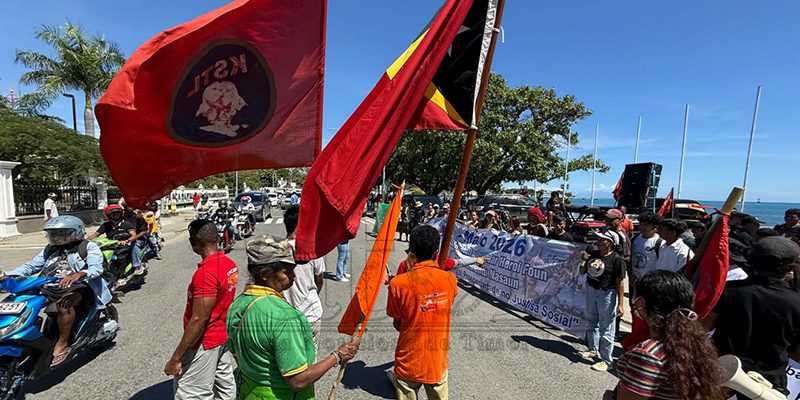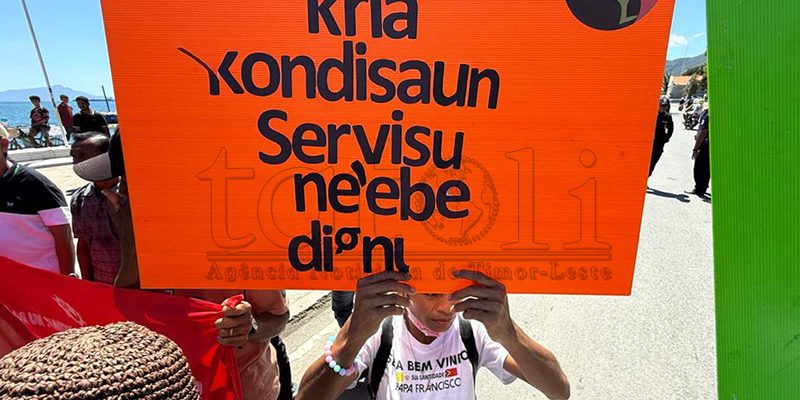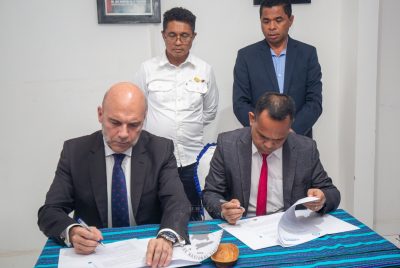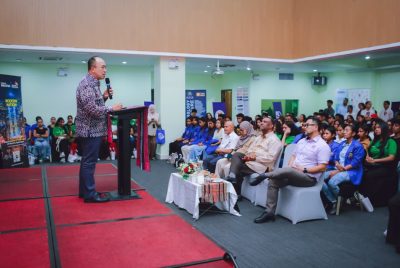




DILI, 26 october 2024 (TATOLI) – La’o Hamutuk delivered a submission to National Parliament that outlines our analyses, perspectives and constructive recommendations about the proposed General State Budget (GSB) for 2025, to help the Honorable Members of Parliament with a reference for thorough, prudent and detailed discussion in plenary before deciding to approve the budget. The views that we expressed in our submission are as follows:
The Government, in writing and speeches, recognizes the urgency of making alternative investments for the post-petroleum period to prevent Timor-Leste from falling over a fiscal cliff. Unfortunately, this understanding is not shown in the scenarios in the 2025 budget; the Government proposes to spend $2.2 billion, 12% more than is budgeted for 2024, and will continue to increase expenditures in the future.
We note that the allocation in the 2025 budget for the Tasi Mane Project — construction and rehabilitation of the highway and the Suai supply base — is almost $40 million and continues to rise sharply in projections for the following years, $145 million in 2026 and $223 million in 2027, including $1.6 million to rehabilitate Suai airport, as well as Dili airport whose funding will increase in future projections. The government has spent a lot of energy and money on dubious mega projects. These large projects to date have not been able to bring benefits to the people or help to strengthen the economy of Timor-Leste. Why does the Government still give priority to them?
Another concern is the cost of electricity. We recognize that electricity is important for the people, but there is an urgency to think how this sector need not continue to depend on state spending every year: appropriations through the Ministry of Public Works to subsidize EDTL, pay EDTL’s debts, pay for fossil fuel, as well as through the Infrastructure Fund and RAEOA for electricity. We note that the appropriations for electricity from 2019-2023 averaged $146 million/year, in 2024 were $174 million, and the 2025 proposal continues to increase them, to $202 million. These expenditure show the lack of sustainability of electricity production, meaning that this sector does not have sufficient capacity to manage and generate revenue.
It is necessary to reduce administrative expenditures and prioritize social and productive sectors, because in reality expenditure of the 2025 budget, mostly for administration costs, subsidies for veterans that continue to rise from $113 million in 2024 to $207 million in 2025, and pensions for ex-office-holders. We are also concerned about the financing of public institutions and companies such as TimorGAP, which still will receive an allocation of $16 million in 2025, while in truth its balance at the end of 2023 was $106 million. There is no reason to continue allocating more money to institutions that do not provide revenue to the state and continue to promote plans which are unrealistic for the people and the nation of Timor-Leste.
We believe that to resolve the situation in the country, the best way is to increase production for domestic consumption, such as through investing in agriculture to strengthen food sovereignty. Unfortunately, the agricultural sector continues not to be prioritized, as it will receive only $50 million or 2.2% of the total 2025 budget. We believe that the Government must be serious about investing in productive sectors in order to solve many issues such as malnutrition, food insecurity, unemployment and heavy dependence on imported food (food imports increased by 14.5%/year since 2019. )
In addition, according to the information in proposed 2025 GSB, a total of $1,024 million in loans have been contracted, with $259 million disbursed by the end of 2023. In 2025, the Government will pay $26 million in debt service, which increases to $40 million/year in 2028 and 2029. The new ceiling will allow the Government to contract $850 million in new loans in 2025. Existing loans will require repayments until 2062 , and new ones may be repaid over a longer period. We must be clear about the rational for these costs — how can Timor-Leste pay after the Petroleum Fund is empty?
Based on the above points, we offer the following suggestions and recommendations to Parliament and Government:
- We suggest the Government reduce spending on large projects and unnecessary administrative expenditures, such as projects such as the highway, Suai airport and Suai Supply Base, as well as inefficient and ineffective expenditures. We therefore recommend that the Government build infrastructure that provides real benefits to our entire population such as quality, long-lasting rural roads, installation of adequate water systems to meet basic needs, building quality infrastructure and facilities for equitable education and health in all municipalities, especially remote areas.
- We suggest that the National Parliament use all their powers to review the administrative expenditures for public institutions that continue to receive large subsidies from the budget every year, but which in reality have not yet provided significant revenue to the state. We also suggest that the Government look again at personal subsidies such as for veterans and ex-officeholders that show a tendency to increase every year.
- We suggest that Parliament ask the Government to clarify the reason for the high loan ceiling (even though there is a reduction in loans for essential sectors), the tendency of large loans to be used to finance the extractive sector, and require a detailed clarification from the Government as to the state’s capacity to repay these debts when the Petroleum Fund is gone.
- Essential sectors linked to people’s lives, such as health, education and water/sanitation, continue to be underfunded, receiving less than 19% of all expenditure in the proposed 2025 budget. Although the Government in its descriptions often mentioned investing in people and social conditions, in reality these sectors are neglected. We believe that the Government needs to think seriously and about the long-term in their program plans, and must truly trust that investing in our people is the fairest solution to prepare our next generation to be more resilient, intelligent and productive.
Journalist: Jose Belarmino de Sa
Editor: Filomeno Martins