


DILI, 15 May 2025 (TATOLI) – Coffee was the only product exported by Timor-Leste between January and March this year, the National Director of Foreign Trade at the Ministry of Trade and Industry (MCI), Mário Abrão has said.
He explained that in the first quarter of the year, the country experienced a sharp decline in coffee exports, with only around 96 tons exported: “This marks a significant drop compared to the same period in 2024, when over 558 tons of coffee were exported.”
He recalled that, in early 2024, the country exported a wider variety of products, including 25 tons of seaweed, 38 tons of elephant foot yam, over 7 tons of tea, and 6,000 liters of candlenut oil.
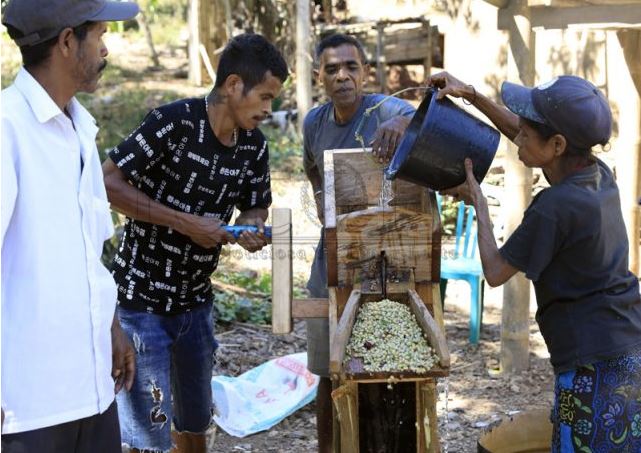
Café Timor Cooperative (CCT-Tetun), Timor-Leste’s largest agricultural cooperative with 28,000 members, which has been buying coffee mainly in Ermera, also experienced a sharp decline in its coffee exports.
Previously, CCT’s General Manager, Sisto Moniz Piedade, revealed that CCT’s coffee exports dropped by 40%. “Our coffee exports dropped from 3,500 tons in 2021 to just 1,600 tons in 2022.” He noted that coffee production has declined in recent years due to several factors, including climate change, aging coffee and shade trees, reduced farmland, and waning farmer interest—largely driven by low prices.
The data underscores a narrowing of the country’s export activity and raises concerns about its current trade deficit and economic diversification efforts.
Earlier this year, Timor-Leste National Institute of Statistics, I.P. (INETL, I.P.) reported that the country’s trade deficit in goods and services rose from US$746 million in 2023 to US$787 million in 2024, driven by rising imports and falling exports. The significant increase in the negative balance of trade (BOT) shows that Timor-Leste imported more goods in 2024 than in previous years, making Timor-Leste one of the most dependent countries on imported goods in the world.
Januário Gonçalves, a coffee farmer from Ermera Municipality, called on the government and private sector to fulfill their promises and take concrete action to support the expansion and rehabilitation of coffee plantations, as part of efforts to diversify the country’s economy through productive sectors like agriculture.

Gonçalves recalled that the VIII Constitutional Government, in 2022, approved a rectification budget of US$6.4 million to rejuvenate and rehabilitate coffee plantations in six municipalities, but the investment has yet to boost coffee production
“It’s sad for a coffee farmer to witness such a sharp decline in Timor-Leste’s coffee yields,” Gonçalves said. “One of the main reasons farmers abandon their coffee plantations is the low coffee prices in the country.”
He said that many coffee farmers in Ermera municipality are clearing their coffee plantations to cultivate other profitable crops such as vanilla, clove, and konjac.
“Timor-Leste’s organic coffee deserves higher prices to make it a sustainable livelihood for many Timorese. Fair prices would certainly motivate farmers to increase coffee production,” Gonçalves said.
Coffee is grown by almost one-third of all Timorese households, covering six municipalities – Ermera, Aileu, Liquiça, Ainaro, Manufahi, and Manatuto. Goncalves, therefore, said that urgent actions are needed to be taken seriously by the Ministry of Agriculture and Fisheries (MoAF) and the private sectors to save Timorese coffee and the livelihoods of many coffee farmers across the six municipalities.
Journalist: Camilio de Sousa
Editor: Filomeno Martins