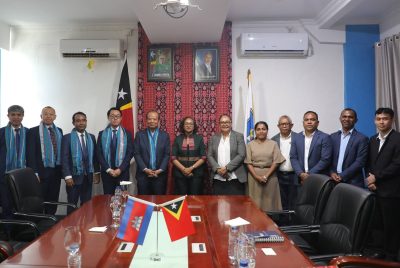




DILI, 19 May 2025 (TATOLI) – The Timor-Leste Non-Governmental Organization Forum (FONGTIL) is organizing a conference on Asia-Pacific solidarity with Western Sahara to demonstrate Timor-Leste’s commitment to the values of freedom and global justice for the people of Western Sahara, who continue their struggle for self-determination.
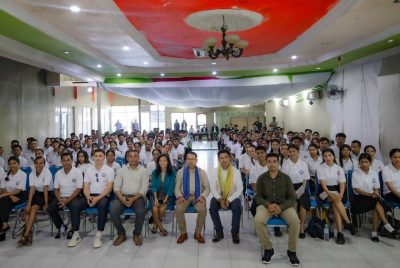
The conference is taking place at the Fundação Oriente, with direct participation from Prime Minister Xanana Gusmão.
In his speech, the head of government strongly criticized the weak response from the international community to the human rights violations faced by the people of Western Sahara, as well as the injustice in the implementation of international law, which often tends to be subordinated to the interests of powerful nations.
Xanana Gusmão stated that international law itself is disregarded when it does not affect the interests of major powers, as they prefer to remain uninformed.
“This conference is not merely symbolic, but also a call to action, as it is crucial to build an active solidarity movement across all nations. Such a movement can push for the implementation of the referendum that was long promised by the United Nations (UN), yet remains unfulfilled. We must do more than just raise our voices—we must start establishing support movements in various countries,” Xanana Gusmão stated today at Fundação Oriente.
He emphasized that this conference also serves as a forum to express support from allied nations such as Japan, Australia, and the Philippines, which have participated and demonstrated their solidarity. This moment is particularly significant ahead of the 24th meeting of the UN Committee on Decolonization and the UN General Assembly in September 2025.
FONGTIL Director Valentim da Costa Pinto stated that Timor-Leste’s civil society supports the struggle of the Sahrawi people based on the principles of human rights and universal justice.
He noted that Western Sahara remains one of the last colonized regions in the world. Its people have endured exile, pressure, and separation for nearly five decades, yet they have survived and continue their struggle.
He underscored that the Sahrawi people’s struggle is not only political but also moral—a global fight that requires international community involvement and support.
This solidarity movement, which initially began with young Timorese students, has now grown into a broader initiative involving nations and different generations. This spirit remains strong, ensuring that the voice of the people of Western Sahara is not lost amid global geopolitical interests.
“For our brothers and sisters in Western Sahara, know that you are not alone. Timor-Leste stands with you,” Valentim stated.
On this occasion, the Ambassador of Western Sahara to the UN, Sidi Omar, also spoke about the injustices faced by the Sahrawi people for over 50 years.
“Our people have never wavered in their struggle for freedom and independence. For 50 years, we have endured brutal occupation, yet we remain steadfast in our right to self-determination, as guaranteed by UN Resolution 1514,” Ambassador Sidi Omar declared.
He recalled that in May 1975—50 years ago—the UN Fact-Finding Mission in Western Sahara reached three key conclusions: the Sahrawi people overwhelmingly supported independence, the Polisario Front was recognized as the legitimate dominant force, and the UN must allow for self-determination. However, these recommendations have yet to be implemented.
He further stated that the UN’s failure to resolve the issue of Western Sahara reflects a systemic crisis that is weakening multilateral institutions. Pressure from major powers, such as France, has contributed to the deadlock in the peace process.
“Occupation does not grant legitimacy. Morocco is attempting to create a colonial reality on the ground, but it will never replace the validity of international law,” Sidi Omar asserted.
He emphasized the importance of continuing to internationalize the issue of Western Sahara and encouraged participation from civil society, the media, and multilateral institutions to strengthen awareness campaigns and solidarity, particularly in the Asia-Pacific region.
The conference also featured Akihisa Matsuno, Secretary-General of the Japan Solidarity Group for Western Sahara, who reflected on his experience during Timor-Leste’s independence referendum in 1999.
He stressed that political will was key to Timor-Leste’s successful struggle and is just as crucial for Western Sahara.
“I saw with my own eyes, in Dili, how people—some sick, and elderly men and women—came to the voting canters to save their nation for future generations,” he stated.
He described the current conditions in Western Sahara as strikingly similar to Timor-Leste’s occupation, citing political repression, censorship, neglect of education, and systematic torture of Sahrawi activists.
He highlighted that this conference serves as a crucial moment to strengthen the international solidarity network, reignite the spirit of the Sahrawi people’s struggle, and demand global accountability for the unfulfilled promise of decolonization.
“Suffering is not only caused by war. Struggle itself brings suffering. Living under occupation is not like anything else—it is a life of hardship,” he stated, calling on nations and civil society groups across the Asia-Pacific to unite and push for a peaceful referendum for the Sahrawi people as a pathway out of prolonged occupation.
Journalist: Arminda Fonseca
Editor: Maria Auxiliadora
Translation: Rafael Ximenes de A. Belo