


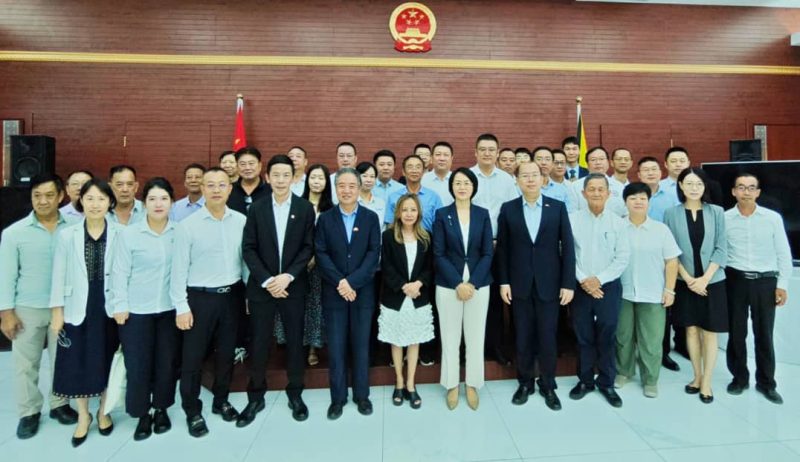
DILI, 14 August 2025 (TATOLI) – Today, the Chinese Embassy in Timor-Leste held a symposium to commemorate the 80th anniversary of the victory in the Chinese People’s War of Resistance Against Japanese Aggression and the World Anti-Fascist War.
Chinese Ambassador Wang Wenli attended the event and delivered remarks. More than 30 representatives from the Chinese community in Timor-Leste, Chinese enterprises, the Chinese medical team, the Chinese agricultural technical expert group, and the Confucius Classroom participated in the event.
Participants recalled the arduous and heroic 14-year struggle of the Chinese people, noting that the Chinese People’s War of Resistance Against Japanese Aggression strongly supported the Eastern Main Battlefield of the World Anti-Fascist War. They emphasized that this great victory was not only a pivotal historical turning point for the Chinese nation on its path toward rejuvenation, but also an indelible contribution to the victory of the World Anti-Fascist War.
“They emphasized that the Chinese Communist Party’s role as the mainstay was key to the victory of the Chinese People’s War of Resistance. At the critical juncture of national survival, the CPC was the first to propose resistance against Japanese aggression, consistently holding high the banner of the Chinese united front, mobilizing people at home and abroad, and forging a nationwide torrent of resistance,” Ambassador Wang Wenli told TATOLI at the Embassy of China in Dili.
Participants also stressed that the fruits of victory in the World Anti-Fascist War should be cherished and safeguarded by all humanity. They called on all countries to work together to uphold the outcomes of the victory, oppose any acts that distort history or deny the crimes of aggression, and promote the building of a community with a shared future for mankind.
Ambassador Wenli added that this year marks the 80th anniversary of the end of World War II, with China specifically commemorating its victory in the Chinese People’s War of Resistance Against Japanese Aggression. This war, which began with the Marco Polo Bridge Incident in 1937 and lasted 14 years, resulted in significant Chinese casualties and destruction.
The 80th anniversary will be observed with a series of ceremonial events, including a military parade scheduled for 3 September 2025 in Beijing, commemorating the end of the Second Sino-Japanese War and World War II.
World War II officially ended for China and Japan with the formal surrender of Japan on September 2, 1945, following the atomic bombings of Hiroshima and Nagasaki and the Soviet declaration of war. The surrender ceremony took place aboard the USS Missouri in Tokyo Bay. In China, the surrender was celebrated as “Victory over Japan Day” (V-J Day), marking the end of the Second Sino-Japanese War.
Ambassador Wenli highlighted that China and Timor-Leste have forged deep historical bonds and shared values in their respective struggles for national independence. She noted that China–Timor-Leste relations are currently at a historic peak. The overseas Chinese community in Timor-Leste expressed their readiness to continue carrying forward the great spirit of the War of Resistance Against Japanese Aggression, to care for and support the development of their motherland and ancestral homeland, actively integrate into Timorese society, and contribute to advancing the China–Timor-Leste comprehensive strategic partnership and building a China–Timor-Leste community with a shared future.
At the same event, Kathleen Goncalves, head of the local Chinese community in Timor-Leste, stated that the symposium was crucial for sharing the history of the Second Sino-Japanese War and World War II.
“This symposium was organized by the Embassy of China, inviting the Chinese community in Timor-Leste to share the history of the Second Sino-Japanese War and World War II, to commemorate the 80th anniversary of the victory of the Chinese People’s War of Resistance Against Japanese Aggression and the World Anti-Fascist War,” she concluded.
Journalist: Camilio de Sousa
Editor: Rafael Ximenes de A. Belo