



By: Dionísio Babo Soares*
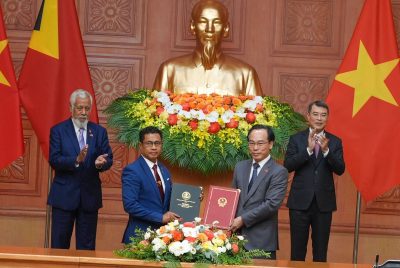
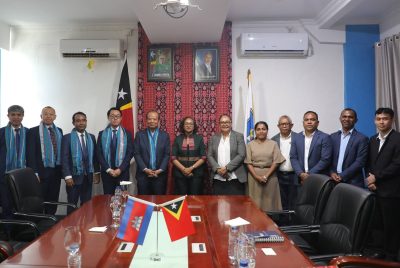
The return to the table of formal negotiations on maritime delimitation between the Democratic Republic of Timor-Leste and the Republic of Indonesia—beginning with the first round in Dili on August 19–20, 2025, and resumed with the third round in Singapore in April 2026—amounts to more than a technical exercise. It represents a development of particular significance in the contemporary practice of maritime delimitation, especially in Southeast Asia, a region often associated with prolonged and highly complex disputes.
In a regional context marked, among other factors, by the persistence of multiple maritime controversies in the South China Sea—including claims over the Spratly and Paracel Islands, recurring incidents around Scarborough Shoal, and jurisdictional disputes off the Natunas—the fact that Timor-Leste and Indonesia have chosen to sit down, in a structured and sustained manner, at the negotiating table to address the delimitation of their respective maritime boundaries, in a declared spirit of good faith and with express reference to the normative framework of the United Nations Convention on the Law of the Sea (UNCLOS), projects a particularly significant diplomatic message of commitment to the peaceful settlement of disputes. This choice of the negotiating route aligns closely with the mechanisms for the prevention and cooperative management of disputes enshrined in the ASEAN Charter and the Treaty of Amity and Cooperation in Southeast Asia, reinforcing, at the regional level, the idea that disputes concerning maritime spaces can and should be addressed through legal and diplomatic processes, rather than through escalations of tension, displays of naval force, or unilateral practices of fait accompli.
The first formal round, held in Dili, confirmed the commitment of both States to seek a peaceful solution to the pending issues concerning maritime boundaries, in full accordance with international law and, in particular, with UNCLOS. UNCLOS—adopted in 1982 and frequently described as the “constitution of the oceans”—defines the principal maritime zones, the rights and duties of coastal States, and the criteria of equity applicable to the delimitation of boundaries between States with opposite or adjacent coasts. In practical terms, it establishes where a State’s sovereignty at sea begins and ends, and who may exploit which resources and under what conditions, offering a common grammar for the negotiation of fair boundaries between coastal neighbors.
The relatively cooperative trajectory of the maritime boundary negotiations between Timor-Leste and Indonesia appears to derive from a combination of factors, including a shared adherence to UNCLOS and a stated commitment to conduct the process on the basis of its delimitation regime, the relative clarity of the land border inherited from past treaties, and the involvement of highly specialized technical and legal teams on both sides, which function, in practice, as transnational epistemic communities. It is argued, however, in line with recent literature on maritime delimitation, that political will remains the decisive factor in converting these favorable conditions into a final agreement—particularly in light of the 2025–2026 rounds, which cover technically and politically sensitive segments, including potential adjustments around the future tripoint with Australia.
From the standpoint of regime theory, UNCLOS continues to play the role of the central organizing framework in maritime delimitation. As Donald R. Rothwell and Tim Stephens argue in The International Law of the Sea (2016), the Convention provides both procedural and substantive guidance for delimitation, structuring State conduct through legally recognized methods. In a convergent vein, Yoshifumi Tanaka emphasizes that the broad acceptance of the Convention provides a common legal language that reduces normative ambiguity and facilitates negotiation. The 2025–2026 negotiations between Timor-Leste and Indonesia illustrate this dynamic, insofar as the parties have stated that they are conducting the process on the basis of UNCLOS, with a view to the equitable delimitation of the zones where their respective maritime claims overlap and taking into account the legal framework applicable to Indonesia’s archipelagic status.
This shared legal framework substantially reduces transaction costs, in line with the liberal institutionalism developed by Robert O. Keohane in After Hegemony (1984), by providing a common normative language and parameters of legitimacy that facilitate negotiation among States. In this sense, UNCLOS contributes to mitigating the risks of interpretive contestation and excessive politicization that have complicated maritime disputes in other subregions, including the South China Sea.
In parallel, the publicly available information on the 2025 negotiating rounds between Timor-Leste and Indonesia indicates that both delegations agreed on guiding principles for the discussions, reaffirmed their adherence to UNCLOS, and committed to seeking equitable solutions in a spirit of cooperation. Although the available sources do not fully detail the methodological sequence adopted, this practice is consistent with the technical approach generally described by Timor-Leste’s own Boundary Office, based on the construction of a provisional equidistance line, susceptible to adjustment in light of relevant circumstances. To that extent, it is plausible to argue that the early phases of the process have prioritized the consolidation of technical understandings before the negotiation of politically more sensitive adjustments, in line with prevailing practice and with the specialized literature on maritime delimitation.
The role of epistemic communities in the conduct of these negotiations also deserves particular attention. Peter M. Haas defined such communities as networks of professionals with recognized expertise and shared normative and causal commitments, capable of consistently influencing the coordination and behavior of States. In the field of maritime delimitation, the specialized literature shows that technical and legal experts—including hydrographers, geodesists, cartographers, and international law jurists—play a central role in translating legal principles into workable negotiated solutions, narrowing interpretive divergences and creating bases of procedural trust between the parties.
The 2025–2026 negotiations between Timor-Leste and Indonesia illustrate this trend. Official sources show that the process has been conducted by formally structured delegations, with technical-legal leadership on the Timorese side through the Land and Maritime Boundary Office, in a context in which Timor-Leste draws on the institutional experience gained from the successful maritime conciliation with Australia, concluded in 2018. This relative symmetry of technical capacities is particularly important for the quality of the negotiating process. Recent work by Massimo Lando, a professor of international law specializing in maritime delimitation, emphasizes that delimitation is a process strongly structured by technical and legal criteria, in which the capacity of States to master the methodology and the factual record influences the timing, predictability, and robustness of outcomes. In line with this view, the literature on boundary disputes indicates that asymmetries in technical capacity can translate into delays, greater mistrust, and less robust solutions, whereas comparable levels of expertise tend to narrow methodological divergences and favor more efficient negotiations, including in the choice of base points and the analysis of coastal configuration.
The case of Timor-Leste and Indonesia can be read as an expression of this emerging trend: the two delegations field professionalized and well-structured teams, and Timor-Leste mobilizes the experience accumulated in the successful maritime conciliation process with Australia, suggesting that professionalization and the sharing of technical knowledge contribute to mitigating, at least in part, traditional asymmetries of material power.
Geography and historical continuity also help reinforce this cooperative dynamic. Unlike many maritime disputes that involve contested islands or particularly intricate archipelagic configurations, the delimitation between Timor-Leste and Indonesia presents, in comparative terms, a relatively lower degree of geographical complexity. The segments still pending—to the west and east in the Timor Sea, in the area surrounding the Oecusse enclave, and, further north, in the Wetar Strait—are geographically well defined and do not, at this stage, involve open disputes of sovereignty over islands or other maritime features. This reality bears out the observation made by Victor Prescott and Clive Schofield in The Maritime Political Boundaries of the World (2005), and revisited in more recent work by Schofield, that the absence of sovereignty disputes over land features tends to reduce the complexity of maritime delimitation substantially.
In addition, the legacy of the Portuguese-Dutch colonial boundaries serves as an important historical frame of reference. Although those boundary lines do not project automatically onto the sea, international practice and case law show that pre-existing land boundaries frequently serve as a point of departure or “guiding framework” in maritime negotiations, contributing to the predictability and stability of agreements, in line with the emphasis placed by Jonathan I. Charney and Yoshifumi Tanaka on the stability and finality of boundaries. In the Timorese context, the land border—defined largely on the basis of colonial treaties and subsequently confirmed by the two States—serves as an anchor for identifying the points of departure for maritime delimitation, reinforcing in diplomatic practice and international case law the principle of stability and finality of boundaries.
Nevertheless, structural and legal alignment is not, on its own, sufficient to fully explain negotiating outcomes. Constructivist-inspired approaches remind us that boundaries are not only legal constructs but also social artifacts deeply rooted in local realities, as Victor Prescott and Clive Schofield emphasize, along with recent studies on Timorese boundaries. In the case of Timor-Leste and Indonesia, coastal communities—particularly in Oecusse, Atauro, and Nusa Tenggara Timur—maintain cultural, economic, and kinship ties that transcend formal State borders, drawing on traditional fishing routes and customary practices that predate the modern delimitation of maritime spaces.
The communiqués issued from the 2025 and 2026 negotiating rounds explicitly highlight the conduct of the talks in good faith, in a spirit of collaboration and mutual respect, underscoring the parties’ commitment to reaching an equitable solution on the basis of UNCLOS. This language aligns with a broader trend in contemporary maritime delimitation and ocean governance practice, which seeks to incorporate human and socioeconomic considerations. This trend is analyzed, for example, by M. H. Song and Keyuan Zou in the edited volume Preserving Community Interests in Ocean Governance towards Sustainability (2023), which explores how community and environmental interests can be incorporated into legal regimes for disputed areas, as well as by José A. García in a 1991 study on institutional options for the governance of marine and coastal zones.
In light of this literature, mechanisms such as joint development zones, regimes for the shared management of fisheries resources, and community-based cross-border arrangements are increasingly regarded as important instruments for complementing the formal delimitation of boundary lines, particularly in areas where economic, environmental, and community interests are intense and intertwined.
Despite these favorable conditions, political will remains the decisive element. In line with the analyses of John S. Odell, professor of International Relations specializing in international political economy and international negotiation (University of Southern California), and with the contemporary negotiation theory developed by Robert D. Putnam, political scientist at Harvard University, originator of the two-level games model, and by James K. Sebenius of Harvard Business School, international agreements ultimately depend on domestic political calculations, the management of domestic coalitions, and the commitment of political leaders. In the case of Timor-Leste, the narrative built around the Maritime Boundary Treaty with Australia, signed in 2018 following a process of compulsory conciliation under UNCLOS, has been presented as a historic victory and a decisive step in consolidating the country’s sovereignty, raising the bar of domestic expectations regarding what counts as a “fair” outcome in future delimitations. This symbolic capital is at once a strength and a risk: it makes it more demanding to explain that each negotiation has its own context and that equity is not synonymous with absolute symmetry.
The negotiations between Timor-Leste and Indonesia are no exception. Although the technical foundations are largely consolidated and the areas under discussion have been clearly identified—four segments along the southern coast, to the west and east in the Timor Sea and in the area surrounding the Oecusse enclave, as well as sectors to the north between Batugade, Atauro, and the Wetar Strait—crucial issues, in particular the definition of any tripoints with Australia and the articulation with the 1972 line, require decisions at the highest political level. The leaders of the two countries must reconcile domestic interests, social sensitivities, economic agendas, and electoral calendars, while simultaneously preserving a climate of mutual trust and predictability for external partners.
Encouragingly, the 2025–2026 rounds show a high degree of political commitment on both sides. Official communiqués stress that the negotiations are taking place in a spirit of collaboration and good faith, with constructive and sincere engagement and a shared commitment to finding an equitable and acceptable solution based on UNCLOS. Indonesia has reiterated the centrality of regional stability and the predictability of borders, while Timor-Leste highlights the delimitation of maritime boundaries as an essential component of its process of sovereignty consolidation, which is reflected in the national policy on maritime boundaries and in the creation of dedicated structures for the Definitive Delimitation of Maritime Boundaries. Even so, the literature on negotiation processes shows that even robust institutional arrangements and consolidated technical foundations may go through periods of stagnation in the absence of sustained, solution-oriented political momentum.
In sum, the maritime delimitation negotiations between Timor-Leste and Indonesia constitute an illustrative case of structural alignment in the contemporary practice of diplomacy and ocean governance. Convergence around a robust legal framework grounded in UNCLOS, shared historical references, and highly qualified epistemic communities, supported by specialized institutions, has substantially reduced the complexity of the negotiating process. In keeping with both classical and contemporary negotiation theory, these factors prove necessary but not sufficient: ultimate success will depend on sustained political will—that is, on the capacity of both governments to translate technical solutions into a durable, socially legitimate, and legally sound agreement, capable of reinforcing regional stability and supporting the sustainable development of the coastal communities that experience these boundaries in their daily lives.
*This article reflects a strictly personal opinion, expressed for exclusively academic purposes, and does not commit any institution with which the author is or has been associated.