


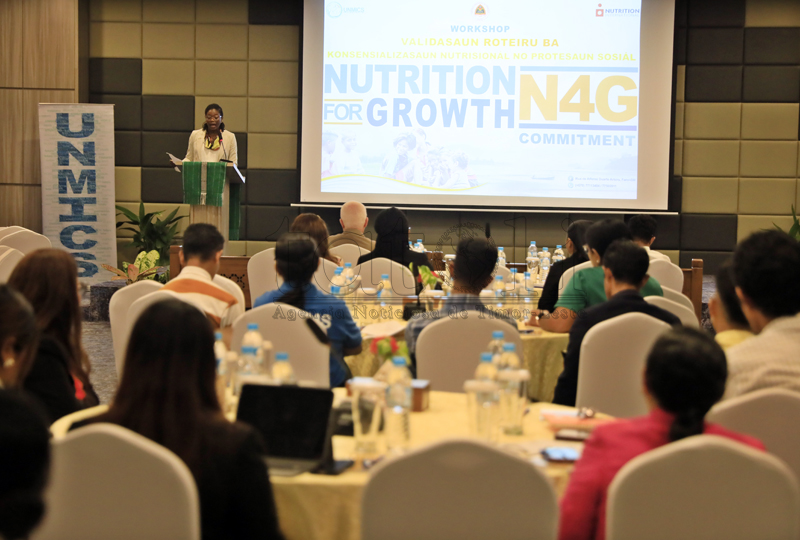
DILI, 17 June 2026 (TATOLI) — Timor-Leste took a significant step toward improving nutrition outcomes and reducing child stunting on Tuesday as the Mission Unit for Combating Stunting (UNMICS) convened a validation seminar for two strategic roadmaps aimed at implementing the country’s commitments under the global Nutrition for Growth (N4G) initiative for the 2024–2030 period.
The seminar, held at the JL World Hotel in Metiaut, Dili, brought together government officials, development partners, United Nations agencies and civil society representatives to review and endorse the proposed implementation plans.
UNMICS Executive Director Joel Pereira said the two roadmaps form part of broader efforts to translate into action the 10 national commitments presented by Vice Prime Minister Mariano Assanami Sabino during the Nutrition for Growth Summit held in Paris, France, last year.
According to Pereira, the roadmaps are designed to operationalize the government’s nutrition objectives and provide a coordinated framework for institutions responsible for implementing the commitments.
“We have developed two priority roadmaps from the 10 commitments undertaken by Timor-Leste,” Pereira said. “The first focuses on increasing awareness and access to healthy and nutritious food within communities, while the second aims to expand nutrition-sensitive social protection programmes. These documents are now being validated.”
Timor-Leste’s commitments under the N4G initiative include expanding the distribution of iron and folic acid supplements for pregnant women, strengthening the management of acute malnutrition, enhancing nutrition training for health workers, improving data collection systems for newborns and children, broadening social protection programmes, promoting climate-resilient agriculture, and improving the national school feeding programme.
The roadmaps were developed with technical support from Nutrition International through an extensive consultation process involving relevant ministries, development partners, United Nations agencies, civil society organizations and other national stakeholders.
Nutrition International’s Global Director for Nutrition Governance Programmes, Temitope Akintunde, described the roadmaps as an important milestone in the country’s efforts to improve nutritional outcomes.
She said that the roadmaps are more than planning documents, adding that they provide a clear pathway for transforming commitments into concrete actions that can improve the lives of people, particularly women, adolescents and children.
He said that the plans reflect Timor-Leste’s national realities and priorities, as they were developed through a participatory process and aligned with government strategies.
Akintunde noted that Nutrition International has supported the initiative with funding from the Government of Canada, emphasizing that investments in nutrition generate long-term benefits for health, education, productivity and economic development.
Vice Prime Minister Mariano Assanami Sabino stressed the importance of strengthening coordination among institutions and ensuring policy continuity to achieve measurable results.
“We need to work in an integrated manner with clear objectives,” Sabino said. “Programmes must be sustained and guided by well-defined targets.”
He also called on UNMICS to incorporate measurable indicators into the roadmaps, including specific targets for reducing the country’s stunting rate, which remains among the highest in the region.
According to data presented during the seminar, approximately 47 percent of Timorese children suffer from stunting, a condition characterized by impaired growth and development resulting from chronic malnutrition.
Representatives from the Food and Agriculture Organization (FAO), the World Food Programme (WFP), the International Labour Organization (ILO), and other development partners also participated in the event, reaffirming their support for Timor-Leste’s efforts to address malnutrition and improve the well-being of its population.
Joornalist: Afonso do Rosário
Editor: Isaura Lemos de Deus
Translation: Filomeno Martins