


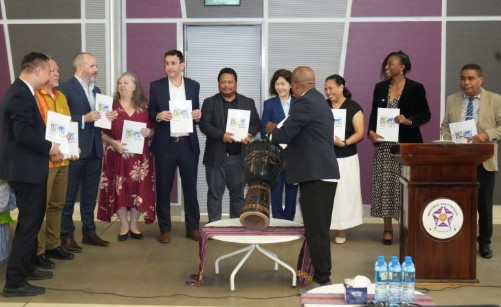
DILI, 16 June 2026 (TATOLI) – The Government, through the National Institute of Statistics of Timor-Leste (INETL, I.P. – acronym in Portuguese), under the Ministry of Finance, in collaboration with the Ministry of Health and with support from the United Nations Population Fund (UNFPA), today launched the Key Indicators of the Timor-Leste Demographic and Health Survey 2025–2026 (TLDHS) at a ceremony in the Auditorium of the Ministry of Finance in Dili.
The report presents updated data on demographic and health indicators and serves as an evidence base for public policy-making, programme development, and the monitoring of national progress in areas related to health and development.
The ceremony was chaired by the Minister of Finance, Santina J.R.F. Viegas Cardoso, and attended by the President of INETL, I.P., Elias dos Santos Ferreira; the Director of the Office of Policy, Planning, Cooperation, and Development at the Ministry of Health, Florindo Pinto; the UNFPA Representative in Timor-Leste, Navchaa Suren; and representatives of development partners.
The 2025–2026 Timor-Leste Demographic and Health Survey was conducted between September 29th, 2025, and January 31st, 2026, covering a national sample of 12,880 households. This is the fourth survey of its kind since the restoration of independence, following surveys in 2003, 2009–2010, and 2016.
In her speech, the Minister of Finance said she was “proud to participate in the launch of the report on key indicators from the 2025–2026 Timor-Leste Demographic and Health Survey.” “This survey is the fourth conducted since our independence, following the studies from 2003, 2009/2010, and 2016.”
The minister stressed that the new data enable assessment of progress and identification of the challenges facing the health sector. “With the new data for 2025–26, we can compare health programmes, their outcomes, and the challenges that remain,” she said.
Among the results presented, the most notable is the decline in the national fertility rate to 3.4 children per woman, down from 4.2 in 2016 and 5.7 in 2009–2010. The report also shows a significant increase in the proportion of births attended by skilled health personnel, rising from 33% in 2009–2010 to 60% in 2016 and to 78% in 2025–2026.
Elias dos Santos Ferreira, President of INETL, I.P., noted that the survey results provide up-to-date data on fertility, mortality, reproductive health, maternal and child health, nutrition, and family planning, and serve as a reference for health policy planning.
Despite progress, the data reveal persistent challenges, particularly in malnutrition. The prevalence of chronic child malnutrition decreased from 58% in 2009–2010 to 46% in 2016 but remains at 45% in the 2025–2026 survey.
The Minister of Finance emphasised that “with accurate data, we can plan effectively. With accurate data, we can track the progress we have made and use it as a barometer to assess the implementation of plans that have a direct impact on the well-being of the people of Timor-Leste.”
The minister added that “reliable data is the foundation of sound policy. Data not only strengthens our ability to target development programmes effectively but also ensures that the Government’s decisions are based on the best available evidence.”
The UNFPA Representative in Timor-Leste, Navchaa Suren, highlighted the Government of Timor-Leste’s role in conducting the survey and stated: “I would like to commend the leadership and commitment of the National Statistics Institute and the Ministry of Health to the successful implementation of this survey. I would also like to acknowledge the substantial financial support and oversight provided by the Ministry of Finance, which were critical to the timely completion of the survey, particularly in addressing funding gaps that arose during its implementation.”
Navchaa Suren also emphasised that the newly released results provide relevant information on maternal and child health, fertility, infant mortality, family planning, nutrition, and early childhood development, enabling identification of areas where progress has been made and those that require further effort.
The 2025–2026 Timor-Leste Demographic and Health Survey was conducted by INETL, I.P., in coordination with the Ministry of Finance and the Ministry of Health, with technical assistance from ICF through the DHS Program. The government provided most of the funding for the survey, supplemented by contributions from UNFPA, the United Nations Children’s Fund (UNICEF), the Australian Department of Foreign Affairs and Trade (DFAT), the World Food Programme (WFP), and the World Bank.
The report, now released, provides an initial overview of the survey’s findings. The final report, which will include more detailed thematic analyses, is scheduled for publication in September 2026, followed by efforts to disseminate the results at the municipal level to support nationwide planning and budgeting.
TATOLI