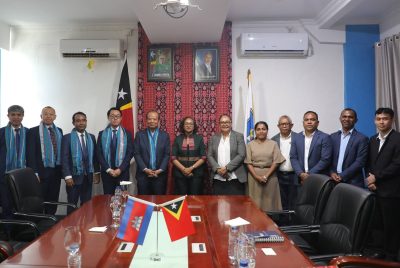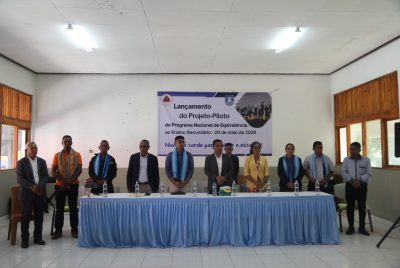



DILI, 21 october 2021 (TATOLI) – The Ministry of Health (MoH) together with the World Health Organization (WHO), UNITAL University, and the National Institute of Science and Technology (INCT) held a one-day international seminar on living science entitled: ‘The current epidemiological situation in Timor-Leste – New variants of Covid-19.’
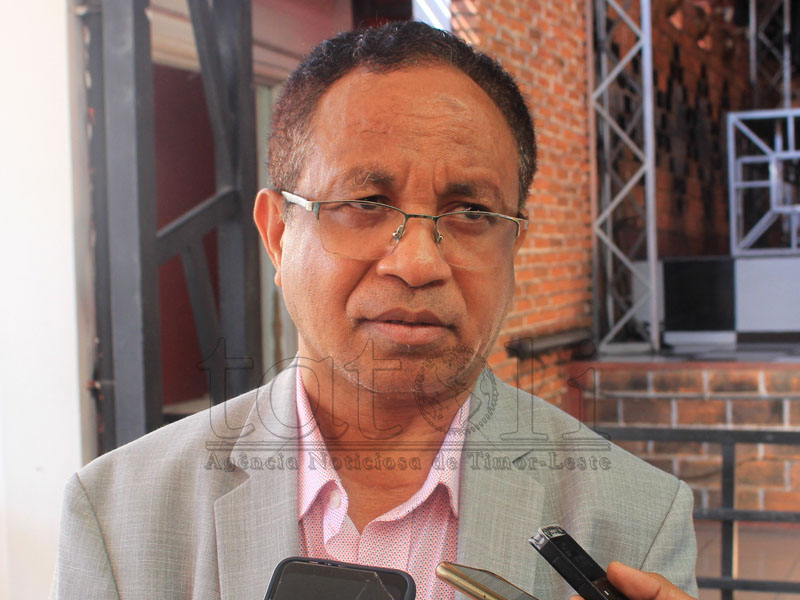
Speaking at the opening ceremony, the President of the Executive Board of the INCT, José Cornélio Guterres informed that the international seminar aims to gather opinions and thoughts from relevant entities and national and international health experts on Covid-19 and its new variants.
Odete Freitas Belo, Minister of Health, Ismael Barreto, the National Scientist from WHO, and Prof. Dr. Amin Soebandrio Soebandrio, the Director of the Eijkman Institute of Molecular Biology, Indonesia were the speakers of the seminar.
The Minister of Health, Odete Freitas Belo, in her opening remarks, said the international seminar was a good initiative to share the epidemiological situation in the country with the communities, youths, and students.
During her presentation on the COVID-19 Response Measures in Timor-Leste, Minister Belo informed that to optimize the health services in the country, especially on the control of the Covid-19, MoH established 10 pillars – Pillar 1 – Coordination, Planning and Monitoring, Pillar 2 – Risk Communication and Community Engagement, Pillar 3 – Epidemiologic Surveillance and Case Investigation, Pillar 4 – Point-of-Entry, Pillar 5 – Laboratory Services, Pillar 6 – Infection Prevention and Control, Pillar 7 – Case Management, Pillar 8 – Operational Support and Logistics, Pillar 9 – Essential Healthcare Services, and Pillar 10 – Vaccines.
The government of Timor-Leste so far had been putting a lot of effort to combat and reduce the transmission of the Covid-19 in the country.
As of Wednesday (20/10), Timor-Leste recorded 16 new cases, and the active cases dropped to 86.
Minister Belo said the health measures applied by the government play a crucial role in combating the Covid-19 in the country: “These measures include law enforcement on the measures in public places (offices, schools, shops and markets, church, parks, etc.) – Social Distancing, Hand hygiene practices and Use of Mask; the epidemiologic surveillance at point-of-entry to national territory and mandatory quarantine of all passengers; contact tracing and active testing of COVID-19 among suspected cases, especially in newly infected areas; isolation of suspected and confirmed cases; continue event-based surveillance and investigation of clusters; include variants of concern in surveillance capacities, including sequencing where available; track vaccination status of infected individuals to contribute to awareness of vaccine effectiveness.”
In addition, Soebandrio said that the accurate and rapid characterization of public health risks of Sars-CoV-2 variants requires a combination of laboratory science, clinical manifestations, and detailed epidemiologic investigations.
At the same place, Barreto informed that of the four types of the Variant of Concern (VOC) – Alpha Variant (B.1.17) had spread in 196 countries (First reported in the UK, in September 2020), Beta Variant (B.1.351) had been detected in 145 countries (First reported in South Africa in May 2020), Gamma variant (P.1) had identified in 99 countries (First reported in Brazil in November 2020 and Delta variant (B.1617.2) had spread in 193 countries, including Timor-Leste (First reported in India in October 2020).
In Timor Leste, 815 positive samples have been successfully sequenced, of which 110 samples identified as B.1.617.2 (Delta) and one B 1.1.7 (Alpha) variant.
He added many countries are still facing challenges in genomic surveillance for SARS-CoV-2, including differences in sequencing capacities, sampling strategies between countries, delays in reporting, and unequal distribution of technology for genomic sequencing.
Cumulatively 19,730 COVID-19 confirmed cases have been reported since the start of the pandemic in March 2020. However, the vast majority of the cases (99%) were reported after March 2021.
The Ministry of Health (MoH) reported 49 new cases of COVID-19, 137 recoveries, and 1 death over the last seven days. The number of new cases and deaths has been on a declining trend since late August. Currently, there are only 73 active cases across the country.
The test positive rates for the last seven days averaged 2.6%, which is below 5% and considered as limited community transmission. Compared to the averaged test positivity rate of 4.9% in the previous seven days, there was a 47.2 % reduction.
Journalist: Filomeno Martins
Editor: Nelia Borges Rosario