


Caibada community appreciate World Vision for supporting them in fighting Covid-19
BAUCAU, 28 february 2022 (TATOLI) – Community in the hamlet of Hau-Robu and Ana-Waro of Caibada village, in Baucau municipality expressed their contentment and appreciation for the support provided by the Government of Australia, through its Australian Humanitarian Partnership (AHP) Covid-19 Response Project to combat Covid-19 in the village.
AHP Covid-19 Response Project in Baucau municipality was implemented by World Vision.
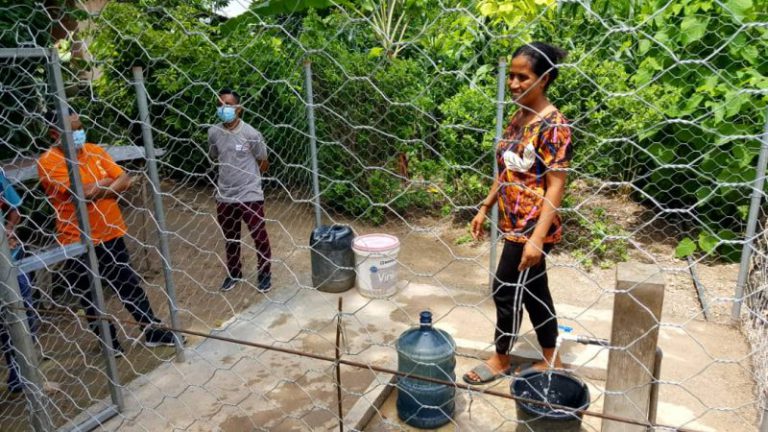
Through AHP Covid-19 Response Project, World Vision supported the communities in Caibada with the rehabilitation of four water tanks, and the installation of three water taps protection fences.
World Vision also distributed the Covid-19 hygiene kits to the communities to prevent the spread of the coronavirus. In addition, World Vision also supported basic food to the most needy family in the village, including rice, cooking oil etc.
The project coordinator of the World Vision, Juvinal da Costa Simões said that the implementation of the AHP Covid-19 Response Project and AHP Flood Response Project in Baucau municipality was financed by the Government of Australia with a total budget of US$10.000.
“During Covid-19 time, World Vision supported the vulnerable community with the distribution of the basic foods. We also distribute the hygiene kits to the communities to help them combat the Covid-19, including hand washing buckets, face masks, soaps, and hand sanitizers,” Simões told reporters in Caibada village, in Baucau.
Brigida da Silva Freitas, one of the beneficiaries, said that more than 10 households in the village have been accessing clean drinking water since the completion of the rehabilitation of the water tanks, and the installation of the water taps protection fences.
“We thank World Vision for all the support we received so far. We use the water for cooking, filling the bathroom tanks, and washing the dishes. World Vision supported us with cement, sand, steel, and wire fence and we do all the rehabilitation and installation work ourselves,” she said.
Creation of local chicken farming groups
In order to help communities cope with the impact of the Covid-19, World Vision established two local chicken farming groups, namely Mau-Liga and Mau-Kiak.
Simões said World Vision distributed basic materials to support the communities with the installation of the local chicken coops: “We provide them with the basic materials such as roofing sheets, steel and wire fence to construct the chicken coops.”
“We also give each group 11 eleven local chickens, made up of 10 hens and a cock,” Simões said.
Brigida da Silva Freitas thanked World Vision, asking the Australian NGO to continue the program in order to help other households who desperately need such support.
On the other hand, Marciana da Costa Flores from Mau Liga Local Chicken Group thanked World Vision for supporting her group with the creation of her Local Chicken Farm: “I would like to thank World Vision for all the support we have received so far, especially for the installation of the chicken coop. We received one cock and 10 hens.”
Creation of savings and loans groups
Through AHP Covid-19 Response Project, World Vision also established two Savings and Loans Groups to help communities with having access to some money when facing difficulties during Covid-19 emergency situation.
“We have created two Savings and Loans groups called Mau-Liga and Mau-Kiak,” said Siomões.
Pascoela de Carvalho one of the beneficiaries from Mau Kiak Savings and Loans Group said that her group which was made up of 12 women has collected more than US$400: “Those who take more than US$100 for a three months loan have to pay US$3 interest.”
In addition, World Vision also provided horticulture vegetable seeds, including the seeds of eggplant, long beans, peanuts, carrots, sweet potatoes, to the communities to help them improve family economic hardship, by producing more horticultural crops.
World Vision, in partnership with IADE and SECOOP, have been organizing training and capacity building to support the communities with the management of the groups, focusing on the activities of Saving and Loans, Local Chicken Farming, and Horticulture.
On behalf of the local authorities, the head of Hau-Robu hamlet, Miguel Lucio da Costa, informed that over 20 vulnerable households in his hamlet have received humanitarian support from World Vision.
“These is a good project, and I want World Vision to continue supporting our vulnerable households who need support,” Costa said.
AHP NGOs operating in Timor-Leste are Oxfam Australia, Plan International Australia, World Vision Australia, Caritas Australia (CAN-DO) and CARE Australia. Activities are being implemented with communities and local governments in the Oecusse, Covalima, Aileu, Lautem, Bobonaro, and Viqueque municipalities, as well as nationally.
The implementation of the AHT Covid-19 Response Project commenced in june 2020 and was expected to be concluded in march 2022.
Journalista: Filomeno Martins
Editor: Rafy Belo