


World Bank: “TL should spend its petroleum fund rightly”
DILI, 01 july 2022 (TATOLI) – The June 2022 edition of the World Bank’s Timor-Leste Economic Report revealed that the country’s petroleum fund would be depleted over the next decade, saying, therefore, Timor-Leste has to use and spend its petroleum fund rightly by investing in the next generation and the productive sectors to diversify the economy.
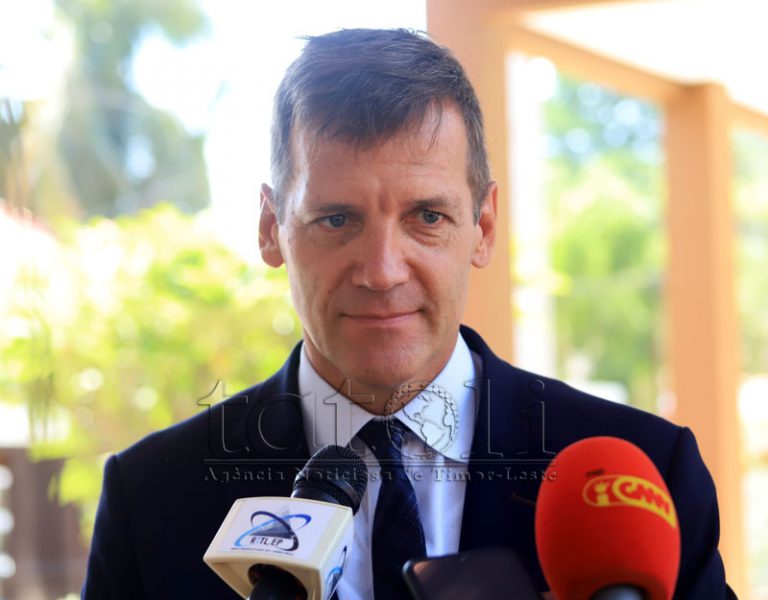
Bernard Harborne, the World Bank Resident Representative in Timor-Leste recommended two important steps to be taken by the government of Timor-Leste to properly utilize the petroleum fund.
“There are two big things that need to happen. One is that the government needs to make better savings. For instance, if I got US$100 how should I use it for people in the past or the future generation. The second thing is to increase revenues. It means that Timor-Leste needs to increase taxes to increase the revenues. As you know that there’s a new Value-Added Tax (VAT) bill that will be passed this year or next year and that will increase the revenue and at the same time support the diversification of the economy to support the productive sectors of agriculture, and tourism,” Harborne made the comments in Dili, at the launch of the 2022 edition of the World Bank’s Timor-Leste Economic Report.
He said reiterated that the government has to start investing in the next generation: “The money has to spend more and spend better on schools, and health, because young Timorese need to grow up big, healthy, and strong to produce and contribute to the economy of the nation.”
According to the report, a strategy to address short- and medium-term challenges is urgently needed. Fiscal policy should aim to protect the vulnerable from rising food and fuel prices, preferably through targeted assistance. The government can promote policy actions conducive to reducing food prices through increasing agricultural productivity and increasing nutrition through diversifying domestic production.
The report also highlighted that the diversification of the economy through the development of export sectors is essential for sustained growth. On the energy side, the efficiency of electricity generation and provision should be improved as doing so would positively impact the budget and reduce the carbon footprint of the country. Diversified energy sources, including renewables, should be explored.
Harborne stressed that the economic situation in the country is not great because Timor-Leste has suffered a number of shocks, including covid-19 and the Seroja Floods.
He said Timor-Leste has been affected by a global crisis where inflation, particularly the price of food and fuel is steadily increasing due to the Ukraine and Russia war
Headline inflation rose to 6.6 percent year-on-year (YoY) in april 2022, driven by surging global food and energy prices.
“Inflation is going to increase, and we will see that maybe for the next two years. The government is trying hard to provide a subsidy to EDTL for electricity and providing a subsidy for fuel for public transport, but the question is how long can that continue,” he explained.
Harborne emphasized that the economy of the country is expected to grow by about 3% in 2022, but saying it’s not enough: “Timor-Leste’s economy has got smaller over the last 4 or 5 five years, while the population is growing. So, it means the average Timorese is getting poorer and we are in difficult times.”
Echoing World Bank’s statement, the Rector of the Lorosa’e National University (UNTL), João Martins also supported the idea of investing in the future generation and the productive sectors.
“We need to direct our energy, our concentration, and our resources to invest in the next generation. If we don’t invest in the future generation, I think it’s a big mistake. Therefore, if we want Timor-Leste to survive in the next hundred years, then we must start investing in the next generation to develop our productive sectors in the future.
Last year, in his survey article entitled “Timor-Leste economic survey: The end of petroleum income”, Charles Scheiner states that as Timor-Leste nears the end of its petroleum-exporting era, the transition to a sustainable economy has become even more challenging due to partisan political competition, disastrous flooding, and the pandemic.
After a brief discussion of the political situation and the impacts of COVID-19, the survey explored expenditure and income trends in recent state budgets, with a particular focus on dependency on oil and gas revenues and their investments, which pay for 80% of state spending and may run out within a decade.
The article also assessed in detail revenue prospects from current and future oil and gas activities, including Greater Sunrise and the planned Tasi Mane petroleum infrastructure project. The analysis shows that it is highly likely that resource revenue will continue to decline. Diversification is not an option; it is the only way forward.
Journalist: Filomeno Martins
Editor: Nelia Borges