



DILI, 01 June 2025 (TATOLI)— José Correia Piedade, Coordinator at INDDICA, said during the World Children’s Day celebrations at Jardim 5 de Maio, Kolmera that the family is the primary authority responsible for ensuring children’s rights.
“Investing in families is essential to ensure that children grow up in a safe and inclusive environment. According to INDDICA’s observations, many children do not receive adequate attention from their families, particularly concerning health and safety. School enrolment rates have not increased annually, malnutrition remains a problem, and forced labour affects children, including those who end up living in transitional homes,” he reported.
He explained that this situation is why INDDICA chose this theme—highlighting the family as the most important foundation for providing care, protection, and a proper understanding of children’s basic needs and character development.
“The celebration and gathering at Jardim 5 de Maio were organized by the Office of the President of the Republic, in collaboration with Plan International, Timor Telecom, the Ministry of Education, and INDDICA. These organizations work on children’s rights issues, aiming to promote and protect children’s well-being through advocacy initiatives with relevant entities,” José added.
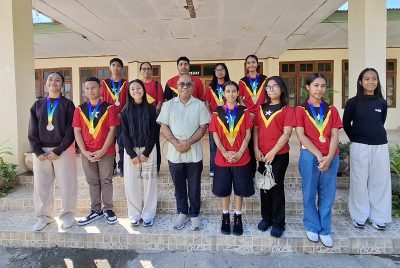
According to TATOLI’s field observation, the celebration was lively, featuring painting, singing, dancing, and performances from schools across Dili.
Education begins at home
In another segment, Nilton Diamantino Paiva, Executive Director of the National Agency for Academic Assessment and Accreditation (ANAAA), emphasized the significance of World Children’s Day in ensuring children’s rights to care, education, and overall well-being.
“We are united in educating our children because they are the future generation of our nation. We encourage them and teach them how to grow up free from harmful influences. Education starts at a young age, and from there, they lead the nation forward,” Paiva stated at Kameli International School, Kampung Baru, Komoro, this Sunday.
He stressed that educating children to be intelligent is not solely the responsibility of schools but also of families—especially parents—who teach their children about love, respect, and, most importantly, developing a relationship with God. According to Paiva, “When we are united with God, everything moves in the right direction.”
“Building their relationship with God is extremely important. As part of the government, we constantly face challenges, but we strongly encourage children to grow into responsible citizens for the nation. The government, alongside parents and families, works to support children with one shared goal: helping them become young leaders and a future generation of quality,” he added.
Paiva reiterated that children do not inherently possess quality but are nurtured over time. He emphasized that intelligence alone is not the most valuable skill—attitude plays a crucial role.
At the event, Rini Fatmawati Alves da Cruz, Director of Kameli International School Timor, shared that the school’s theme for World Children’s Day this year is “LOOK UP.” The theme focuses on collectively observing and caring for children’s futures—guiding them away from harmful influences and supporting them in realizing their dreams.
The celebration featured dancing, poetry readings, and a fashion show, allowing students to express themselves artistically.
Rini also provided historical context on World Children’s Day, explaining that it originated from Pastor Charles Leonard in 1857, when he held special church services for children, which later became an annual tradition known as Rose Day.
In 1949, the International Democratic Federation of Women—based in Russia—established International Children’s Protection Day, now recognized as International Children’s Day.
Since 1950, World Children’s Day has been celebrated worldwide every June 1st.
The United Nations (UN) officially declared World Children’s Day through the Declaration of the Rights of the Child during the UN General Assembly in 1959.
Children’s rights in Timor-Leste
In Timor-Leste, Article 10 (Protection of Children) of the Constitution of the Democratic Republic of Timor-Leste (RDTL) outlines fundamental rights:
- Paragraph 1: Children have the right to special protection from family, community, and the state, including protection against neglect, discrimination, violence, oppression, sexual abuse, and exploitation.
- Paragraph 2: Children are entitled to all internationally recognized rights as outlined in global conventions that the state has approved, accepted, or ratified.
- Paragraph 3: All children—whether born in or out of wedlock—have the right to social protection.
Journalist: Felicidade Ximenes/Arminda Fonseca
Translation: Rafael Ximenes de A. Belo