




DILI, 10 June 2025 (TATOLI) – In a bold move to bolster the country’s economy, the government has announced an innovative plan to convert the depleted Bayu Undan field into a large-scale Carbon Capture and Storage (CCS) project.
This initiative is set to transform the field into a key player in the global effort to reduce carbon emissions while generating significant economic benefits for Timor-Leste.
The Bayu Undan field, known for its rich natural resources, is now planned to be repurposed as a regional underground carbon storage center.
With an estimated capacity of up to 10 million tons of CO2 per year, this project is not only a significant step in reducing emissions but also a strategic move to extend the life of existing infrastructure.
The government envisions this project as a beacon for international investment, attracting global players eager to participate in the growing CCS industry.
“This innovative initiative will make it possible to transform the depleted Bayu Undan into a regional underground carbon storage center, with an estimated capacity of up to 10 million tons per year, which represents a strategic opportunity to extend the useful life of the infrastructure, attract international investment and generate billions of dollars in future revenue for the State,” Government of Timor-Leste said in a statement on Tuesday.
Government said that the closure of Bayu Undan’s production does not represent an end, but the beginning of a new phase, based on a plan to reconvert and valorize existing infrastructures, along with the development of other strategic solutions, such as the exploration of the Chuditch and Greater Sunrise fields, mineral prospecting in new areas of the territory and the integrated implementation of the Tasi Mane Project.
“The Government also plans to exploit the remaining gas reserves in the Bayu Undan field, which could be used under other contracts, such as the Chuditch and other fields, with the aim of channeling the gas to Timor-Leste. This strategy ensures that the field’s energy potential continues to be valued, even after the end of its main production phase,” read the statement.
The proposed CCS project is expected to generate billions of dollars in future revenue for the country.
Previously, the former President of the National Petroleum and Minerals Authority (ANPM), Florentino Soares Ferreira said that the Bayu-Undan Carbon Capture and Storage (CCS) project is estimated to generate up to US$7 billion. Meanwhile, the proposed CCS project is estimated to cost around US$1.6 billion.
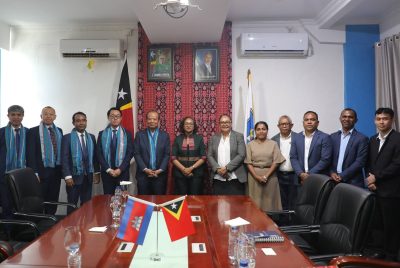
Last month, the representative of Australian company Santos Ltd, José Lobato Gonçalves, met with the President of the Republic, José Ramos-Horta, to discuss Santos’ proposed CCS project offshore Timor-Leste.
It was the second time Santos has presented and discussed the plan with the Head of State, following their previous meeting in 2022 at the Presidential Palace, where Kevin Gallagher, Managing Director and CEO of Australian company Santos Ltd, presented the Bayu-Undan Carbon Capture and Storage (CCS) project.
In 2023, Santos and its Bayu-Undan joint venture partners signed a Memorandum of Understanding (MOU) with Timor-Leste’s national oil company TIMOR GAP to explore partnership opportunities for the proposed Bayu-Undan CCS project.
Santos said that the project has the potential to reduce the absolute emissions and emissions intensity of Australian and Timor-Leste gas and LNG projects, as well as other hard to abate industries in the region.
Last year, the Minister of Petroleum and Mineral Resources (MPMR) and International Finance Corporation (IFC) signed a one-year cooperation agreement for the implementation of the Carbon Capture and Storage (CCS) project in Bayu Undan field. The agreement was signed by the Petroleum Minister, Francisco Monteiro, and the IFC Country Director for Indonesia and Timor-Leste, Euan Marshall, in Dili.
According to Francisco Monteiro, IFC will provide technical assistance to the ministry, contributing to the formulation of legal and commercial frameworks, as well as sharing its experience in similar projects in other countries.
Euan Marshall, IFC Country Manager for Indonesia and Timor-Leste said that the collaboration is also intended to support the ministry in exploring the conditions necessary to establish an innovative carbon capture and storage site in Bayu Undan
The Bayu-Undan CCS project is part of Santos’ three-hub CCS strategy that includes the Moomba CCS project, now 70 per cent complete and on track to store up to 1.7 million tonnes of CO2 per year commencing in 2024.
Carbon Capture and Storage (CCS) is a climate change technology that captures carbon dioxide emissions from sources like power plants and industrial processes, transporting them to an underground storage site, typically in a geological formation. This process prevents the CO2 from entering the atmosphere, where it contributes to global warming. CCS is widely regarded as a crucial component in the global strategy to combat climate change.
Despite the project’s potential to generate billions of dollars for the country, La’o Hamutuk—a local non-governmental organization in Timor-Leste—has consistently expressed concerns about the CCS project, warning that it may pose significant risks to Timor-Leste and is unlikely to provide an effective solution to climate change.
In June 2021, La’o Hamutuk published an article questioning the CCS plan because it undercuts the principle of climate justice and will negatively impact on Timor-Leste and the global climate. “This is already a public and worldwide concern, because human activities, especially extractive industries, are changing our climate, creating a serious crisis for humanity.”
In February 2022, La’o Hamutuk wrote a submission asking the Northern Territory (Australia) Environmental Protection Authority (NTEPA) to look at Santos’ CCS proposal holistically, and to analyze it deeply, rather than only looking at Santos’ interests.
La’o Hamutuk expressed strong opposition to the proposed CCS project at the Bayu-Undan field, stating, “Carbon Capture and Storage is not a solution.”
Santos has a 43.4% operated interest in Bayu-Undan. The remaining interest is held by SK E&S (25%), INPEX (11.4%), Eni (11%) and Tokyo Timor Sea Resources (9.2%).
Journalist: Camilio de Sousa
Editor: Filomeno Martins