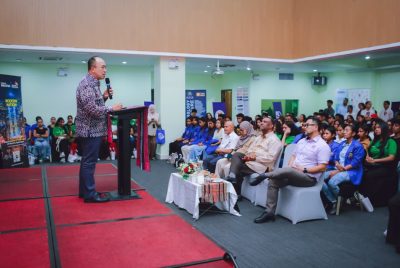



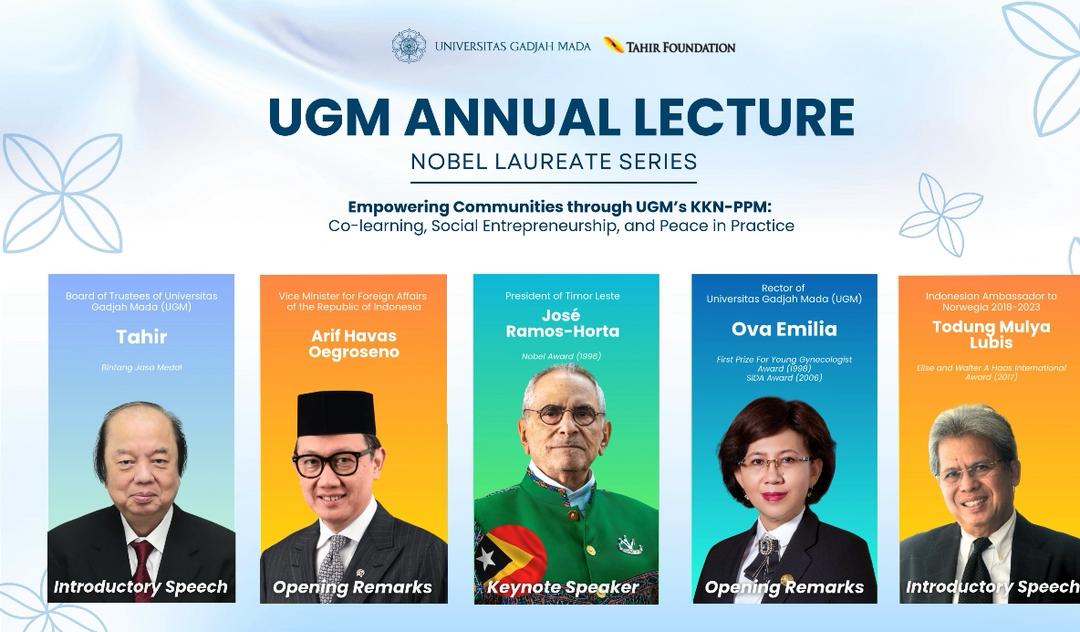
DILI, 31 July 2025 (TATOLI) – President of Timor-Leste and Nobel Peace Laureate José Ramos-Horta has urged youth and universities to embrace community-centered leadership and inclusive development during his keynote address at Gadjah Mada University (UGM) in Yogyakarta, today, in the presence of university leaders, lecturers, and students.
Speaking under the theme “Empowering Communities: Education, Social Entrepreneurship, and Peace”, President Ramos-Horta praised UGM’s KKN-PPM community service program, calling it “inspiring and deserving of recognition and should be replicated globally.”
He stressed that leadership for social change must be rooted in empathy, integrity, and resilience, emphasizing that “true inspirational leadership consists in igniting the flame of potential in others, mobilizing individuals and communities toward a common vision of a more just, inclusive, sustainable, and peaceful future.”
Ramos-Horta said that inspirational leadership requires perseverance and resilience. “The path of change is difficult. An inspiring leader must have the strength to persist, to rise after every fall, and to instill that same tenacity in others.” “Integrity is also essential. Trust is the foundation of any lasting movement. A leader must embody honesty, transparency, and fidelity to their principles—even it is difficult and unpopular,” he added
The president said that a leader must be able to articulate a compelling vision for the future — “a future free from conflict, poverty and injustice— the vision must be grounded in a realistic understanding of the present and enforced with concrete, achievable steps and goals. It is about dreaming big, but acting smart!”
“Inspirational leadership is, above all, community-centered. It is not about imposing solutions, but about listening deeply to the communities, understanding their needs, their inherent strengths, and their traditional wisdom as well as their valuing local knowledge — empowering them to be the architects for their own transformation, and equipping them with tools, skills, and opportunities so they can build their own path,” Ramos Horta explained.
He therefore reiterated that communities must be central in decision-making, and that local voices and traditional knowledge are critical for lasting development.
The Pillars of Social Change: Education, Social Entrepreneurship, and Peace
In his keynote address, Ramos-Horta laid out a vision for transformative social change built on three interconnected foundations: education, social entrepreneurship, and peace.
“The most effective social change initiatives are based on three interlinked pillars: education, social entrepreneurship, and peace,” Ramos-Horta said, emphasizing that each pillar reinforces the others to drive lasting, inclusive development.
He recalled Timor-Leste’s struggle to rebuild its education system after years of conflict, when schools were destroyed and children were deprived of learning. “We understood that to rebuild the country, we had to rebuild education,” the President said.
The Head of State urged ASEAN member states to strengthen ties between universities and local communities, proposing an ASEAN Network of Universities for Social Transformation. This network would lead joint programs on digital literacy, climate justice, social inclusion, and community entrepreneurship—areas he described as crucial to building an inclusive Green and Blue Economy.
“Academic knowledge must leave the classroom,” he said, calling for applied learning that supports local microenterprises, family businesses, and cooperatives.
Turning to social entrepreneurship, Ramos-Horta called it a “modern and powerful tool” for converting social challenges into sustainable opportunities. He advocated for youth-centered policies across ASEAN, including the establishment of a Young ASEAN Program for Transformative Leadership, featuring internships, innovation labs, and cross-cultural exchanges: “Our youth is our greatest resource.”
On the third pillar, peace, Ramos-Horta emphasized that development is impossible without it. He reflected on Timor-Leste’s experience with truth and reconciliation, which he said demanded “political courage and moral clarity.”
Building on that model, he proposed the creation of an ASEAN Center for Peace and Community Reconciliation Studies, to bring together civil society and academic institutions in promoting local conflict resolution and restorative justice.
“Inclusive development must be grounded in community voices, local knowledge, and shared responsibility,” Ramos-Horta said, urging the region’s future leaders to pursue change with empathy, integrity, and courage.
He outlined that genuine peace cannot exist where homes are filled with violence, stating, “Where there is a high level of domestic violence, violence hidden at home—homes that are supposed to be havens of love and happiness—there is no peace for the terrified mother and terrified child.”
Ramos-Horta encouraged UGM students to fully engage with their community service roles and practice leadership values that center on listening, humility, and action. “Apply the principles of inspirational leadership: empathy, resilience, integrity, and vision. Each of your gestures can create a lasting impact,” he said.
He said that world faces immense challenges: “multidimensional poverty, economic and social inequalities, climate change, and persistent conflicts.” “But we also possess great human capacity for innovation, cooperation, and resilience.”
“I believe deeply that through dedicated leadership, the power of education, the creativity of social entrepreneurship, and the relentless pursuit of peace, we can build a better world,” Ramos-Horta said.
He added that the future belongs to those who dream—and who have the courage to work to make those dreams come true. “May we continue working together, with global solidarity, to empower every community and transform lives.”
As Timor-Leste prepares to become a full member of ASEAN in October 2025, Ramos-Horta said the country hopes to contribute a model of “community-based, intercultural, and regenerative leadership.”
TATOLI