


By: Dionisio Babo Soares
TimorLeste is scheduled to officially join the Association of Southeast Asian Nations (ASEAN) in October 2025. This will be more than a ceremonial milestone. It will culminate a long, deliberate process that began with its 2011 application and has involved years of legal harmonisation, diplomatic outreach, and institutional strengthening. It will also be the start of a far more demanding phase: translating the symbolism of membership into tangible economic, political, and social gains, while navigating the constraints of ASEAN’s consensusdriven system and the realities of its own limited capacity.
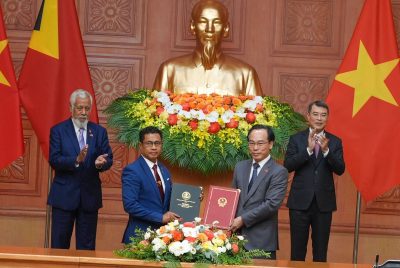
Indeed, the accession process has already reshaped the machinery of government. By mid2025, Dili had ratified 84 ASEAN related agreements, from the ASEAN Charter to the ASEAN Comprehensive Investment Agreement, the ASEAN Trade in Goods Agreement, and multiple Mutual Recognition Arrangements. Ninetyone legal instruments have been translated into Tetum and Portuguese with Japanese assistance, covering all three pillars of the ASEAN Community: 23 in the Political Security sphere, 59 in the Economic sphere, and 9 in the Socio Cultural sphere. These translations are not symbolic; they are the legal foundation for aligning domestic regulations with ASEAN standards, and they will be ratified by Parliament and promulgated in the “Jornal da República” to give them binding force. The ASEAN Secretariat and the Asian Development Bank have been running Phase 2 of a capacity building programme in 2025, training 86 officials from ministries such as Commerce, Finance, Petroleum, and Foreign Affairs on the technical requirements of the ASEAN Economic Community’s priority agreements and the post2025 strategic plan.
What more needs to be done?
The economic baseline is challenging. With a per capita GDP of roughly US$1,000, TimorLeste will be ASEAN’s smallest economy, onethirtieth the size of Myanmar’s. Oil and gas still account for about 80% of GDP and 90% of state revenue, leaving the country acutely vulnerable to price swings. Nonoil exports are narrow, as coffee brought in US $28 million in 2023, about 7% of nonoil GDP, with small volumes of organic spices and handicrafts. Imports are heavily ASEAN-oriented; for example, between 2004 and 2022, 60% of Timor-Leste’s US$13.43 billion in goods and services imports came from ASEAN markets, mainly Indonesia, Singapore, Vietnam, Malaysia, and Thailand. Food imports alone comprised 20% of the total between 2018 and 2022. Membership will open tariff free access to a market of 667 million people with a combined GDP of US $3.6 trillion, and to ASEAN+1 free trade agreements with partners such as China, Japan, and Australia. However, it will also require new systems for tariff classification, certification of origin, and investment protection, all of which will strain fiscal and human resources.
Politically and strategically, ASEAN membership will give TimorLeste a seat in the Treaty of Amity and Cooperation, the ASEAN Regional Forum, and the East Asia Summit. Its location near the OmbaiWetar Strait, a key sea lane, positions it to contribute to maritime security under the ASEAN Outlook on the Indo Pacific. However, ASEAN’s consensus based decision making, already tested by divisions over Myanmar and the South China Sea, could be further strained by a new member with a still-developing administrative system.
Timor-Leste’s deep infrastructure ties with other countries considered rivals of the organisation may sharpen intra ASEAN sensitivities over their influence, echoing past frictions with Cambodia and Laos. Balancing relations with such countries, particularly China, the United States, Japan, and Australia, will require careful diplomacy to avoid over alignment and preserve strategic autonomy.
Socially, ASEAN’s labour mobility frameworks could help address youth unemployment, which exceeds 20%. Sixty per cent of the population is under 25, with only 12% of the workforce completing secondary education. English proficiency, ASEAN’s working language, is limited to a small percentage of adults. Timor-Leste needs to catch up with investment in vocational training and language skills to avoid missing out on opportunities in high demand sectors such as health care, construction, and digital services, the latter projected to generate US$330 billion in ASEAN by 2025. Rural development is equally urgent: almost 70% of Timorese depend on subsistence farming, yet agriculture contributes just 8% to GDP. ASEAN’s Socio Cultural Community frameworks, including the ASEAN Agreement on Disaster Management and Emergency Response, could support climate resilience and rural livelihoods. These programs must be integrated into national development planning to facilitate it.
The integration challenge is two fold: aligning domestic institutions with ASEAN’s acquis while using membership to catalyse structural transformation. On the institutional side, Timor-Leste must complete ratification and operationalisation of all ASEAN legal instruments, embed ASEAN focal points in ministries, and sequence commitments under the “ASEANX” formula to avoid administrative overload. Economically, it should target niche exports with a comparative advantage, namely, premium organic coffee, spices, and ecotourism, and use ASEAN’s Mutual Recognition Arrangements to professionalise its tourism workforce. Negotiating a free trade zone and developing an Industrial Park, as envisaged by President Joko Widodo and President José Ramos-Horta, with Indonesia’s Nusa Tenggara Timur Province, could stimulate crossborder commerce. It could also lay the basis for European market expansion using Timor-Leste’s quota in the European market. Infrastructure connectivity must be pursued through the Master Plan on ASEAN Connectivity 2025, prioritizing maritime and air links, and eventual participation in the ASEAN Power Grid for renewable energy integration.
Governance reforms are equally critical. Timor-Leste ranks 110th of 180 countries in Transparency International’s Corruption Perceptions Index, still considered a deterrent to investors. Therefore, strengthening judicial independence, improving public procurement transparency, and ratifying the ASEAN Agreement Against Trafficking in Persons will be essential, particularly as crossborder labour mobility expands. Climate resilience should be mainstreamed into development planning, leveraging ASEAN’s Blue Economy Framework to develop sustainable fisheries and protect marine biodiversity.
The risks of mis-managing integration are real. Administrative overload could delay compliance with ASEAN obligations; economic dependency on oil could persist if diversification stalls; over reliance on one partner, such as China, could create geopolitical vulnerabilities; skills gaps could limit benefits from labour mobility; and climate shocks could disrupt growth. Mitigating these risks will require phased implementation of commitments, targeted investment in human capital, balanced foreign policy, and climate proof infrastructure.
In this context, the most tangible and urgent step after accession is the creation of a permanent ASEAN Integration and Competitiveness Council. Chaired by the Prime Minister or a senior minister, and comprising key ministries, the private sector, academia, and youth representatives, this body would coordinate policy alignment, oversee capacity building, identify market opportunities, and monitor integration bench marks. It should be legally established within six months of accession, with a dedicated budget and technical secretariat supported by ASEAN partners. Its mandate would include aligning national policies with ASEAN commitments, overseeing training programmes for officials and businesses, conducting market intelligence to promote niche exports, tracking progress on integration, and running public awareness campaigns to build domestic support for ASEAN engagement.
Such a council would institutionalise ASEAN engagement at the highest level, ensuring that membership is symbolic and a driver of inclusive growth, governance reform, and strategic influence in Southeast Asia. It would also signal to ASEAN partners and investors that Timor-Leste is serious about meeting its obligations and maximising the benefits of integration. In the long run, success will depend not only on the mechanics of compliance but on the vision and leadership to use ASEAN as a platform for national transformation, turning the promise of membership into tangible gains for the Timorese people. If ASEAN’s founding ethos is “One Vision, One Identity, One Community,” TimorLeste’s challenge will be to weave its narrative into that fabric without losing the threads of its hardwon sovereignty and democratic values. The next chapter begins in October 2025; how it is written will depend on choices made now, in the narrow window between accession and the realities of life inside the ASEAN tent.
Opinion expressed by the author is personal and does not bind the institution he represents.
Note: the statistics in this text are indicative and may not represent the latest version.