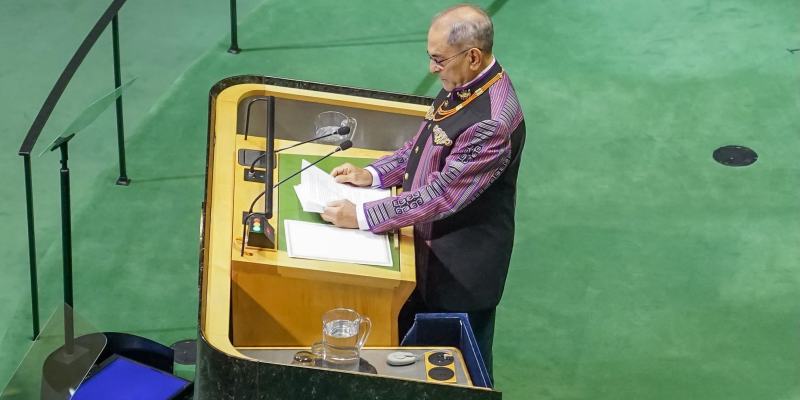



De-escalation or Global Catastrophe: The United Nations, Great Power Rivalry, and the Role of Small States in Preventing World War III

Author: Remigio Alexandre do Carmo Vieira
Affiliation: Independent Researcher, Timor-Leste
Statement: Conducting research to promote global peace, multilateral cooperation, and security for small and non-aligned states
Abstract
The escalation of armed conflict in the Middle East following the death of Iran’s Supreme Leader under militarized circumstances has significantly heightened the risk of systemic global escalation. This article examines two competing trajectories—escalation toward a third world war and coordinated de-escalation—through the lens of classical realism, neorealism, and neoliberal institutionalism. It argues that de-escalation is not merely a normative preference but a strategic necessity for global survival. By analyzing the institutional role of the United Nations and highlighting the perspective of small and non-aligned states, particularly Timor-Leste, the article demonstrates that global peace depends on proactive multilateral leadership and the preservation of international norms governing the use of force.
Keywords: De-escalation, World War III, United Nations, small states, multilateralism, global security
1. Introduction
The contemporary international system is increasingly characterized by strategic rivalry, declining trust in multilateral institutions, and the normalization of force as an instrument of political signaling. The escalation of conflict in the Middle East following the death of Iran’s Supreme Leader represents a critical juncture for international peace and security. What might otherwise appear as a regional crisis carries the potential to evolve into systemic global confrontation, raising renewed concerns about the possibility of a third world war.
This article is written from the perspective of an independent researcher based in Timor-Leste, committed to promoting global peace, multilateral cooperation, and the interests of small and non-aligned states. It examines the conditions under which regional conflict escalates into global war and assesses the capacity of multilateral institutions—particularly the United Nations—to prevent such an outcome. It argues that small states, often marginalized in great-power politics, possess both a moral and strategic stake in de-escalation processes that warrant greater scholarly and policy attention.
2. Theoretical Framework: Classical Realism, Neorealism, and Neoliberal Institutionalism
This study adopts a pluralist theoretical framework integrating Classical Realism, Neorealism, and Neoliberal Institutionalism to explain both the persistence of escalation toward systemic war and the possibilities for de-escalation through multilateral governance.
Classical realism, as articulated by Morgenthau (1948), views international politics as a struggle for power rooted in human nature and the desire for dominance. Escalation following the death of a senior political leader is interpreted as actors seeking to preserve prestige, credibility, and national honor. Morgenthau’s emphasis on prudence as the supreme virtue of statecraft is particularly relevant today, as the failure to exercise restraint transforms rational security competition into moral and strategic disaster.
Neorealism, developed by Waltz (1979), shifts focus to the structure of the international system. In an anarchic environment lacking a central authority, states are compelled to prioritize survival and relative power. Systemic pressures, such as multipolar competition and security dilemmas, drive escalation even when actors recognize catastrophic consequences.
Neoliberal institutionalism, articulated by Keohane (1984), challenges the realist assumption that anarchy precludes cooperation. Institutions facilitate cooperation by reducing uncertainty, lowering transaction costs, and creating expectations of reciprocity. The United Nations actively shapes state behavior through preventive diplomacy, mediation, and collective signaling (Finnemore & Sikkink, 1998). For small states like Timor-Leste, engagement with these institutions represents both a strategic necessity and a moral commitment to global peace.
Integrating these approaches demonstrates that while escalation is structurally explainable, it is not inevitable. De-escalation depends on institutional mechanisms capable of reintroducing prudence, transparency, and cooperation in a system otherwise governed by power competition.
3. Escalation Dynamics and the Risk of World War III
Escalation theory emphasizes dangers of retaliation cycles, miscalculation, and commitment traps (Jervis, 1978). The Middle East is a high-risk escalation zone due to dense proxy forces, strategic resources, and external interventions. States including Iran, Israel, and United States, combined with interests of Russia and China, heighten the probability of systemic shock.
Targeted violence against leadership erodes norms of restraint and sovereign immunity. Realist theory predicts that structural pressures alone can drive escalation, independent of individual intentions (Waltz, 1979; Mearsheimer, 2001).
4. De-escalation and the Role of the United Nations
De-escalation is a rational strategy to prevent catastrophic loss. The United Nations provides preventive diplomacy, mediation, and norm-setting authority (Keohane & Nye, 1977; Finnemore & Sikkink, 1998). Despite Security Council divisions, its legitimacy remains essential for coordinating restraint and collective responsibility.
Preventive diplomacy and confidence-building can transform zero-sum security dilemmas into cooperative solutions, demonstrating that de-escalation is both strategic and moral.
5. Small States and Non-Aligned Actors: The Case of Timor-Leste
Small and non-aligned states are disproportionately affected during global crises. While limited in hard power, they face indirect costs, including economic shocks, energy disruptions, and humanitarian crises. For Timor-Leste, engagement in multilateral diplomacy supports both survival and moral responsibility for global peace. Small states amplify normative pressure, reinforcing institutional authority and norms against unilateral force.
6. Conclusion
The risk of a third world war is neither inevitable nor abstract.
De-escalation preserves conditions for global coexistence. The United Nations, despite limitations, remains central to coordination, accountability, and law enforcement.
For small and non-aligned states like Timor-Leste, the stakes of de-escalation are particularly high.
Preventing global war is a collective responsibility of all states. The present crisis tests whether multilateral institutions can constrain the logic of war and reinforce global peace.
As an independent researcher from Timor-Leste, I advocate for evidence-based multilateral strategies that prioritize diplomacy, institutional cooperation, and the protection of small states in global security governance.
References
Buzan, B., & Waever, O. (2003). Regions and powers: The structure of international security. Cambridge University Press.
Bull, H. (1977). The anarchical society: A study of order in world politics. Columbia University Press.
Finnemore, M., & Sikkink, K. (1998). International norm dynamics and political change. International Organization, 52(4), 887–917. https://doi.org/10.1162/002081898550789�
Gause, F. G. (2010). The international relations of the Persian Gulf. Cambridge University Press.
Hinnebusch, R. (2016). The international politics of the Middle East (3rd ed.). Manchester University Press.
Ikenberry, G. J. (2011). Liberal leviathan: The origins, crisis, and transformation of the American world order. Princeton University Press.
Jervis, R. (1978). Cooperation under the security dilemma. World Politics, 30(2), 167–214. https://doi.org/10.2307/2009958�
Keohane, R. O. (1984). After hegemony: Cooperation and discord in the world political economy. Princeton University Press.
Keohane, R. O., & Nye, J. S. (1977). Power and interdependence: World politics in transition. Little, Brown.
Mearsheimer, J. J. (2001). The tragedy of great power politics. W. W. Norton & Company.
Morgenthau, H. J. (1948). Politics among nations: The struggle for power and peace (3rd ed.). Knopf.
United Nations. (2023). Charter of the United Nations and statutes of the International Court of Justice. United Nations. https://www.un.org/en/about-us/un-charter�
Walt, S. M. (1987). The origins of alliances. Cornell University Press.
Waltz, K. N. (1979). Theory of international politics. Addison-Wesley.
Lake, D. A. (2009). Hierarchy in international relations. Cornell University Press