


President Ramos-Horta awards Collar of the Order of Timor-Leste to former Indonesian Foreign Ministers

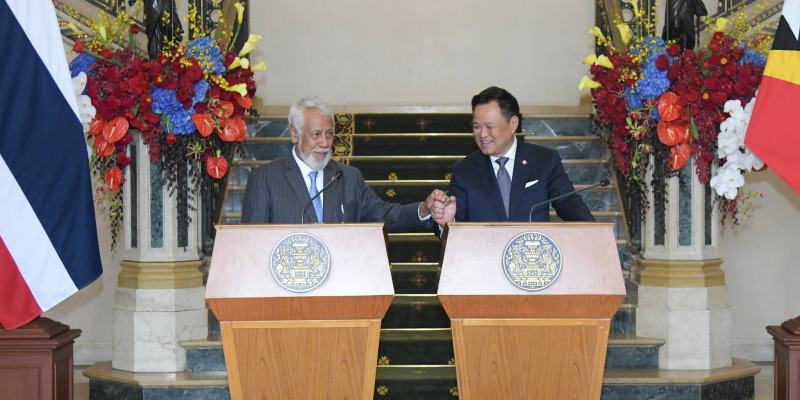
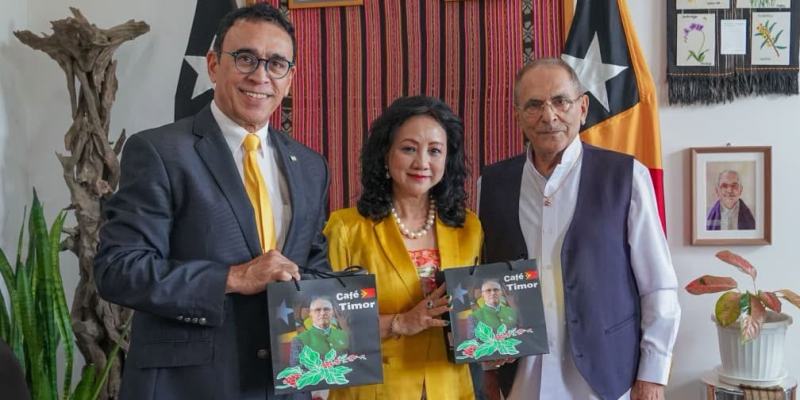
DILI, 19 May 2026 (TATOLI) — President José Ramos-Horta on Tuesday bestowed the Collar of the Order of Timor-Leste upon former Indonesian foreign ministers Hassan Wirajuda and Marty Natalegawa in recognition of their contributions to reconciliation between Timor-Leste and Indonesia, as well as support for Timor-Leste’s regional integration.
The awards ceremony was held at the Nicolau Lobato Presidential Palace under Presidential Decree No. 50/2026.
According to the presidency, Wirajuda was recognised for his central role in building reconciliation diplomacy between Timor-Leste and Indonesia. His contribution to the Commission for Truth and Friendship was cited as demonstrating that justice and peace can advance together.
Natalegawa was honoured for his strategic vision and steadfast support for Timor-Leste’s accession to ASEAN, with his concept of regional equilibrium continuing to serve as an important reference for small states navigating an increasingly multipolar world.
“Both have contributed to something greater than bilateral diplomacy: they have contributed to the architecture of a more stable, more cooperative, and more inclusive region,” said in a statement.
Hassan Wirajuda served as Foreign Minister of the Republic of Indonesia from 2001 to 2009 and later as a member of the Indonesian Council of Presidential Advisors.
He is widely credited as the principal initiator of the ASEAN Political and Security Community concept and played a decisive role in establishing the ASEAN Intergovernmental Commission on Human Rights. Notably, he co-partnered directly with President Ramos-Horta to create the Commission of Truth and Friendship between Indonesia and Timor-Leste in 2005, overseeing its mandate to address past gross violations.
He also served as chief negotiator with the Free Aceh Movement and facilitator of the Manila Peace Agreement between the Philippine government and the MNLF.
Currently Rector of Universitas Prasetiya Mulya, he continues to shape policy through his roles as Senior Advisor to the Indonesian Border Negotiation Team and member of the Trilateral Commission.
Hassan Wirajuda is a graduate of the University of Indonesia, Oxford University, Harvard Law School (LL.M.), and The Fletcher School (M.A.L.D.), and is a recipient of the Fletcher Gold Medal.
Marty Natalegawa served as Foreign Minister of the Republic of Indonesia from 2009 to 2014 and is the author of the acclaimed Does ASEAN Matter? A View from Within.
He is a Distinguished Fellow of the Asia Society Policy Institute and Chairperson of the Asia Pacific Leaders Network on nuclear non-proliferation.
Natalegawa was instrumental in securing Indonesia’s ratification of the Comprehensive Nuclear Test Ban Treaty and is credited with initiating the concept of ASEAN’s “dynamic equilibrium” for the Indo-Pacific. He served as President of the UN Security Council, Permanent Representative of Indonesia to the UN, and Ambassador to the UK and Ireland. His honours include the Grand Cordon of the Rising Sun (Japan) and being made an Honorary Knight Commander of the Order of St. Michael and St. George (UK).
A member of the UN Secretary-General’s High-Level Advisory Board on Mediation, he is widely cited as one of the most respected foreign policy and international security thinkers of his generation in the Asia-Pacific. Dr. Marty Natalegawa holds a D.Phil. from the Australian National University, an M.Phil. from Cambridge, and a BSc from the London School of Economics.
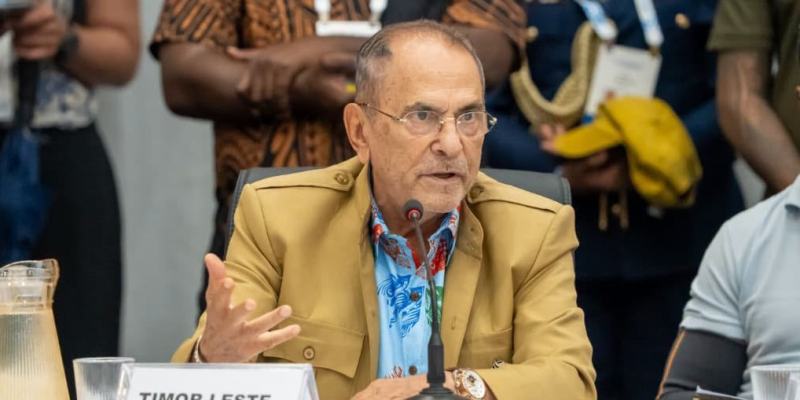
After the award ceremony, President Ramos-Horta led the 2026 Presidential Lecture Series II, under the themed “Timor-Leste in ASEAN: Completing the Regional Circle and Navigating the Global Turbulence.”
The lecture examined the transformation of the relationship between Timor-Leste and Indonesia, highlighting how their journey from reconciliation to partnership offers valuable lessons for regional and global post-conflict diplomacy.
It assessed the significance of Timor-Leste’s ASEAN membership, considering how historical reconciliation can pave the way for deeper integration and cooperation within Southeast Asia, and explored strategies for ASEAN to maintain unity and balance, enabling the region to navigate an increasingly complex and divided geopolitical environment.
President Ramos-Horta in his opening remarks said: “Our full membership in ASEAN is not merely a diplomatic milestone; it is a structural choice to anchor Timor-Leste in a dynamic regional community of 700 million people, transforming integration into lasting prosperity, stability, and strategic autonomy in a turbulent world. Today, we confer the Order of Timor-Leste upon two great friends: Hassan Wirajuda, who turned reconciliation into an art of peace, and Dr. Marty Natalegawa, whose strategic vision guided our ASEAN journey. They chose dialogue over division and built lasting bridges between nations. They are now part of our history.”
The 2026 Presidential Lecture Series II featured the two former foreign ministers of the Republic of Indonesia. Hassan Wirajuda presented on the topic “From Reconciliation to Integration: Towards Community Building in ASEAN/East Asia,” exploring how the Indonesia–Timor-Leste relationship serves as a global blueprint for post-conflict diplomacy. He was followed by Marty Natalegawa, who presented on “Navigating the Reefs in a Multi-Polar World,” applying his renowned “rowing between two reefs” philosophy to Timor-Leste’s strategic autonomy amid U.S.–China competition.
The lecture moderated by Helder da Costa, Secretary General of the g7+ Secretariat, and followed by an interactive Q&A.
As Timor-Leste takes its rightful place at the ASEAN, the 2026 Presidential Lecture Series II and the conferral ceremony upon two distinguished statesmen underscore a timeless truth: peace is not merely the absence of conflict but the presence of persistent and principled diplomacy. The journey from reconciliation to regional integration, embodied by Wirajuda and Natalegawa, offers a beacon for small nations navigating global turbulence.
President José Ramos-Horta’s vision, now embedded in Timor-Leste’s national trajectory, underscored that completing the regional circle was not an endpoint but the start of a broader commitment to building a Southeast Asia where dialogue prevails over division, historical wounds are transformed into foundations for partnership, and even the smallest states can help shape a more stable, inclusive and hopeful future.
TATOLI