


Timor-Leste urges stronger media cooperation to promote transparency and combat disinformation
DILI, 04 November 2026 (TATOLI) – Timor-Leste has called on countries participating in the Belt and Road Initiative (BRI) to strengthen media cooperation through greater transparency, cross-border fact-checking and joint reporting to ensure development projects benefit communities and are accurately represented.
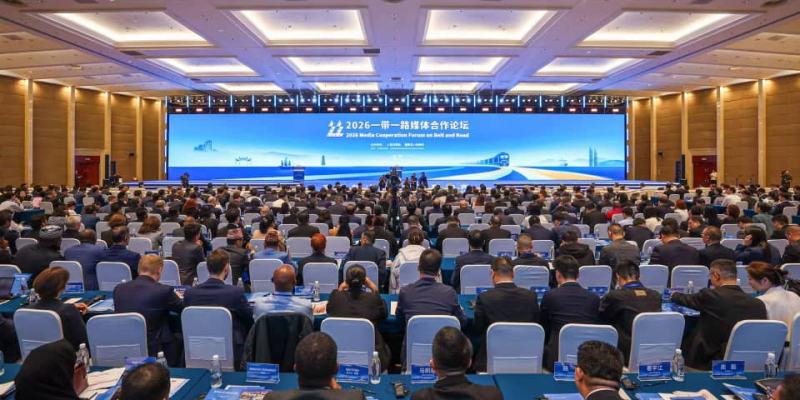
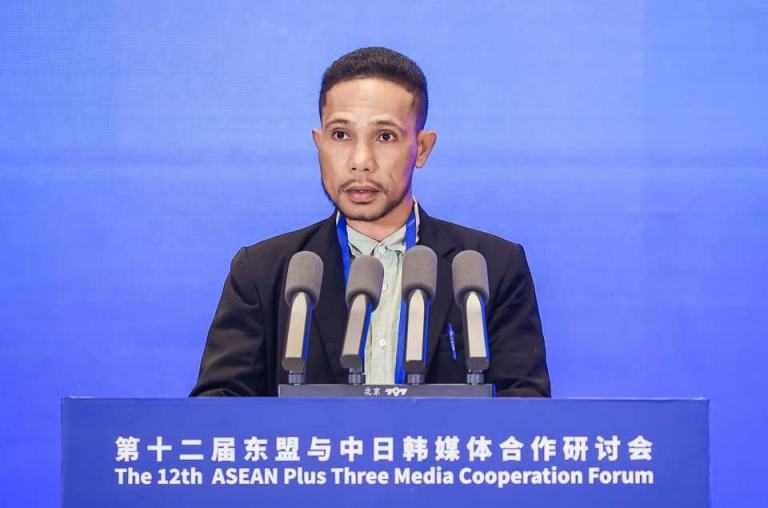
Zezito da Silva, Vice President of the Board of Directors of TATOLI News Agency, made the appeal on Tuesday while representing Timor-Leste at the 2026 Belt and Road Media Cooperation Forum in Fuzhou, China, where he delivered a speech titled “Openness and Cooperation for Shared Development.”
He said openness and cooperation were essential not only to promoting sustainable development but also to combating misinformation and strengthening public trust in an increasingly complex information environment.
“How do we tell the truth in a time when lies travel faster? And how do we make development truly shared?” Zezito asked, stressing that these challenges required practical commitments rather than political statements or slogans.
Drawing on Timor-Leste’s experience, he outlined three priorities for international media cooperation: public access to government information, coordinated efforts to counter disinformation, and more inclusive reporting that gives developing countries and local communities a stronger voice.
On transparency, Zezito highlighted the difficulties journalists can face when investigating the use of public funds, citing an example of a reporter seeking information about a US$500,000 fertiliser procurement contract intended to support farmers in rural communities in Timor-Leste.
He said the journalist was denied access to the contract after authorities classified it as confidential, preventing her from examining the procurement process and investigating why subsidised fertiliser had not reached the intended beneficiaries.
He argued that infrastructure investment alone could not guarantee shared development if the public was denied access to information about how projects were financed and implemented.
“If we build ports, roads and fibre cables but keep the contracts confidential, we are not building shared development. We are building shared suspicion,” he said.
Zezito urged countries participating in Belt and Road projects to adopt an open-contract policy requiring all public contracts worth more than US$10,000 to be published online in local languages and made searchable.
He said greater access to public information would enable journalists to hold institutions accountable while helping citizens understand how development projects affect their lives.
Turning to disinformation, Zezito recalled Timor-Leste’s 2022 presidential election, during which more than 300 fake accounts reportedly emerged over two months, spreading fabricated photographs, AI-generated videos and hate speech targeting women candidates.
He said the experience demonstrated that misinformation could not be effectively addressed by individual countries or media organisations working in isolation.
Welcoming the launch of the Belt and Road Media Workshop Programme at the forum, he called for the initiative to be expanded into a permanent international cooperation mechanism.
He proposed establishing a Shared Fact-Checking Network connecting fact-checkers from the 120 countries represented at the forum to exchange information, verification tools and multilingual expertise in real time.
Under the proposed initiative, journalists and fact-checkers would work together to identify and verify misleading content circulating across national borders, supported by reverse-image searches and translation services in languages including Tetum, Portuguese, Mongolian, Mandarin and so on.
Zezito said international coordination could significantly reduce the time needed to debunk false information, which might otherwise take several days for an individual newsroom to investigate.
“A false photo used in Dili today will be used in Mongolia tomorrow and in Zambia next week,” he said, emphasising the importance of establishing a connected network to respond quickly to emerging disinformation.
He also stressed that media cooperation should extend beyond training programmes and formal exchanges to include practical, ongoing collaboration.
The third priority, he said, was ensuring that development stories reflected the experiences of ordinary people, particularly communities in developing countries whose voices were often underrepresented in international media coverage.
He questioned whether major media organisations were adequately representing the experiences of small traders, farmers and fisherwomen whose livelihoods were affected by infrastructure and economic development projects.
“Who tells the story of the Belt and Road? Too often, it is told only by big media from big countries,” he said.
Zezito welcomed the inauguration of the Belt and Road Journalists’ Station in Fuzhou, describing it as an opportunity for international journalists to gain a deeper understanding of China.
He expressed hope that a similar journalists’ station could be established in Dili, allowing Chinese and other international journalists to spend time working alongside Timorese reporters and producing stories in Tetum.
Rather than serving as a showcase for visiting journalists, he proposed that the facility provide opportunities for foreign reporters to work directly with local newsrooms, exchange professional experience and report on development from the perspectives of communities.
He said such exchanges would strengthen mutual understanding and create more balanced international coverage.
To translate the forum’s theme into practical action, Zezito presented three proposals for international media cooperation.
The first, an Open Contracts Pledge, would encourage participating countries to support the public disclosure of government contracts linked to development projects.
The second, a Shared Check Network, would connect fact-checking organisations across participating countries to jointly combat disinformation, particularly ahead of elections scheduled for 2027.
The third, One Story, Two Reporters, would establish an annual joint-reporting initiative pairing one Chinese journalist with a journalist from a Global South country to investigate and report on a shared development issue from different perspectives.
He said the initiatives were intended to turn the forum’s commitments into measurable actions that could strengthen professional relationships and improve the quality of international reporting.
Concluding his speech, Zezito referred to a Tetum proverb, “Hamutuk ita bele, fahe malu ita monu,” meaning that people can achieve more together but risk falling when divided.
Adapting the proverb to the journalism profession, he said international media organisations needed to work together to defend truth and prevent misinformation from undermining public trust.
“Openness without cooperation is just exposure. Cooperation without openness is just a closed club. We need both,” he said.
He stressed that achieving meaningful and inclusive development required greater transparency, stronger cooperation and a shared commitment to ensuring that the benefits of development reached all communities.
TATOLI