


Ramos-Horta urges global solidarity and dialogue at OACPS-EU Parliamentary Assembly
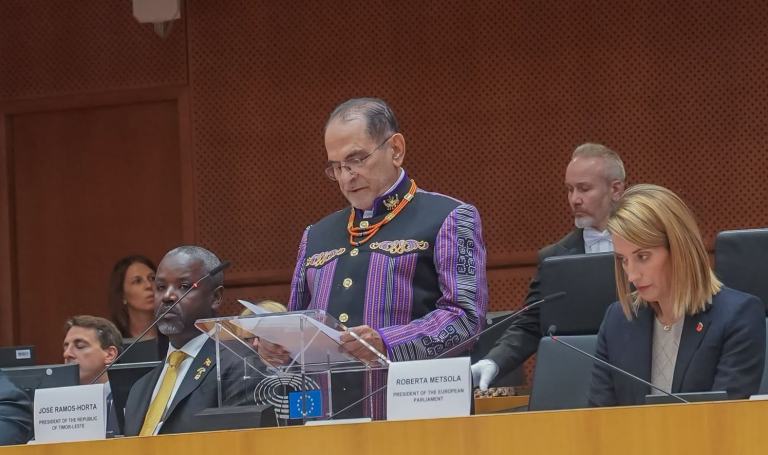
DÍLI, 09 November 2026 (TATOLI) — Timor-Leste President and Nobel Peace Prize laureate José Ramos-Horta has called for greater international solidarity, dialogue and reconciliation to address global conflicts, urging parliamentarians from Europe, Africa, the Caribbean and the Pacific to work together towards a more peaceful and equitable world.
Ramos-Horta made the appeal while addressing the Second Plenary Session of the Organisation of African, Caribbean and Pacific States (OACPS)–European Union (EU) Joint Parliamentary Assembly, held at the European Parliament in Brussels from 9 to 13 November 2026.
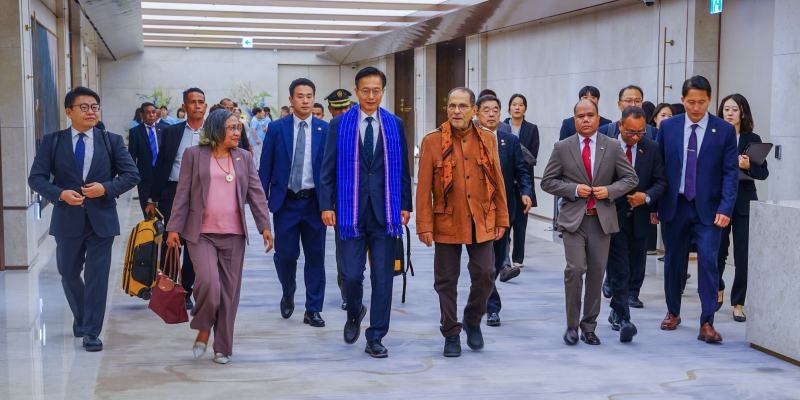
He attended the opening ceremony on Monday, 9 November, as Guest of Honour, following an invitation from the Assembly’s Co-Presidents, European Parliament member Francisco Assis and Thomas Tayebwa.
In an address delivered in Portuguese, French, Spanish and English, Ramos-Horta reflected on Timor-Leste’s struggle for self-determination and independence, highlighting the European Parliament’s historical support for the Timorese people during the Indonesian occupation.
He acknowledged the solidarity shown by European parliamentarians and other international partners during the country’s difficult path to independence, saying Timor-Leste had returned to the European Parliament not merely to recall its history but also to contribute to addressing today’s global challenges as an equal partner.
“During our long journey toward freedom, often solitary and facing seemingly insurmountable obstacles, we found our first welcome, consolation, and active solidarity at the Casa Lusófona, where we heard voices of courage, solidarity, and hope—and it was also in many national parliaments and the European Parliament that the first resolutions supporting the Timorese people’s right to free self-determination and independence were adopted; we do not forget, and today we return not to ask others to speak for us but to affirm our willingness to contribute, as equal partners, to a more just, more peaceful, and more humane world,” Ramos-Horta said.
The President also highlighted Timor-Leste’s experience of reconciliation following independence, particularly its efforts to overcome historical grievances and establish peaceful relations with Indonesia, its closest neighbour.
He stressed that lasting peace requires political courage, mutual understanding and a willingness to resolve disputes through dialogue rather than retaliation.
Ramos-Horta stressed that peace requires more courage than war; reconciliation demands greater moral strength than revenge; dialogue is not a concession to an adversary but an investment in a shared future.
“Peace may come at a heavy cost, but continuing war is not a win-win certainty—it is a lose-lose option. After independence, we made a conscious choice not to imprison ourselves in the grievances of the past, pursuing reconciliation within our society and with Indonesia, our closest neighbour. Reconciliation does not require us to forget history or ignore the victims; it requires us to recognise that future generations should not remain prisoners of it—an experience that has shaped my lifelong conviction that conflicts, however painful and complex, must ultimately be resolved through dialogue and reasonable political solutions. Recalling how this Parliament kept Timor-Leste’s hopes alive during our darkest years, I urge that same spirit of solidarity today toward children in conflict zones, families in island nations, and young people across Africa, the Caribbean, the Pacific, and Europe. Let this Assembly be remembered for the bridges it builds and the lives it improves, proving that even the smallest nation can overcome adversity through hope, determination, and the solidarity of others,” he said.
Ramos-Horta’s participation also carried historical significance, reflecting the transformation of Timor-Leste’s relationship with the European Parliament over more than three decades.
He first addressed the European Parliament in 1992 as a representative of a people living under occupation, advocating a peaceful solution based on dialogue and the Timorese people’s right to determine their own future.
Following the 1991 Santa Cruz massacre, the European Parliament adopted resolutions calling for accountability and an arms embargo. In 1999, it awarded the Sakharov Prize for Freedom of Thought to then Resistance Commander Kay Rala Xanana Gusmão in recognition of his contribution to the struggle for freedom and democracy.
Ramos-Horta returned to the European Parliament in 2010 as President of an independent Timor-Leste. His participation in the 2026 assembly further reflects the country’s transition from a recipient of international solidarity during its independence struggle to an equal partner in addressing shared international priorities.
The five-day parliamentary gathering brings together around 160 representatives from OACPS member states and the European Parliament to discuss major global challenges and strengthen cooperation between the two regions.
Key issues on the agenda include global security and multilateralism, ocean protection, development financing, international competition for critical raw materials and the EU’s Global Gateway strategy.
The programme also includes a Youth Forum, a Women’s Forum and a Civil Society Consultation, providing opportunities for young people, grassroots organisations and other stakeholders to contribute to discussions and policy recommendations.
The opening ceremony was attended by several senior political figures, including European Parliament President Roberta Metsola; Jamaican Prime Minister Andrew Michael Holness; Togo’s Foreign Affairs Minister Robert Dussey; Irish Minister of State Frank Feighan, representing the Irish Presidency of the Council of the European Union; Ethiopian State Minister of Finance Tiguist Fisseha, representing the OACPS Presidency; and European Parliament Vice-President Younous Omarjee.
The OACPS-EU partnership, established under the Samoa Agreement, brings together nearly two billion people and more than half of the United Nations’ member states.
The Joint Parliamentary Assembly serves as the parliamentary component of the partnership, comprising 78 representatives from OACPS member states and 78 Members of the European Parliament.
It provides a platform for political dialogue, parliamentary cooperation and the exchange of perspectives on issues of mutual concern between Europe and its African, Caribbean and Pacific partners.
TATOLI