


Timor-Leste Seizes Historic Future: Launch of the 2026 State of World Population Report Empowers a New Generation
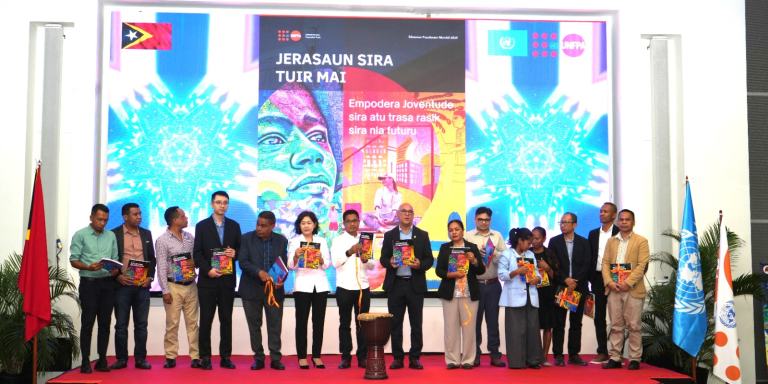
DÍLI, 20 November 2026 (TATOLI) – In a landmark joint session that marks a defining moment for one of Asia’s youngest nations, the Government of Timor-Leste and the United Nations Population Fund (UNFPA) on Thursday officially launched the 2026 State of World Population (SWOP) Report, titled “Succeeding Generations: Empowering Young People to Chart the Future.”
Released alongside the dissemination of the Timor-Leste National and Municipal Youth Profiles and powered by the strategic vision of the Government of Timor-Leste, the event united national leaders, international partners, and passionate youth advocates in a shared mission to turn demographic potential into lasting national prosperity.
The high-level launch featured compelling key addresses by Mariano ASSANAMI Sabino, Acting Prime Minister, Minister Coordinator for Social Affairs and Minister of Rural Development and Community Housing; Nelyo Isaac Sarmento, Minister of Youth, Sports, Arts and Culture; and Navchaa Suren, UNFPA Representative in Timor-Leste.
Timor-Leste stands at a powerful demographic crossroads where roughly 72% of the population is under the age of 35. With youth aged 15 to 24 comprising 21.6% (289,992 individuals) and youth aged 15 to 35 making up 38.1% (510,657 individuals), the nation holds an extraordinary, time-bound opportunity to harness a demographic dividend. Leaders emphasized that this window requires immediate, courageous action to prevent missed potential.
Addressing critical real-world hurdles head-on, the latest figures show that 105,882 young people are currently not in employment, education, or training (NEET) – with a disproportionate impact on young women at 55.7% for ages 25 to 35 compared to 40.3% for young men. Furthermore, with 67.2% of youth residing in rural areas facing a rural illiteracy rate of roughly 20% compared to 7% in cities, alongside an average marriage age of 27 and an adolescent birth rate of 34 per 1,000, the call for targeted intervention has never been more urgent or compelling.
Bridging global insights with local realities drawn directly from the Population and Housing Census profiles, the Government of Timor-Leste has unveiled four transformative pillars designed to reshape the nation’s trajectory. First, Timor-Leste will aggressively expand local businesses, digital technology, modern agriculture, and tourism to integrate the 105,882 NEET youth into the formal economy, creating stable jobs that allow young people to build secure families at home. Second, the government is dramatically scaling up domestic funding to deliver youth-friendly health services, comprehensive maternal care, and mental health support directly within every village (suco). Third, the nation is embedding climate resilience into rural infrastructure, roads, and green public works, turning environmental protection into thriving rural livelihoods. Fourth, moving far beyond symbolic gestures, the government is opening official, empowered spaces for young people—especially young women – to actively shape municipal budgets, local governance, and peacebuilding.
Highlighting the government’s unwavering commitment, Acting Prime Minister Mariano ASSANAMI Sabino declared, “Our government is firmly committed to investing in our young people today – through quality education, decent jobs, and inclusive governance—so they can stand as the greatest engine of peace, justice, and prosperity Timor-Leste has ever known.” Directly reinforcing the core message of the 2026 report, UNFPA Representative Ms. Navchaa Suren stated, “Succeeding generations must have the opportunity, freedom and power to shape the future.”
Closing with an impassioned call for a whole-of-society movement, leaders urged government institutions, development partners, the private sector, and civil society to unite behind Timor-Leste’s youth. As powerfully underscored during the launch and championed in MoYSAC remarks, young Timorese are not merely the beneficiaries of tomorrow – they are the vital, indispensable architects of today. Their voices, aspirations, and active participation matter deeply, ensuring that Timor-Leste’s future will be built on a foundation of inclusive growth, justice, and enduring prosperity.
TATOLI