



DILI, 10 december 2021 (TATOLI) – The overall water demand in Capital Dili continues to increase, while water availability and supply decrease every year, said the Executive Director of the National Authority for Water and Sanitation Public Institute (ANAS, IP), Domingos Pinto.
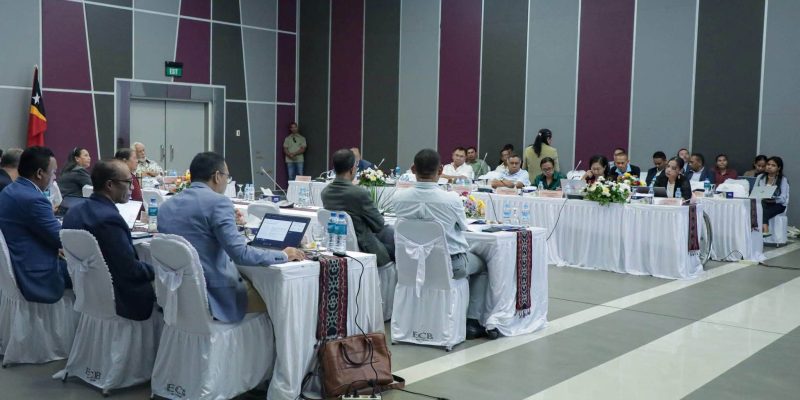
“The population of Dili alone requires around 75.000 Cubic meters of water daily, however, the availability of water remains at 60.000 Cubic meters per day or it would be decreasing in the future,” Pinto said in his presentation at the National Seminar on Water, Sanitation, and Hygiene (WASH), at the CNE’s hall, in Dili, on friday.
He said Climate change, deforestation, population growth, urbanization, and wasteful use of water can be the main causes of insufficient water supply in capital Dili and other municipalities.
“Due to insufficient water supply, therefore, water management is important for Timor-Leste to ensure that we have enough water for all communities in Dili as well as in the municipalities,” said Pinto.
ANAS had elaborated its National Water Policies to have better management of water resources under set policies and regulations.
He said the amount of fresh water available may decline in the future, while the increased competition of water resources is unstoppable, adding, therefore, proper water management in the country is urgently needed, particularly in Capital Dili, where the population keeps increasing every year.
“According to Timor-Leste’s 2015 Census, the number of water supply systems decrease from 1650 in 2015 to around 1.300 in 2019. It means that water access also might have decreased in the past two years (2019 to 2021), said the President of the Bee Timor-Leste (BTL, E.P), Carlos Peloi dos Reis.
He said to achieve Sustainable Development Goal 6 of ensuring “clean water and sanitation for all in 2030, serious investments and efforts are needed to reach this goal.
Reis informed that, in 2021, the Government of Timor-Leste allocated more than US$ 30 million of the General State Budget (GSB) on the National Clean Water and Sanitation program: “This year the Government only allocated US$ 17 million for this program.”
According to WASHdata.org, around 78 percent of the population in Timor-Leste have access to clean drinking water in 2017, compared to 51 percent in 2002.
Reis said that based on the 2019 Water and Sanitation Survey, around 70 percent of the population in urban areas have access to clean water and sanitation, as well as 71 percent of communities in rural areas also have access to clean drinking water.
Journalist: Filomeno Martins
Editor: Nelia Borges Rosario