


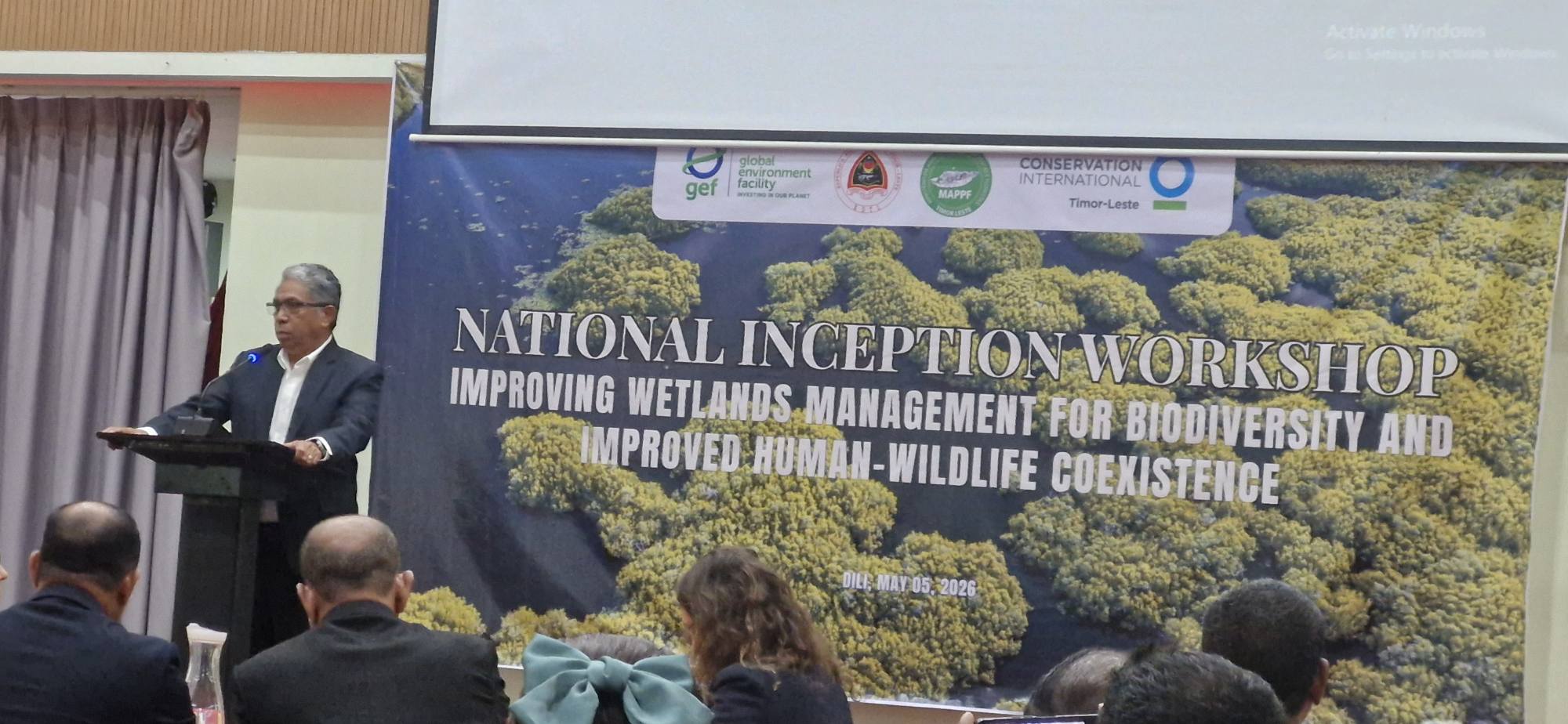
DILI. 05 May 2026 (TATOLI) — Timor-Leste’s government, in partnership with Conservation International Timor-Leste and the Ministry of Tourism and Environment, on Tuesday launched a four-year project aimed at improving lagoon management, protecting biodiversity and reducing human-crocodile conflict in several districts.
The initiative was unveiled during a national workshop at Timor Plaza in Dili under the theme Promoting Good Lagoon Management for Biodiversity and Human-Crocodile Coexistence.
The project is funded by the Global Environment Facility (GEF) with an investment of $2.6 million and will focus on lagoons in Manatuto, Manufahi, Covalima and Ainaro.
The initiative seeks to strengthen sustainable lagoon management, conserve ecosystems and biodiversity, and support sustainable livelihood opportunities for local communities.
Agriculture, Livestock, Fisheries and Forestry Minister Marcos da Cruz said the project aims to raise awareness among stakeholders about the importance of protecting lagoons as critical ecosystems.
“Lagoons are extremely important because they host a wide diversity of species, including wildlife. We need to protect them and discuss ways to ensure coexistence between communities and, in particular, crocodiles,” he said.
Da Cruz also highlighted the cultural significance of crocodiles in Timor-Leste, where the animal is often regarded as a symbolic “grandfather” in local tradition, while stressing the need to reduce conflict between people and crocodiles.
Under the project, authorities plan to designate specific zones for crocodiles and nearby communities to minimize risks and improve public safety.
“These areas could also be developed as potential tourist attractions, contributing to local economic development,” da Cruz added.
Manuel Mendes, director of Conservation International Timor-Leste, said the project will cover seven lagoons identified as priority sites for biodiversity conservation.
He said the initiative will focus on ecosystem sustainability, including water quality management and species protection, while generating economic benefits for local communities.
Twelve people will be recruited to support project implementation and work alongside forest rangers, with a dedicated management group to be established for each lagoon, Mendes said.
Warning signs will also be installed in crocodile zones to discourage people from entering high-risk areas, he added.
The GEF funding will support community groups tasked with developing tourism-related activities around the lagoons as part of broader conservation and local development efforts.
Journalist: Afonso do Rosário
Editor: Isaura Lemos de Deus
Translation: Filomeno Martins