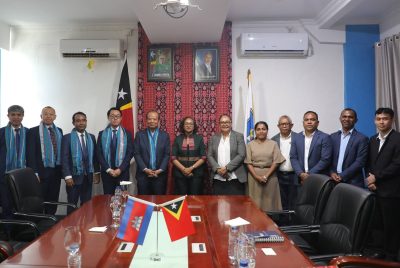




DILI, 31 january 2022 (TATOLI) – The International Labor Organization (ILO) presented the National Action Plan for the Elimination of Child Labor to the Minister of the Presidency of the Council of Ministers (PCM), Fidelis Manuel Leite Magalhães.
“Today, we are here to present the National Action Plan for the Elimination of Child Labor to the Minister Magalhães to seek government support for the approval of the national action plan. We hope that within the year 2022, this national action plan will be approved to support ILO and relevant parties to combat and eliminate child labor in the country,” the Project Coordinator of Child Labor of ILO in Timor-Leste, Jacinto da Silva Caldas Belo told reporters after having a meeting with Minister Magalhães at the Palace of the Government, in Dili, on monday.
Belo said ILO is going to cooperate with State Secretary for Vocational Training and Employment (SEFOPE), Coordinating Minister of Economic Affairs (MCAE), General Labor Inspectorate Directorate, and Timor-Leste’s National Commission Against Child Labor to combat and eliminate child labor.
“We had been working and putting efforts to eliminate child labor in Timor-Leste by 2025. Therefore, this special opportunity is important to present to the PCM regarding the approval of National Action Plan for the Elimination of Child Labor in Timor-Leste,” he said.
Belo stressed that child labor is a serious issue in Timor-Leste. You know, many children are working everywhere across the capital Dili and in other municipalities: “Many of these children spend most of their time on the streets and spend only a few hours at school.”
Belo said ILO’s 2016 survey indicated that more than 60.000 children in Timor-Leste have been engaging in child labor activities.
“These children are supporting their parents by engaging in various activities to improve their family’s economic hardship. Based on International Labor Standards, of the 60.000 kids, 12% had been considered as child laborers because they spent most of their time selling stuff on the streets,” Belo emphasized.
“PCM was delighted with our presentation. He said it was important to eliminate child labor in Timor-Leste, and the government will be committed to working with ILO and relevant parties to realize that dream,” he said.
Apart from the National Action Plan for the Elimination of Child Labor, the ILO team also presented three conventions to PCM to be approved by the Council of Ministers in 2022, namely Labor standards on Social Dialogue and Tripartism (Convention 144), the Violence and Harassment Convention (C190), and the Minimum Age Convention (C138).
Minimum Age Convention, 1973 (No. 138) – This fundamental convention sets the general minimum age for admission to employment or work at 15 years (13 for light work) and the minimum age for hazardous work at 18 (16 under certain strict conditions). It provides for the possibility of initially setting the general minimum age at 14 (12 for light work) where the economy and educational facilities are insufficiently developed.
Worst Forms of Child Labor Convention, 1999 (No. 182) – This fundamental convention defines as a “child” a person under 18 years of age. It requires ratifying states to eliminate the worst forms of child labor, including all forms of slavery or practices similar to slavery, such as the sale and trafficking of children, debt bondage and serfdom, and forced or compulsory labor, including forced or compulsory recruitment of children for use in armed conflict; child prostitution and pornography; using children for illicit activities, in particular for the production and trafficking of drugs; and work which is likely to harm the health, safety or morals of children.
The convention requires ratifying states to provide the necessary and appropriate direct assistance for the removal of children from the worst forms of child labor and for their rehabilitation and social integration. It also requires states to ensure access to free basic education and, wherever possible and appropriate, vocational training for children removed from the worst forms of child labor.
Child labor is a violation of fundamental human rights and has been shown to hinder children’s development, potentially leading to lifelong physical or psychological damage. Evidence points to a strong link between household poverty and child labor, and child labor perpetuates poverty across generations by keeping the children of the poor out of school and limiting their prospects for upward social mobility.
This lowering of human capital has been linked to slow economic growth and social development. Recent ILO studies have shown that the elimination of child labor in transition and developing economies could generate economic benefits much greater than the costs, which are mostly associated with an investment in better schooling and social services.
The fundamental ILO standards on child labor are the two legal pillars of global action to combat child labor.
Journalist: Filomeno Martins
Editor: Rafy Belo