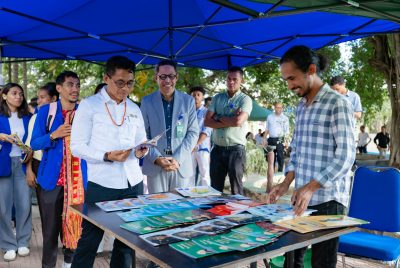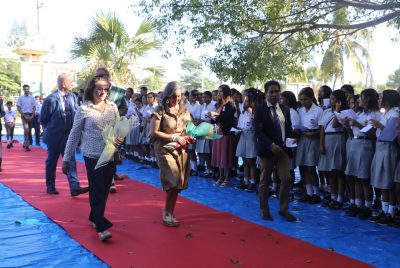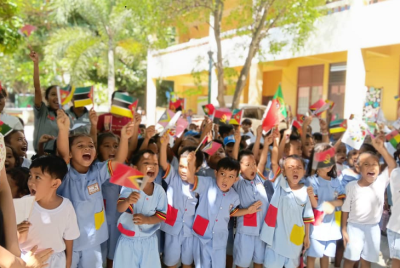




DILI, 15 december 2022 (TATOLI) – The Government of Timor-Leste, through the Ministry of Higher Education, Science and Culture (MoHESC), together with the Ministry of Tourism, Trade, and Industry (MTTI), the Secretary of State of Art and Culture (SoSAC), the Secretary of State of Equality and Inclusion (SoSEI) and Timor Aid launched books of Timorese traditional textiles (Tais) of four municipalities – Baucau, Bobonaro, Lautem, and RAEOA.
The four books are “The Textiles of Baucau”, “The Textiles of Bobonaro”, “The Textiles of Lautém”, and “The Textiles of RAEOA”. These books are written by Timorese writer Rosália Soares, Timor Aid’s Executive Director.
The launch of the four books was part of the government’s Intangible Cultural Heritage Safeguarding Programme 2022-2025.
Each of the four books describes the various weaving techniques and the different types of motifs and structures of Tais from each municipality.
“The Textiles of Lautém” provides the process of making ‘Tais’ in Lautém municipality. It also describes different types of motifs, structures, waving techniques, and cultural values of Tais from different places in Lautém municipality, including, Mehara Muapitine, Lorehe, Bauro, Lospalos, Maina I, Maina II, Pairara, and Lautem Moro.
As described in “The Textiles of Lautém”, the ‘Tais’ of Lautém municipality have always been woven on a traditional backstrap loom. The backstrap look is placed between two wooden posts on a balcony or in an empty space under traditional houses. Some weavers leave the look rolled up on the posts for storage, and unroll it again when they are ready to weave. Weavers manage the tension of the yarn and allow the well and shovel thread to pass through the layers of yarn and lean back to tighten the tension as they weave.
The book explains that there are various techniques used to weave Tais in Lautem. The most widespread technique is the single wrap resist-dye technique, widely known as Ikat. In Lautem, resist-dye is known as sisirana, or futus. Sisirana can appear in single or double color black and red stripes dyed with the indigo and morinda plants. This technique is considered the most ancient and traditional, making it highly valued.
“Unlike some other areas of Timor-Leste, where knowledge of local designs has either been lost or altered, the various traditional designs in Lautem are still strongly connected to local knowledge and customs. The designs reflect natural phenomena – such as leaves, flowers, and animals – as well as man-made objects and tools such as combs, bracelets, and the traditional three-stone cooking stove,” the book explained.
In terms of the structure of the textiles in Lautem, the book points out that throughout Timor-Leste, textiles generally fall into two main categories: Men’s clothes and Women’s cloths.
Meanwhile, traditionally, different cultural values are assigned to the different types of Tais in Timor-Leste, depending on which structure, techniques, colors, and designs are valued in the area where each Tais is made.
In addition, ‘The Textiles of Baucau” also describes the different weaving techniques, motifs, structure, and cultural value attached to Baucau’s Tais.
According to the book, Baucau Tais is produced in a backstrap loom, usually provided by family members as a way to maintain tradition. Three different techniques are used widely in the weaving of Tais in Baucau, namely Isu or Esu, Leu, and the Liana technique.
Moreover, the “Textiles of Bobonaro” also details the different weaving techniques, structures, and motifs of Tais from various distinct ethnolinguistic groups, such as Bunak, Kemak, Beakais, Marae, and Tetun Terik. The technique most used to create the patterns in the Tais these groups is the single wrap resist-dye technique, called Futus.
The widely known process of making Tais across Bobonaro is performed manually on a very simple backstrap loom called the Atis.
Furthermore, RAEOA is the municipality occupied exclusively by ethnic Baiqueno. The variation of Tais existing in RAEOA is of the category of Tais Baiqueno. The influence of the category dispersed into the western part of Timor island actually belongs to Indonesia.
Minister of Higher Education, Science and Culture, Longuinhos dos Santos said the launch of the books was part of the Government’s Urgent Program for Safeguarding the Intangible Cultural Heritage – ‘Tais’.
At the same place, the Minister of Tourism, Trade, and Industry (MTTI), José Lucas Carmo da Silva stressed that collective efforts are needed to ensure the sustainability of ‘Tais’.
“To celebrate National Tais Day, we launched four different ‘Tais’ books in three different languages – English, Portuguese, and Tetum. The launch of these books is part of the government’s efforts to promote, protect and preserve Timorese traditional textiles,” the Director General of the Secretariat of State for Arts and Culture (SEAK), Manuel Ximenes Smith made the comments at the launch of the four books, at the Dili Convention Centre (CCD).
KOMNAS PKI TL’s Vice President Abrão Mendonça said the books will help the younger generation to learn Tais and its weaving techniques: “It would give our future generation sources of information to help them be able to protect and preserve our Tais.”
“The research and the book launch were part of the Government’s 2022-2025 Urgent Safeguarding Program for the protection and preservation of Tais,” he concluded.
Journalist: Filomeno Martins
Editor: Nelia Borges