


Dili Dialogue Forum: Xanana calls on journalists to use Artificial Intelligence responsibly

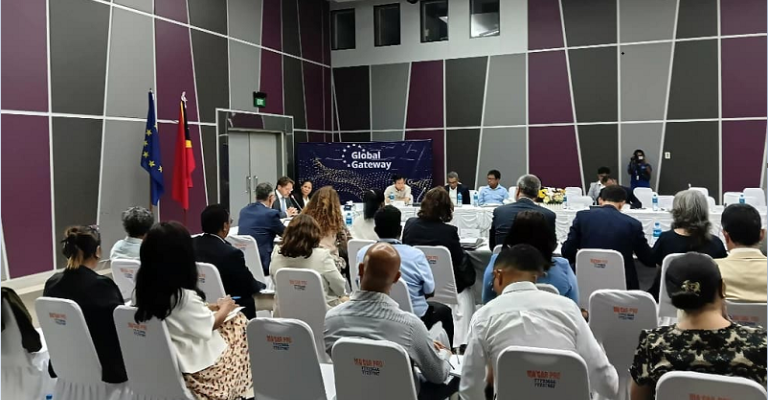
DILI, 10 May 2025 (TATOLI) –The Timor-Leste Press Council (CI) hosted the international conference “The Dili Dialogue Forum 2025,” with the theme “Artificial Intelligence (AI), Media, and Democracy in the Digital Age.” The event took place at the ‘Salão Multiuso GMN’ – GMN Multi-Purpose Hall, in Bebora on Saturday.

During the opening session, Prime Minister Kay Rala Xanana Gusmão emphasized that the forum has become an important national and regional platform for strengthening the role of the media.
“In our society, discussions on critical issues must reflect the challenges of our time. This forum brings together voices from all sectors of the media, as well as government, civil society, education, and diplomacy, to analyse how we can protect freedom of expression and encourage an informed and engaged society,” Prime Minister said.
Xanana Gusmão praised the Timor-Leste Press Council (CI) for organizing the forum, highlighting its role in promoting dialogue and debate, as well as its contribution to freedom of expression and support for building a democratic state in Timor-Leste.
“This year’s theme—Artificial Intelligence, Media, and Digital Democracy—is particularly complex, as we are living in a period where artificial intelligence is accelerating change. While AI holds great promise, we must also discuss its various risks,” said Prime Minister Xanana Gusmão during his speech.
The Head of Government stated that in fragile and post-conflict countries, social communication plays a vital role, not only in providing information to the public but also in building the foundations of peace, trust, and national identity after violence and repression. An open society with independent social communication serves as a clear signal that a country has moved beyond fear and control, embracing transparency, inclusion, and democratic governance.
“In Timor-Leste, we have learned from experience what happens when the press is silenced. Timorese people still remember the censorship and propaganda they faced during occupation. The truth was suppressed, and people were forced into silence. Independent voices were banned. Our struggle was not only for freedom but also to show the world the hardships and suffering of our people—many of which were denied by the international community,” he said.
Xanana Gusmão affirmed: “During our peace-building and state-building process, we have placed great importance on press freedom, as it is a central pillar of our democracy.”
“Our struggle for democracy did not end with the restoration of independence, nor was it completed with elections and multiple political parties. Democracy is also reflected in a fair, independent, and truthful press, one that does not incite division but instead upholds the law, strengthens communication channels, and fosters critical discussions in classrooms and public discourse,” Xanana Gusmão said.
“Democracy cannot thrive in secrecy; it requires strong and independent social communication to promote dialogue, expose corruption, support an open political culture, and give a voice to the vulnerable,” he added.
Xanana Gusmão emphasized: “We must never silence the voices of Timorese people. We must all work together to make Timor-Leste a country that stands for truth. Today, we have a society that is open to free press, because we made a conscious decision about the kind of society we want to build.
This is also thanks to Timorese journalists, who carry out their work with honesty and dedication, and to government officials who understand the importance of respecting the space for free expression.”
Thus, Prime Minister Xanana Gusmão urged the press not to focus solely on viral declarations, but to engage in deeper reflection.
“We must all work together to make Timor-Leste a country that stands for truth. That is why I always emphasize that journalists should not simply report statements, but must have the spirit and determination to investigate. To be independent and truthful, journalists must present facts with honesty, which is not just a matter of technical preparation, but a commitment to integrity,” said Xanana Gusmão.
According to the Prime Minister, while progress is not yet guaranteed, the role of the Timor-Leste Press Council (CI) remains crucial in ensuring that media outlets operate freely but with responsibility.
The Media faces new challenges
Prime Minister Xanana Gusmão emphasized that the role of the media is more important than ever, as it faces new and emerging challenges.
“The world is constantly changing, and it is changing rapidly. We cannot rely solely on certainty from the past to navigate the future,” he stated.
Prime Minister Xanana Gusmão urged journalists to take a broader view of the world and engage in critical analysis, rather than simply reacting to current discussions.
“We have dropped in the Press Freedom Index rankings. Whether we have declined or not is not my biggest concern. The issue is not about security, as we have never heard of a journalist being attacked for reporting something. Instead, it is about how we process and present information,” Xanana Gusmão said.
Advancements in Technology and Artificial Intelligence
The Prime Minister stated that Artificial Intelligence (AI) will have a major impact on the future of developing countries, including Timor-Leste. AI can help deliver services in remote areas, including healthcare and education, by providing students with tools to learn in their local languages and assisting medical professionals in making faster diagnoses for serious illnesses.
“AI can be a powerful force for good, but it also carries significant risks. AI can be used to spread misinformation, and we have already seen the destructive power of rumours and false narratives on social media in our country. We are beginning to rely more on social media than on a transparent, honest, and independent press,” he warned.
Meanwhile, Prime Minister Xanana Gusmão called on the media and journalists to uphold journalism based on truth, as democracy depends on facts.
“Journalism is built on truth, and democracy relies on facts. This is why I urge journalists and young students to remain committed to factual reporting. When misinformation spreads, democracy weakens. If we fabricate stories to attack one another without knowing the real facts, we cannot make sound decisions for ourselves or our country. Without real facts, we lose the ability to think critically. This is something we must be extremely cautious about,” the Prime Minister emphasized.
Prime Minister Xanana Gusmão acknowledged that Artificial Intelligence (AI) can now be used to write news articles, but warned that it poses a risk to journalism as a profession and could threaten the financial sustainability of media agencies and social communication organizations.
He also stressed that digital democracy is not just about being online or using the internet, but about ensuring that all Timorese people have access to reliable information and can participate in public life with confidence.
“We must work together to build a digital democracy that reflects the principles of our struggle—justice, equality, and human dignity,” he stated.
Journalist: Nelson de Sousa
Editor: Florencio Miranda Ximenes
Translation: Rafael Ximenes de A. Belo