


Timor-Leste Didn’t Break ASEAN, Myanmar Exposed It

Khoo Ying Hooi
On 15 February 2026, Myanmar’s military junta issued a diplomatic note demanding that the Charge d’Affaires of Timor-Leste in Yangon leave the country within one week, accusing Dili of violating principles of sovereignty and non-interference. On the surface, this was framed as a bilateral diplomatic dispute. In reality, it marked the latest flashpoint in ASEAN’s unresolved Myanmar crisis; one that now implicates the bloc as a whole rather than a single member state acting on the basis of its stated principles.
The immediate trigger was Timor-Leste’s decision to allow its judicial authorities to examine a criminal file submitted by the Chin Human Rights Organisation (CHRO), alleging war crimes and crimes against humanity committed by Myanmar’s armed forces in Chin State. The case is being considered under universal jurisdiction, a legal principle rarely invoked in Southeast Asia and one that sits uneasily within a regional order built on restraint and careful diplomacy.
This escalation did not emerge in a vacuum. In a commentary published in Tatoli on 2 February 2026, I described Timor-Leste’s Myanmar policy as a tightrope walk between principle and membership, between its commitment to human rights and the behavioural expectations placed on a new ASEAN member state. At the time, the dilemma appeared largely conceptual. Events since then have made it concrete. The expulsion of a Timorese diplomat confirms that normative dissent inside ASEAN is no longer theoretical; it carries real political costs.
This is not the first time the junta has used diplomatic pressure. In August 2023, it expelled Timor-Leste’s ambassador after senior Timorese officials met representatives of Myanmar’s National Unity Government (NUG), which the regime labels a terrorist organisation. That earlier episode was widely interpreted as punitive retaliation for Dili’s engagement with opposition elements. Today’s escalation differs more in context than in pattern. Timor-Leste is now a full ASEAN member, and the confrontation therefore resonates beyond bilateral relations.
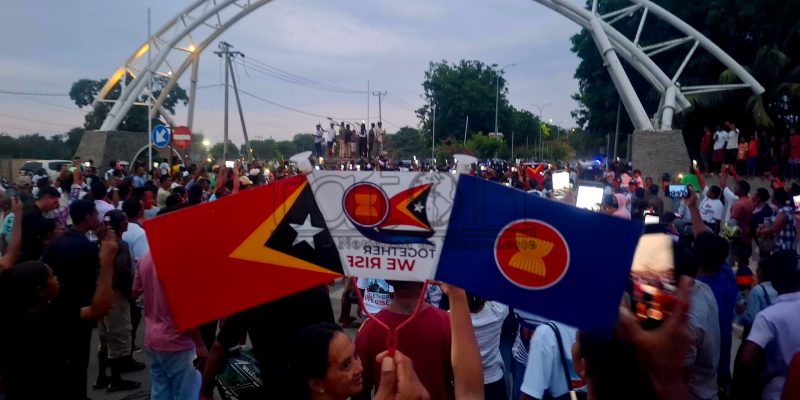
For Timor-Leste, the stakes are considerable. As a young democracy shaped by its own experience of independence and transitional justice, Dili has consistently condemned the 2021 military coup and called for a return to democratic rule. Yet ASEAN membership, achieved in October 2025, also brings expectations of restraint, ambiguity, and procedural loyalty. The junta’s repeated protests therefore reflect a broader tension over how ASEAN accommodates divergent national approaches within its institutional framework.
Timor-Leste’s willingness to allow prosecutors to examine a universal jurisdiction case is historically uncommon in Southeast Asia. ASEAN’s preferred mode has long emphasised quiet diplomacy, consensus-building, and the avoidance of overt legal confrontation. By contrast, this move introduces judicial scrutiny into a regional order that has traditionally prioritised political process over legal accountability. At the same time, Dili has framed its position as consistent with international law and solidarity with affected communities, rather than as a personal or political attack on a fellow member state.
Underlying this standoff is ASEAN’s enduring structural tension. The organisation is anchored in non-interference and sovereign equality, yet the Myanmar crisis has tested these principles in unprecedented ways. The Five-Point Consensus adopted in 2021 has seen limited implementation. Myanmar’s recent elections, widely criticised as neither free nor inclusive, were met not with outright endorsement or rejection, but with procedural distancing. This ambiguity has created space for individual member states to act, while offering limited collective guidance on how the political consequences of such actions should be managed.
The Philippines’ role as ASEAN’s current chair further underscores the bloc’s broader dilemma. Manila’s recent engagement with Myanmar reflects ASEAN’s continued preference for dialogue, humanitarian access, and incremental confidence-building. At the same time, this approach highlights the constraints facing the chair when engagement proceeds in the absence of clearly articulated political parameters. The result is a familiar ASEAN balancing act, that is maintaining channels of communication while avoiding steps that could be interpreted as endorsement or collective judgement.
These constraints are closely linked to ASEAN’s consensus-based decision-making. Long regarded as the organisation’s defining feature, consensus has also limited ASEAN’s ability to respond coherently to protracted crises. It enables any single member to slow or dilute collective action, while dispersing political responsibility across the group. In practice, this means that member states willing to take clearer positions may bear immediate diplomatic costs in the absence of a coordinated regional framework. Timor-Leste’s experience illustrates how principled action can carry national consequences when collective positions remain unsettled.
Other intra-ASEAN disputes are sometimes cited as precedents for managing tensions within the bloc. Border tensions between Cambodia and Thailand were prolonged and at times militarised, requiring a combination of bilateral negotiation, international legal reference, and quiet regional facilitation. Likewise, the Sabah jurisdictional question between Malaysia and the Philippines has remained politically sensitive and periodically resurfaced despite diplomatic management. These cases demonstrate that even sovereignty disputes within ASEAN are rarely simple or swiftly resolved. Myanmar, however, presents a different order of challenge. It is not only a territorial disagreement, but a crisis of governance, contested legitimacy, and sustained internal violence. Approaching it through the same gradual, dispute-management template risks underestimating both its structural depth and the limits of ASEAN’s existing tools.
The Timor-Leste–Myanmar confrontation therefore places ASEAN at an important juncture. The question is no longer whether Timor-Leste’s actions are appropriate, but whether ASEAN’s existing approach to Myanmar remains sufficient under current conditions. The Philippines’ engagement reflects recognition that the situation requires sustained attention and careful management. At the same time, continued engagement in the absence of clearer political benchmarks may blur the distinction between dialogue and acceptance, complicating ASEAN’s stated positions.
A more sustainable path forward requires greater procedural clarity. While ASEAN has already restricted the participation of Myanmar’s military leadership in high-level meetings, these measures remain politically discretionary rather than institutionally codified. Clarifying the conditions under which re-engagement could occur, and linking them more explicitly to progress on agreed commitments, would strengthen coherence and reduce uncertainty.
Similarly, ASEAN’s special envoy mechanism would benefit from enhanced continuity and broader engagement. Longer mandates, clearer objectives, and access beyond official state channels could lend the role greater credibility. Humanitarian coordination remains essential, but it cannot fully substitute for political strategy.
Finally, initiatives such as Timor-Leste’s arise in a context where ASEAN has struggled to generate a unified political response. This raises the risk that individual member states may find themselves diplomatically exposed when acting within the space created by ASEAN’s unresolved approach. Managing such divergence will require careful institutional calibration.
Myanmar has long been described as ASEAN’s most difficult test. What the Timor-Leste episode demonstrates is that the test has evolved. The issue is no longer only how ASEAN engages Myanmar, but how it manages internal differences when member states interpret shared principles differently. In that sense, the present moment is less about disruption and more about institutional adaptation. How ASEAN navigates this phase will shape its credibility and cohesion in the years ahead.
Khoo Ying Hooi, PhD is an associate professor at Universiti Malaya, Malaysia.