


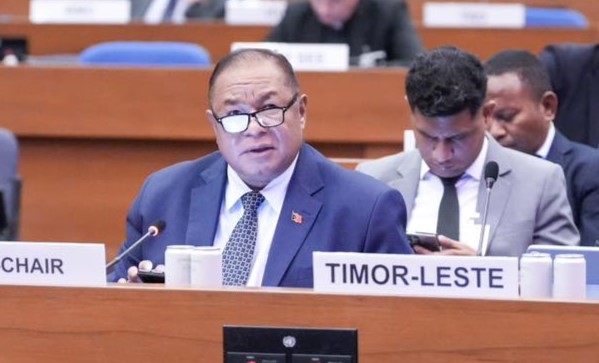
DILI, 23 April 2026 (TATOLI) — Timor-Leste’s Foreign Minister Bendito dos Santos Freitas called for stronger global solidarity, climate justice, and development support for the world’s most vulnerable countries, warning that multiple overlapping crises are deepening inequalities.
Speaking at the 82nd session of the United Nations Economic and Social Commission for Asia and the Pacific (ESCAP) in Bangkok, Freitas delivered Timor-Leste’s statement under an agenda item focusing on Least Developed Countries, Landlocked Developing Countries and Small Island Developing States
Minister Freitas emphasized that the world is facing a defining moment marked by overlapping global crises—including conflict, economic volatility, food insecurity, debt pressures, climate-induced disasters, and growing geopolitical uncertainty—which continue to disproportionately affect the most vulnerable countries, particularly Least Developed Countries (LDCs), Small Island Developing States (SIDS), and Landlocked Developing Countries (LLDCs). He stressed that progress toward the Sustainable Development Goals must remain anchored in solidarity, equity, and meaningful multilateral cooperation.
Highlighting Timor-Leste’s role as Chair of the LDC Group on Climate Change for 2026–2027, Minister Freitas underlined that climate action is not a future agenda but an immediate development imperative.
He called for stronger collective advocacy for climate justice, increased adaptation financing, effective loss and damage mechanisms, and greater international solidarity for climate-vulnerable nations. He reaffirmed that climate diplomacy remains one of the central pillars of Timor-Leste’s foreign policy and an essential component of implementing the Doha Programme of Action.
Minister Freitas further reaffirmed Timor-Leste’s commitment to the Doha Programme of Action as the principal framework for strengthening resilience, productive capacity, and sustainable graduation pathways for LDCs.
Reflecting on the recent Asia-Pacific Midterm Review held in Phnom Penh, he highlighted three strategic priorities: accelerating structural economic transformation from consumption-driven to production-driven growth; strengthening domestic institutional capacity for long-term resilience; and ensuring predictable, coherent, and nationally owned development partnerships.
Minister Freitas also stressed that graduation should not be seen merely as a technical transition between categories, but as a strategic pathway toward resilience, dignity, and sustainable prosperity. Calling for stronger North-South, South-South, and triangular cooperation, Minister Bendito urged the international community to ensure that no country is left behind in the pursuit of sustainable development.
“Leaving no one behind requires that no country be left behind,” Minister Freitas concluded, reaffirming Timor-Leste’s commitment to advancing inclusive multilateralism, stronger partnerships, and a development architecture that truly responds to the realities of the world’s most vulnerable nations.
Journalist: Camilio de Sousa
Editor: Filomeno Martins