


Timor-Leste targets ASEAN integration and quality investment to build a resilient, future-ready economy
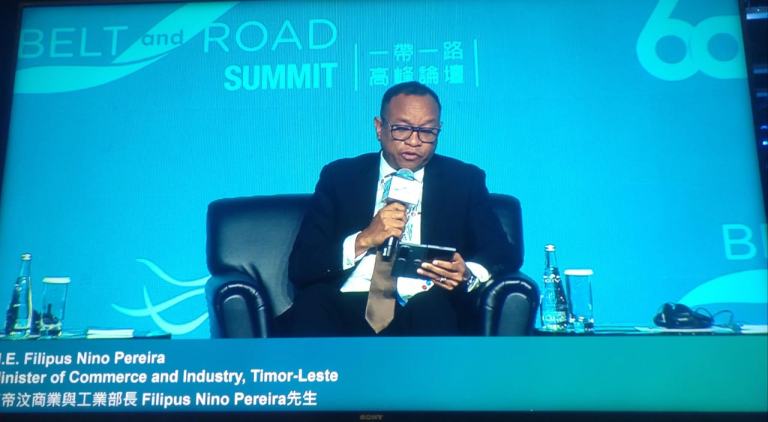
HONG KONG, 09 September 2026 (TATOLI) – As rapid shifts in global trade, geopolitical tensions, and climate change reshape the international economy, small and developing nations must adapt quickly to survive and thrive. For Timor-Leste, the path forward is anchored in economic diversification, enhanced competitiveness, and strategic integration into the Association of Southeast Asian Nations (ASEAN).
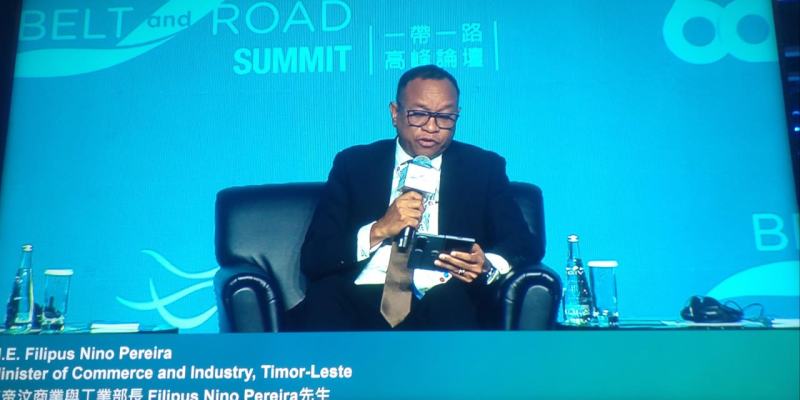
Speaking on the country’s evolving economic priorities during the Policy Dialogue entitled “Building Resilient Trade and Investment Frameworks in a Diverse Global Landscape” on the sidelines of the 11th Belt and Road Summit today, the Minister of Commerce and Industry of Timor-Leste, Filipus “Nino” Pereira, emphasized that national integration into ASEAN extends far beyond opening borders for trade.
“For us, ASEAN is not only about access to a large national market, it is about preparing our people, institutions, and businesses to participate actively,” the Minister added.
Empowering local MSMEs and Moving up the value chain
Despite strong political will, Timor-Leste’s private sector, particularly Micro, Small, and Medium Enterprises (MSMEs), continues to encounter structural obstacles. Local businesses face restricted access to finance, advanced technology, crucial market information, quality standards, digital tools, and regional business networks.
To bridge these gaps, the Ministry is spearheading initiatives to make local enterprises export-ready and investment-ready. A key focus is shifting the nation’s economic output away from raw commodity exports toward higher-value goods and services derived from agriculture, fisheries, and natural resources, allowing local producers to integrate seamlessly into regional value chains.
Digitalization is also playing a transformative role. According to Minister Pereira, e-commerce and digital trade offer a vital lifeline for a small economy, helping overcome geographical isolation by connecting local production directly to regional and international consumers. However, Minister Pereira stressed that digital and physical trade cannot flourish without a stable institutional foundation.
“We need efficient customs, better resources, reliable infrastructure, better connectivity, appropriate standards, transparent regulations, and a practical investment environment,” he said.
Redefining foreign investment for systemic growth
In tandem with trade reforms, Timor-Leste is recalibrating its foreign investment strategy. The government maintains that capital influx alone is no longer enough to secure the nation’s long-term economic sovereignty.
“Quality investment should create jobs, transfer technology and skills, strengthen local businesses, and contribute to system-level development,” the Minister stated.
Because national resilience cannot be built in isolation, Minister Pereira underscored the necessity of robust regional cooperation with ASEAN member states, international organizations, and development partners. Within this network, Hong Kong is highlighted as an indispensable partner due to its prominent global standing in international trade, finance, logistics, and business connectivity.
Three guiding principles for the future
As Timor-Leste enters this pivotal chapter of regional partnership, Minister Pereira outlined three core principles that will govern the nation’s economic roadmap:
- Economic Diversification: Broadening product lines and target markets to insulate the domestic economy from external vulnerabilities.
-
Inclusive Regional Integration: Ensuring that MSMEs are actively supported to participate in regional commerce and climate resilience initiatives.
-
Smart Investment Attraction: Prioritizing partnerships that introduce cutting-edge technology, specialized skills, innovation, and long-term productive capacity.
“Timor-Leste cannot build resilience alone; we need cooperation with ASEAN member states, development partners, international organizations, and, importantly, the private sector,” he highlighted.
Concluding his outlook, Minister Pereira noted that joining ASEAN is not a final destination, but rather the launchpad for a new developmental era.
“ASEAN integration is not the end, but a new chapter. We are ready to learn from ASEAN partners to strengthen our capacity and also contribute to the nation.”
Meanwhile, participating in the Policy Dialogue hosted by Algernon Yau, JP, Secretary for Commerce and Economic Development of the Hong Kong Special Administrative Region of the People’s Republic of China, Minister Pereira was joined by several international counterparts, including Khandakar Abdul Muktadir, Minister for Commerce, Industries, Textiles and Jute of Bangladesh; Wasantha Samarasinghe, Minister of Trade, Commerce, Food Security and Co-operative Development of Sri Lanka; Ahmed bin Mohammed Al-Sayed, Minister of State for Foreign Trade Affairs of Qatar; Arman Shakkaliyev, Minister of Trade and Integration of Kazakhstan; and Kirida Bhaopichitr, Vice Minister for Commerce of Thailand.
TATOLI
Publisidade