


ASEAN journalists explore Guangxi’s rich ethnic music and history
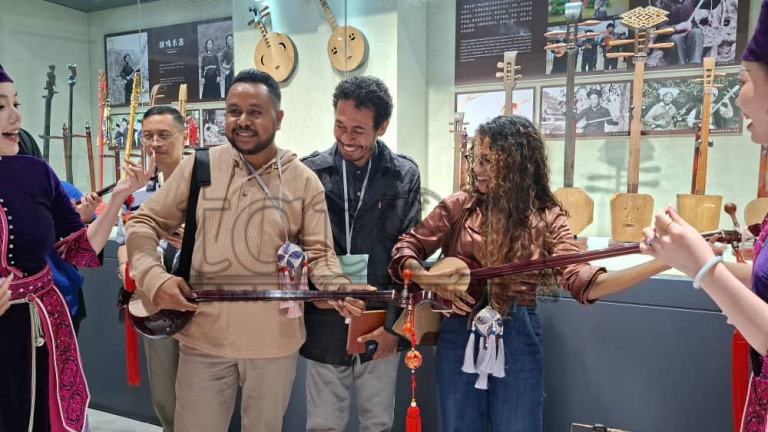
NANNING, 15 September 2026 (TATOLI) — A delegation of journalists from ASEAN countries began its field visits in China’s Guangxi Zhuang Autonomous Region by exploring the region’s rich ethnic music, arts, and history through visits to Guangxi Arts University and the Museum of Guangxi Zhuang Autonomous Region, before continuing their journey to Qinzhou City.
The visits marked the first field activities after the participants arrived in Nanning on Monday, September 14, 2026, following long journeys from their respective countries.
Four participants from Timor-Leste arrived in Nanning after traveling for more than 12 hours from Dili. Upon arrival, they took time to rest and recover from the journey before attending a group dinner. For Timorese delegates, adapting to regional media tours underscores the practical demands of international professional mobility, providing valuable perspective as Timor-Leste builds its own network of cross-border media and cultural partnerships.
On Tuesday morning, after breakfast, around 29 participants gathered in the lobby of Wo Sheng Hotel. At approximately 8:30 a.m. local time, the delegation left the hotel by bus for its first destination, Guangxi Arts University.
Upon arrival at the university, the delegation was welcomed by 17 students dressed in traditional costumes representing several ethnic groups in Guangxi. The students greeted the participants with songs and presented them with xiuqiu, traditional embroidered balls regarded as symbols of good fortune.
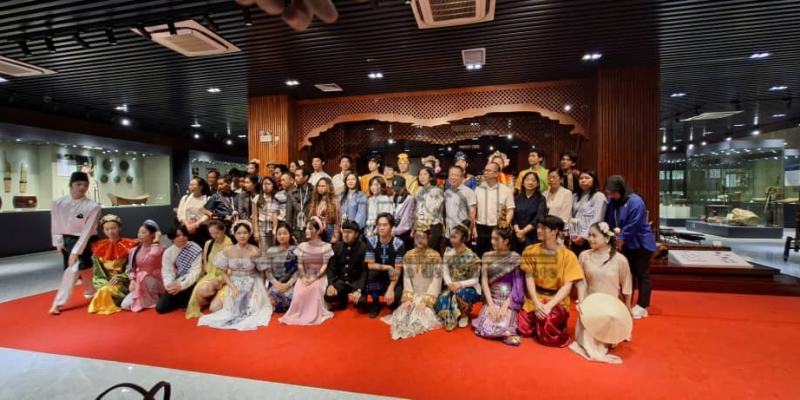
The journalists then visited the Guangxi Ethnic Music Museum, which houses a wide range of traditional musical instruments and serves as one of the university’s platforms for introducing the musical cultures of Guangxi and Southeast Asia.
During the visit, students demonstrated a number of traditional instruments, including drums, Yunluo gongs, Bianzhong bells, the Sheng wind instrument, and the Tianqin, a traditional plucked string instrument demonstrated by a student wearing a Zhuang ethnic costume.
The delegation was also shown how wooden mortars and pestles can be used to create musical rhythms, as well as a collection of traditional wooden masks used in certain rituals. The museum also displays traditional clothing from various ethnic groups in Guangxi, including the Zhuang, Dong, and Yao.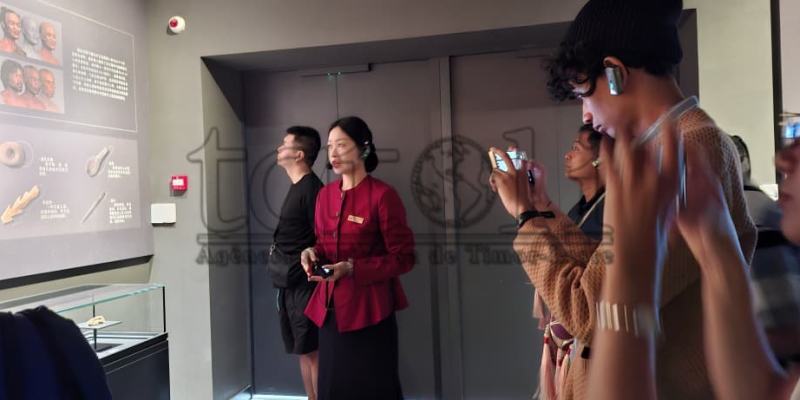
Interestingly, the museum’s collection is not limited to Chinese instruments. Musical instruments from Southeast Asian countries are also represented, including gamelan, drums, and angklung from Indonesia. Participants were even given an opportunity to try playing the angklung.
Director of the International Education Center at Guangxi Arts University, Zhau Ke, said the media play an important role in promoting Guangxi as a hub for exchanges between China and ASEAN countries.
“Through media, we can promote Guangxi as a hub for exchanges between China and ASEAN. We also hope to cooperate with ASEAN countries to promote mutual learning, especially in the fields of arts and music,” Zhau Ke told TATOLI.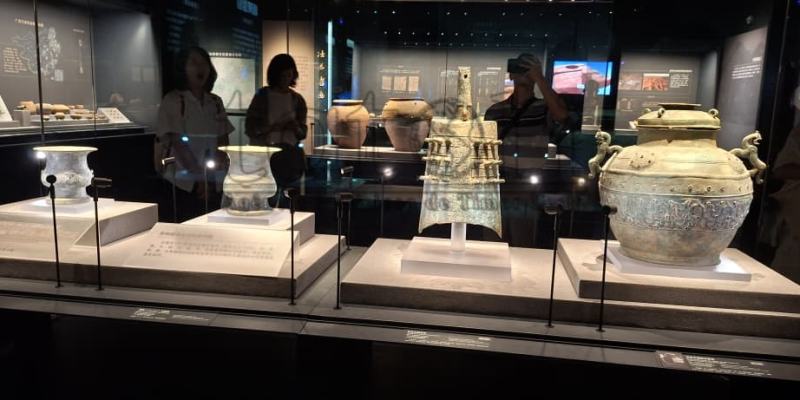
He explained that the university has established cooperation with educational institutions in ASEAN countries, including Indonesia, and has incorporated gamelan into international music activities and festivals.
According to him, such exchanges are expected to go beyond the introduction of musical instruments and develop into broader cooperation and exchanges among artists from Guangxi and ASEAN countries.
Guangxi Arts University currently hosts international students from several ASEAN countries, including Cambodia, Indonesia, Laos, Myanmar, the Philippines, Singapore, Thailand, and Vietnam.
However, Zhau Ke noted that the university has yet to establish formal academic cooperation with Timor-Leste and currently has no Timorese students enrolled. For Timor-Leste, as an emerging partner deepening its integration into regional platforms, expanding institutional and educational linkages like arts scholarships and cultural exchanges presents a significant opportunity to foster people-to-people ties.
“For Timor-Leste, we currently do not have any cooperation, and we also do not have students from Timor-Leste. We hope there will be opportunities in the future,” he said.
Guangxi Arts University is one of eight comprehensive higher education institutions specializing in the arts in China. The university has three campuses: Nanhu Campus, Xiangsihu Campus, and Guilin Campus, covering a total area of approximately 40.7 hectares.
Meanwhile, the Guangxi Ethnic Music Museum was established in June 2015 and is located at the university’s Nanhu Campus. Covering approximately 2,600 square meters, the museum opened to the public in October 2018 and houses more than 1,600 objects or sets of collections, ranging from musical instruments, traditional songbooks, musical scores, and manuscripts to audio-visual materials.
The museum is also said to house one of the largest collections of ASEAN musical instruments among universities in China, making it a platform for showcasing Guangxi’s ethnic music as well as the musical cultures of Southeast Asia.
Exploring Guangxi’s history
Following the university visit, the delegation continued to the Museum of Guangxi Zhuang Autonomous Region to learn about the history and way of life of the people of Guangxi across different periods. Such historical preservation offers valuable lessons for Timor-Leste as it continues to document, archive, and promote its own rich indigenous heritage and national identity.
At the museum, the journalists viewed various historical relics illustrating how people in the past lived and developed their civilization in the Guangxi region.
The collections on display included images and relics found on rocks, cooking vessels, jars, arrowheads, knives, and various other historically significant artifacts.
The Museum of Guangxi Zhuang Autonomous Region was established in 1934 and is a comprehensive autonomous regional-level museum focusing on history and art. It is also classified as a national first-class museum in China.
The museum’s architecture reflects elements of Zhuang culture while integrating spaces for cultural relics, exhibitions, modern technology, and cultural activities.
The morning program concluded with a bamboo dance performance before the participants had lunch and prepared to leave Nanning for Qinzhou.
According to the program, the journey to Qinzhou began at around 1:00 p.m. In the city, the delegation was scheduled to continue its field visits to the Qinzhou Blue Bay Mangrove Nature Reserve, logistics facilities at Qinzhou Port, and the Qinzhou Nixing Pottery Museum and Experience Center before attending a dinner hosted by the Qinzhou Municipal Government.
The activities were part of the official Guangxi program scheduled for September 15.
Journalist: Cidalia Fátima
Editor: Rafael Ximenes de A. Belo