


Exploring Quanzhou’s heritage from traditional houses to an 800-year-old bridge
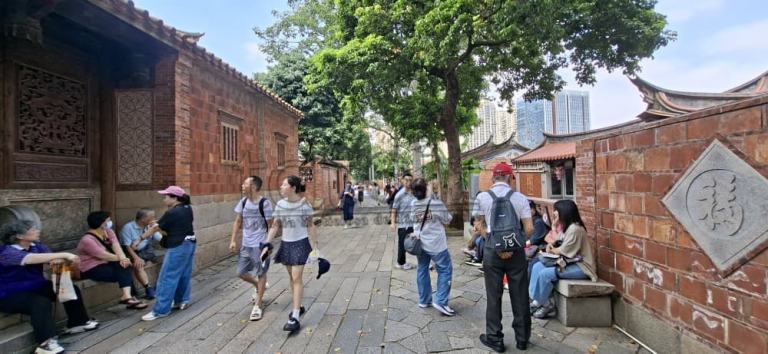
QUANZHOU, 22 September 2026 (TATOLI) – From rows of traditional houses preserving traces of life in southern Fujian to a stone bridge more than 800 years old, a delegation of media representatives from ASEAN countries explored the historical, cultural, and architectural heritage of Quanzhou in Fujian Province, China, on Tuesday.
The journey began after the delegation completed a morning visit to ANTA Group’s headquarters in Jinjiang. The group then headed to the Jinjiang Wudianshi Traditional Blocks, a historic area that preserves buildings dating from the Ming and Qing dynasties, the Republic of China period, and the modern era.
At Wudianshi, the journalists saw how traditional architecture served not only as living spaces but also reflected the social life, culture, and status of people in their time.
From the layout of houses, bedrooms, and tea rooms to the shape and size of buildings, each element had its own function and meaning. The delegation was also shown the differences between the residences of wealthy families, buildings associated with government officials in the past, and various elements of traditional Chinese architecture.
One of Wudianshi’s most distinctive features is its palace-style red-brick architecture, characteristic of southern Fujian.
Among the traditional buildings are also structures that combine Chinese and Western architectural elements, reflecting a history of cultural exchange and Fujian’s connections with the outside world.
Wudianshi Traditional Blocks is known as one of the birthplaces of Jinjiang’s urban area. Located in Meiling Subdistrict, Jinjiang, under the administration of Quanzhou City, the area covers approximately 84,000 square meters.
Around 130 structures have been preserved, including ancestral halls, temples, residential houses, and shops.
Beyond its physical architecture, Wudianshi also serves as a space for preserving various forms of intangible cultural heritage, including Gaojia Opera, puppet shows, and Nanyin.
Fujian’s historical connections with overseas Chinese communities can also be seen through several buildings in the area. The religious traditions associated with Shigu Temple have spread to the Philippines and Taiwan, while the Cai Clan Ancestral Hall and Zhuang Clan Ancestral Hall serve as kinship links with overseas Chinese communities.
The revitalization of Wudianshi as a cultural and tourism area began in April 2012, and it opened to the public in May 2015. In September of the same year, the area was designated a China National 4A-level Tourist Attraction.
Efforts to preserve local traditions are also carried out through various cultural and artistic activities. More than 400 intangible cultural heritage performances were staged in the area throughout 2024.
In January 2025, the National Trend Block opened, bringing in several brands, including ANTA and Xtep, and combining traditional cultural heritage with Jinjiang’s modern industrial development and lifestyle.
A stone bridge more than eight centuries old
After completing the visit to Wudianshi and having lunch, the delegation continued its journey to Anping Bridge, also known as Wuli Bridge.
At the site, the group traveled aboard three sightseeing vehicles around the park, allowing participants to view Anping Bridge from different sides.
The bridge’s construction attracted particular attention because the historic structure was built using massive granite stone beams.
Construction of Anping Bridge began in 1138 during the Southern Song Dynasty. More than eight centuries old and approximately 2,255 meters long, Anping is known as the longest surviving ancient stone beam bridge over the sea in China.
Its construction technique reflects the engineering capabilities of people at the time. Massive granite beams were used to form the bridge structure without relying on modern construction materials such as cement and steel reinforcement bars.
The bridge is significant not only for its architectural value but also for its role in the history of transportation and maritime trade in Quanzhou.
Anping Bridge is one of the 22 component sites of “Quanzhou: Emporium of the World in Song-Yuan China,” which was inscribed on the UNESCO World Heritage List in 2021.
Its status differs from that of Wudianshi Traditional Blocks. Wudianshi is not part of the UNESCO World Heritage Site but is a China National 4A-level Tourist Attraction that preserves Jinjiang’s local architectural and cultural heritage.
The existence of Anping Bridge provides evidence of the development of infrastructure that supported economic activity and the movement of people in Quanzhou during the Song and Yuan dynasties, when the area developed into an important center of maritime trade.
The visits to Wudianshi and Anping Bridge highlighted two different forms of heritage in Quanzhou. Wudianshi preserves traces of community life through its houses, temples, ancestral halls, arts, and traditions, while Anping reflects the engineering capabilities and infrastructure development of society more than eight centuries ago.
The visit to Anping Bridge also marked the conclusion of the ASEAN media delegation’s program in Quanzhou.
From there, the delegation departed Quanzhou for Xiamen, a journey of approximately one hour and 30 minutes by road, to continue the ASEAN Media Workshop program in Fujian Province.
Journalist: Cidalia Fátima
Editor: Rafael Ximenes de A. Belo