


Timor-Leste poverty rate falls to 37%, but economic inequality widens
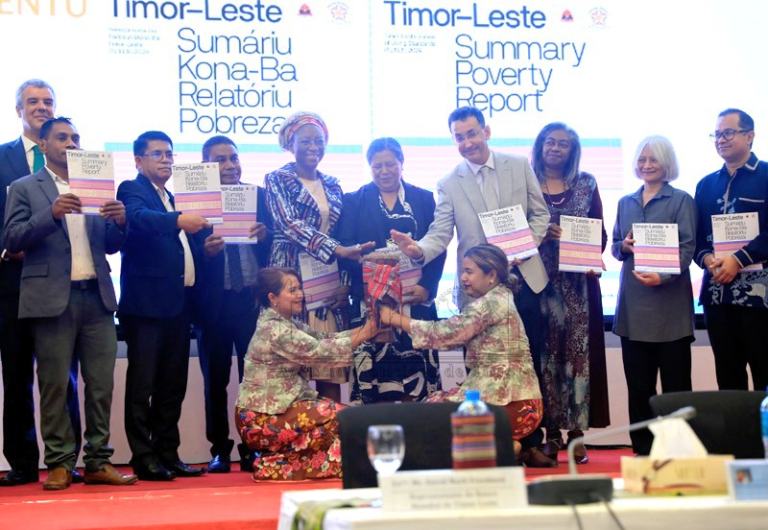
DÍLI, 21 October 2026 (TATOLI) — Timor-Leste’s poverty rate fell from 48.4% in 2014 to 37.02% in 2024, but economic inequality increased and rural communities continued to face significantly higher levels of deprivation, according to a new national living standards survey.
The findings are contained in the Summary Poverty Report of the 2024 Timor-Leste Survey of Living Standards (TLSLS), which also documents improvements in access to electricity, safe drinking water and adequate housing over the past decade.
Despite the overall decline in poverty, the report highlights persistent disparities between rural and urban areas, as well as differences in living conditions, education and access to essential services between poor and better-off households.
During the report’s presentation, National Institute of Statistics (INE-TL) President Elias Ferreira said the findings confirmed progress in reducing poverty over the past decade and improving access to basic services.
He explained that Timor-Leste’s national poverty line is calculated using the cost of essential goods, based on household consumption patterns and prices in the country.
Ferreira also stressed the importance of distinguishing the national poverty line from international poverty thresholds used by the World Bank, which follow different criteria and are designed primarily to monitor global poverty and compare conditions across countries.
According to the report, approximately 522,927 people lived below the national poverty line in 2024, which was set at US$2.31 per person per day.
The survey was conducted between April and October 2024 and covered 7,424 households, with results representative of the country nationally and at municipal level.
Rural communities bear the greatest burden
Poverty remained substantially more widespread in rural areas than in urban centres.
In 2024, the poverty rate in rural areas stood at 44.45%, compared with 18.43% in urban areas. About 86% of people living in poverty were in rural communities, representing 448,556 people, while 74,371 poor people lived in urban areas.
At municipal level, Atauro recorded the highest poverty rate at 74.37%, followed by Liquiçá at 52.95% and Aileu at 52.24%.
Dili had a substantially lower poverty rate of 17.05%, while Viqueque recorded 24.73%.
However, the Dili still had about 59,000 people living below the national poverty line, illustrating that a lower poverty rate does not necessarily mean fewer people are affected.
The report also found that poverty was more intense in rural areas. The rural poverty intensity index stood at 12.65%, compared with 4.18% in urban areas, indicating that poor rural households generally faced deeper deprivation relative to the poverty line.
Vice-Minister of Finance Regina de Jesus welcomed the progress but cautioned that the findings must be interpreted responsibly and should not weaken efforts to tackle poverty.
She said many families continued to struggle to afford essential goods and access adequate economic opportunities despite the decline in the overall poverty rate.
De Jesus called for sustained and effective policies and programmes, particularly those targeting rural communities, improving infrastructure and basic services, and expanding equitable economic opportunities throughout the country.
Economic inequality rises despite lower poverty
While poverty declined, income or consumption inequality increased over the decade, according to the report.
Timor-Leste’s Gini coefficient, a measure of inequality in which zero represents perfect equality and one represents maximum inequality, rose from 0.31 in 2014 to 0.36 in 2024.
The increase of 0.05 points indicates that the reduction in poverty was not accompanied by a reduction in economic inequality.
The report also found differences in poverty trends across municipalities. Comparable estimates showed that poverty declined in most municipalities between 2014 and 2024, with Aileu and Liquiçá identified as exceptions.
The findings highlight the need for policies that address not only the number of people living below the poverty line but also the uneven distribution of economic opportunities and improvements in living standards.
Access to basic services improves
The survey recorded significant improvements in several non-monetary indicators of household well-being.
The proportion of households without electricity fell from 27.9% in 2014 to 1.7% in 2024, bringing the country close to universal household access to electricity.
The share of households without access to safe drinking water declined from 25.4% to 9.1% over the same period.
The proportion of households without adequate sanitation also fell, from 39.6% to 24.4%, while the share living in housing classified as adequate increased from 22.4% to 42.6%.
For the purposes of the report, adequate housing refers to homes with access to safe drinking water and electricity and built with durable construction materials.
Despite these gains, substantial challenges remain in improving housing conditions, sanitation and access to cleaner cooking energy.
In 2024, 70.9% of households still relied on polluting fuels for cooking, although this was an improvement from 86.8% in 2014.
Poor households face wider disadvantages
The survey found persistent differences in living conditions between poor households and those with greater financial resources.
Only 26.8% of poor households lived in housing classified as adequate, compared with 51.9% of non-poor households.
Educational disparities were evident as well. Among children aged six to 11 from poor households, 17.7% were not attending school, compared with 8.2% of children from non-poor households.
Literacy was another major concern. In 63.3% of poor households, at least one member aged 10 or older could not read or write. The corresponding proportion among non-poor households was 37.6%.
Access to cleaner cooking energy also varied considerably. Some 86.7% of poor households relied on firewood or other polluting fuels, compared with 61.7% of non-poor households.
These findings show that poverty extends beyond income and consumption, affecting access to decent housing, education, sanitation and other essential services.
The disparities also suggest that improvements in national poverty indicators do not necessarily translate into equal gains for all households.
Survey to guide future public policies
The report is intended to provide an evidence base for further analysis of the causes and drivers of poverty and inequality in Timor-Leste.
A Poverty and Equity Assessment is planned through a partnership involving INE-TL, the Ministry of Finance and the World Bank.
The assessment is expected to examine employment, labour income, social protection programmes, remittances and the effects of economic shocks.
The findings are expected to support evidence-based policymaking, accelerate poverty reduction and help authorities identify the communities and households most in need of targeted support.
Journalist: Afonso do Rosário
Editor: Isaura Lemos de Deus
Translation: Filomeno Martins