


PM Gusmão urges for greater investment in teachers and education quality
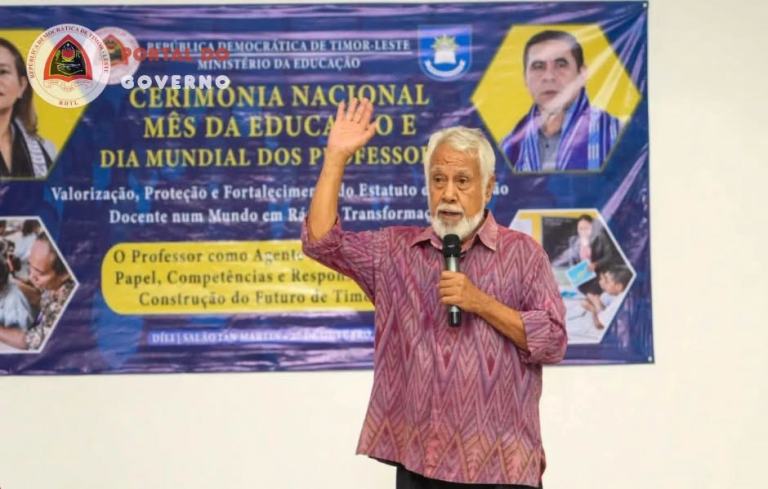
DILI, 27 October 2026 (TATOLI) – Timor-Leste Prime Minister Kay Rala Xanana Gusmão has called for greater investment in teacher training, improved working conditions and school infrastructure, describing education as fundamental to the country’s future development.
Speaking at the National Education Month and World Teachers’ Day commemoration in Dili on Tuesday, Xanana emphasised that teachers play an essential role in shaping future generations and strengthening the nation.
“Education is the foundation of everything we want to build for our future,” he said during the ceremony at the Ian Martin Hall of the National Institute for the Training of Teachers and Education Professionals (INFORDEPE).
He described teachers as agents of change who make a daily contribution to the lives of children and young people, saying their role in educating future generations and building the country could not be replaced.
The Prime Minister also recalled the challenges Timor-Leste faced in rebuilding its education system following independence, including restoring school infrastructure, developing curricula and teaching materials, training teachers and strengthening school management and culture.
“Without quality education, independence cannot fulfil its promise. And without qualified and valued teachers, development cannot take root or translate into tangible improvements in the lives of our people,” he said.
Xanana reaffirmed the Government’s commitment to strengthening both initial and continuous teacher training, progressively improving working conditions, particularly in rural and remote areas, and investing in more adequate and functional school facilities.
He also highlighted the importance of inclusive education, the responsible use of technology to support learning, and stronger management, evaluation and monitoring of the national education system.
On the status of the teaching profession, the Prime Minister stressed that public recognition alone was insufficient to acknowledge teachers’ contributions, calling for concrete measures to protect their rights and improve professional support.
“It is not enough to ‘recognise’ and ‘thank’ you for your dedication to society once a year. The best way to show our appreciation is to give your profession concrete, consistent and meaningful value,” he said.
He added that teachers needed not only public recognition but also greater respect for their rights and stronger support in carrying out their professional responsibilities.
Addressing the impact of rapid technological and social changes on education, Xanana said artificial intelligence, digital technologies and online learning platforms offered significant opportunities but also presented new challenges.
He stressed that technology should complement teaching rather than replace educators, whose responsibilities in guiding, educating and supporting students remained essential.
“Technology must serve learning and human development, but it can never replace the essential role of teachers in guiding, educating and supporting students,” he said.
The Prime Minister also urged teachers to remain committed to educating children and young people despite limited resources and difficult working conditions.
“Do not give up on our children and young people, even when conditions are not ideal and resources are lacking,” he said, adding that a teacher could change an individual’s life and, in turn, transform a family, a community and an entire country.
Education Minister Dulce de Jesus Soares said this year’s theme highlighted the urgent need to safeguard teachers’ rights, improve working conditions, address teacher shortages and respond to emerging challenges, including digital transformation and climate change.
She described teachers as central to the country’s educational transformation, saying modern and creative teaching methods were essential to preparing young people to compete internationally.
“Teachers are the heart of this national transformation. Through modern and creative methodologies, they prepare our young people to compete on a global scale,” she said.
Meanwhile, Secretary of State for General Secondary Education and Technical-Vocational Secondary Education Domingos Lopes Lemos highlighted teachers’ responsibility in developing children’s knowledge, skills and character.
He compared a child’s development to shaping an unformed stone, explaining that teachers needed the knowledge and skills to guide students towards reaching their full potential.
The national commemoration was held under the overarching theme, “Valuing, Protecting and Strengthening the Status of the Teaching Profession in a Rapidly Changing World,” with the specific theme, “Teachers as Agents of Transformation: Roles, Competencies and Responsibilities in Building the Timorese State.”
This year’s event also marked the 60th anniversary of the 1966 UNESCO and International Labour Organization (ILO) Recommendation concerning the Status of Teachers, adopted in 1966 to establish international standards on teachers’ rights and responsibilities, professional training, recruitment, employment and working conditions.
The ceremony brought together Prime Minister Xanana Gusmão, Education Minister Dulce de Jesus Soares, Secretary of State Domingos Lopes Lemos, representatives of educational and teacher-training institutions, development partners, teachers and students.
At the conclusion of the event, Xanana thanked teachers across the country for their contribution to building the Timorese state and nation, reaffirming the Government’s commitment to working towards improvements in the quality of education.
TATOLI