


Timor-Leste strengthens capacity to expand social security coverage to informal workers
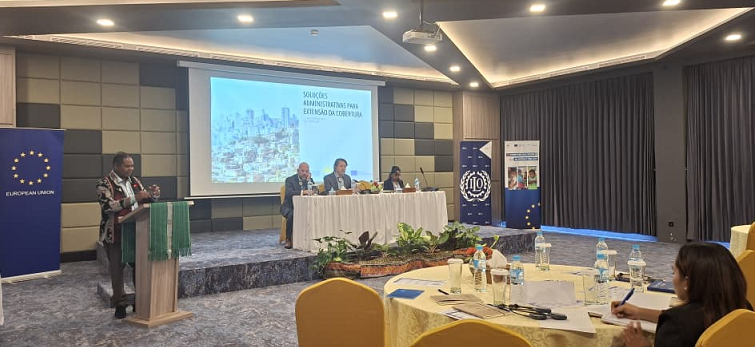
DÍLI, 03 July 2026 (TATOLI) — Timor-Leste has launched a week-long training programme to strengthen national capacity to expand social security coverage, focusing on integrating informal economy workers into the country’s contributory social protection system.
The programme, which runs through August 7 at JL World Hotel in Dili, is organised by the International Labour Organization (ILO) in partnership with the National Institute of Social Security (INSS) and funded by the European Union (EU) under the Strengthening Social Inclusion and Nutrition in Timor-Leste project.
Thirty participants from government ministries, the INSS, development partners, workers’ organisations and employer associations are attending the training, which aims to enhance national expertise in developing and implementing administrative solutions that will enable workers currently outside the social security system to join the contributory scheme.
ILO Country Director for Indonesia and Timor-Leste Simrin Singh said the programme is designed to convert technical knowledge into practical policies that strengthen the country’s social protection system.
“Social protection is a human right and a fundamental pillar of decent work. However, 77% of Timor-Leste’s workforce still works in the informal sector and does not benefit from adequate protection. Expanding coverage to this group is a national priority, in line with the National Social Protection Strategy,” Singh said via video conference.
During the five-day training, participants are receiving technical guidance from ILO specialists, including Carlos Andre Gama, the organisation’s social protection specialist based in Bangkok, Thailand, and Elton Di Tommazi Maciel, a trainer from the ILO International Training Centre (ITC-ILO) in Turin, Italy.
Singh said the programme goes beyond sharing international experience by helping Timor-Leste adapt proven global practices to its own institutional and labour market context.
She noted that Timor-Leste has strengthened its engagement with the international social security community through membership of the International Social Security Association (ISSA), the INSS’s participation in global forums and its attendance at regional conferences.
“However, all these achievements will only have meaning when global knowledge is translated into concrete action at the national level,” she said.
EU Ambassador to Timor-Leste Thorsten Bargfrede reaffirmed the bloc’s commitment to supporting the country’s efforts to build a more inclusive and resilient social protection system, particularly for vulnerable groups.
He said effective social protection helps workers withstand economic shocks, promotes the inclusion of women and disadvantaged communities, and supports sustainable economic and social development.
“I hope this training will not only be an opportunity to listen and learn, but also to generate new ideas and concrete actions that can bring change to this country, even if it begins with small steps,” Bargfrede said.
The ambassador also commended the INSS for its leadership and thanked experts from the ITC-ILO in Turin and the ILO Regional Office in Bangkok for sharing international knowledge and best practices.
INSS Board President Zeferino da Costa Bobo said expanding social security coverage is an urgent national priority, given that most of Timor-Leste’s workforce remains employed in the informal economy.
Those with limited access to social protection include self-employed workers, farmers, fishers, small-scale traders, domestic workers, construction workers and other vulnerable groups.
Bobo said the National Social Protection Strategy 2021-2030 identifies extending coverage to underserved groups as a key step toward achieving universal social protection.
“As the institution responsible for managing the contributory social security system, the INSS is committed to improving access to services and developing practical approaches that respond to the needs of informal economy workers in Timor-Leste,” he said.
He said the training is expected to strengthen the capacity of the INSS and partner institutions to develop effective administrative measures, including improving registration systems, contribution payment mechanisms, public awareness campaigns and incentives that encourage informal workers to enrol in the national social security scheme.
Journalist: Afonso do Rosário
Editor: Isaura Lemos de Deus
Translation: Filomeno Martins