


WHO’s 79th South-East Asia Regional Committee session begins today in Díli
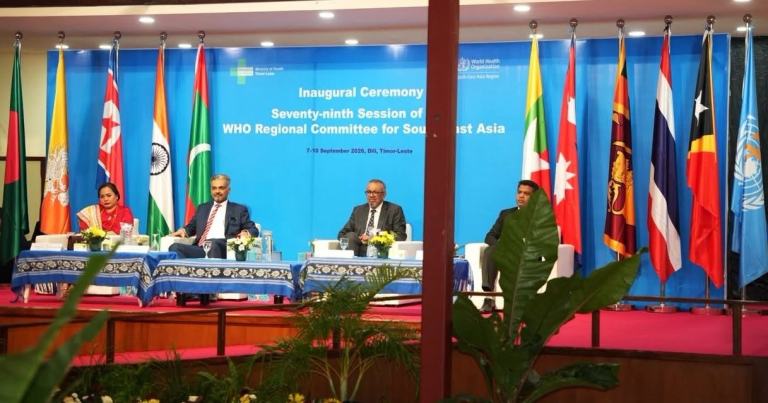
DÍLI, 07 September 2026 (TATOLI) – Timor-Leste is hosting the 79th Session of the World Health Organization (WHO) Regional Committee for South-East Asia in Dili from September 7 to 10, bringing together health ministers and senior officials to set regional priorities and review progress on key health issues.
The four-day meeting is being attended by WHO Director-General Tedros Adhanom Ghebreyesus, who is making his first official visit to Timor-Leste, as well as Nilesh Buddha, Officer-in-Charge of the WHO Regional Office for South-East Asia.
The session marks the first time in 11 years that Timor-Leste has hosted a meeting of the WHO Regional Committee for South-East Asia.
The Regional Committee is the WHO’s main decision-making body for the region and comprises 10 member states: Bangladesh, Bhutan, the Democratic People’s Republic of Korea, India, Maldives, Myanmar, Nepal, Sri Lanka, Thailand and Timor-Leste.
The opening session on Monday will see delegates elect the session’s officers, present credentials and adopt the agenda. They will also receive a report on WHO activities across the region before hearing an address from Tedros.
A ministerial roundtable on “Health workforce: equity in specialist care” is scheduled for September 8. Ministers and officials will discuss challenges facing health workers and ways to improve equitable access to specialist healthcare.
Universal health coverage and progress towards health-related Sustainable Development Goals will also feature on the agenda.
Delegates are expected to discuss disease elimination, efforts to accelerate the fight against tuberculosis, access to quality medical devices and measures to strengthen the resilience of health facilities.
Digital transformation in healthcare will be another key issue, including a proposal to establish the South-East Asia Digital Health and Artificial Intelligence Collaborative Network (SEA-DAC).
The committee will also review progress in maternal, neonatal and child health, mental health, non-communicable diseases, viral hepatitis, HIV and sexually transmitted infections.
Other areas on the agenda include measles and rubella, polio eradication, health emergency preparedness and malnutrition.
Delegates will consider WHO budget and governance matters, along with issues arising from the 79th World Health Assembly and the 158th and 159th sessions of the WHO Executive Board.
A series of technical sessions held alongside the main programme will address sexual and reproductive health, gender equality, climate change and health, climate financing for the health sector, health security, immunisation and the prevention of vaccine-preventable disease outbreaks.
The session will conclude on September 10, when delegates are scheduled to consider and adopt resolutions and decisions before the closing session.
TATOLI