


ASEAN deepens economic and strategic ties with Hong Kong at the Belt and Road Summit
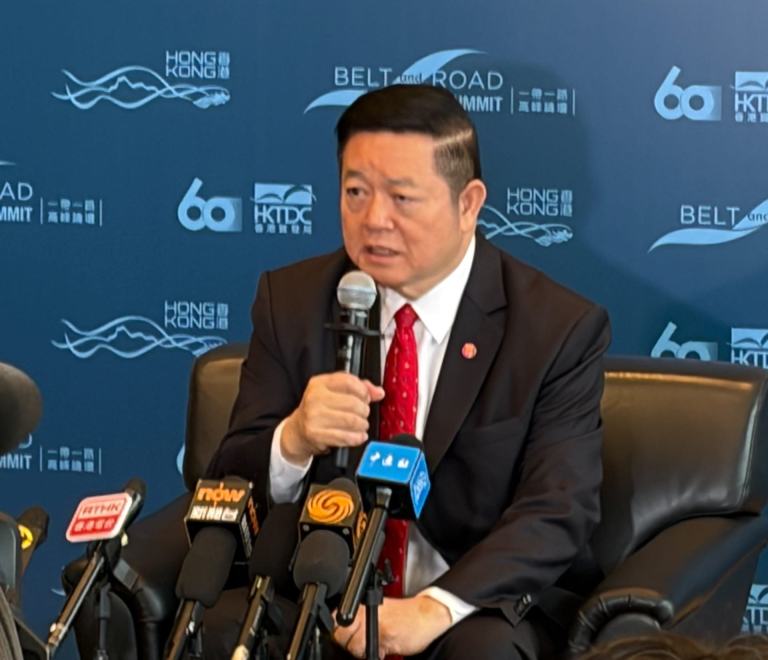
HONG KONG, 09 September 2026 (TATOLI) — ASEAN Secretary-General, Kao Kim Hourn delivered a comprehensive keynote address at the 11th Belt and Road Summit held at the Hong Kong Convention and Exhibition Centre, outlining an expansive strategic blueprint for regional collaboration across infrastructure, digital economies, energy security, and sustainable finance.
Addressing a high-level audience of international dignitaries, government officials, and business leaders, Kao highlighted the immense economic scale and potential of the Association of Southeast Asian Nations (ASEAN). Representing 11 member states with a population of approximately 700 million people, ASEAN stands today as the third-largest trading block in the world.
Opening his address, Kao remarked, “I bring warm greetings from ASEAN, a region of 11 member states with a population of approximately 700 million people, the third largest trading block in the world today.”
He noted that the summit’s theme, “Advancing High-Quality Development Embarking on a New Journey,” arrives at a pivotal moment. With rapid shifts in the global economic landscape, including technological transformations, shifting supply chains, the energy transition, and growing geo-economic uncertainties, ASEAN remains firmly committed to staying open, connected, resilient, and forward-looking.
Strategic priorities and robust economic momentum
Guided by the ASEAN Community Vision 2045 and the ASEAN Economic Community Strategic Plan 2026–2030, the bloc is responding through three mutually reinforcing priorities: accelerating digital transformation, strengthening resilient supply chains and economic security, and advancing sustainable development. Kao emphasized that connectivity is central to binding these goals together.
Demonstrating strong economic vitality, Kao reported that ASEAN’s economy expanded by 4.9 percent in 2025, comfortably outpacing global growth of 3.5 percent. Total trade surged to USD 4.39 trillion (up 13.7 percent from the previous year), while foreign direct investment (FDI) inflows rose by 10.1 percent to reach USD 245.7 billion.
Four pillars of cooperation
To build upon this robust economic momentum, the Secretary-General detailed four major areas where cooperation with Hong Kong and Belt and Road partners can generate lasting benefits:
- Resilient Supply Chains and Infrastructure: Kao emphasized the need to consolidate ASEAN as a premier hub for robust supply chains. Highlighting that the region requires at least USD 210 billion annually in infrastructure investments through 2030, he noted ongoing efforts to support Hong Kong’s inclusion in the Regional Comprehensive Economic Partnership (RCEP).
- Digital Economy Integration: Pointing to the ASEAN Digital Masterplan 2030 (ADM 2030) and the upcoming ASEAN Digital Economy Framework Agreement (DEFA), Dr. Kao called for building a seamless digital ecosystem spanning cross-border data flows, digital payments, and cybersecurity.
- Energy Security and Interconnection: With energy demand projected to climb significantly, scaling up the ASEAN Power Grid is vital to diversify energy sources and accelerate renewable integration. Kao noted that around USD 27 billion is required by 2040 for planned cross-border interconnections.
- Sustainable Financing: Centered around the ASEAN Strategy for Carbon Neutrality, which aims to unlock USD 5.3 trillion in economic value and USD 6.7 trillion in green investments by 2050—He pointed to Hong Kong’s financial markets as an ideal partner to bridge regional green, blue, and circular economy projects with global capital.
Moving from ambition to implementation
Concluding his keynote address, Kao urged stakeholders to move swiftly from conceptual planning to concrete execution, leveraging strategic partnerships to turn regional connectivity into shared prosperity.
“Our task now is to move from ambition to implementation: to turn connectivity into opportunity, investment into sustainable growth, and partnership into shared prosperity.”
The address marks a significant alignment of regional policies between ASEAN and external economic powerhouses like Hong Kong under the Belt and Road Initiative. By integrating capital markets, aligning digital frameworks like DEFA, and mobilizing billions in infrastructure and green financing, the partnership establishes a concrete framework to mitigate global geo-economic uncertainties. For ASEAN, this cooperation reinforces its position as a leading global investment destination and trading block, while providing Hong Kong with direct pathways into high-growth emerging markets across Southeast Asia.
TATOLI