


AI technology boosts Qinzhou Port efficiency by up to 30 percent
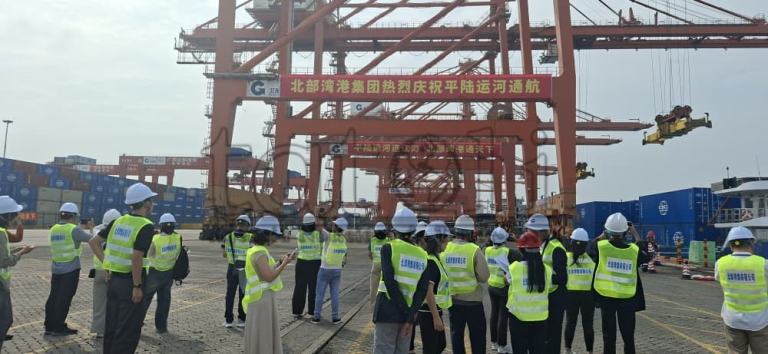
QINZHOU, 16 September 2026 (TATOLI)– A media delegation from ASEAN nations kicked off the second day of its official visit to China’s Guangxi Zhuang Autonomous Region by observing firsthand how artificial intelligence (AI) is revolutionizing operations at Qinzhou Port, a pivotal trade gateway connecting western China with Southeast Asia.
The itinerary began at the Beibu Gulf Smart Port Innovation Center, followed by strategic stops at Guangxi CNGR New Energy Technology, the China-Malaysia Qinzhou Industrial Park, and the Madao Water Control Project along the Pinglu Canal.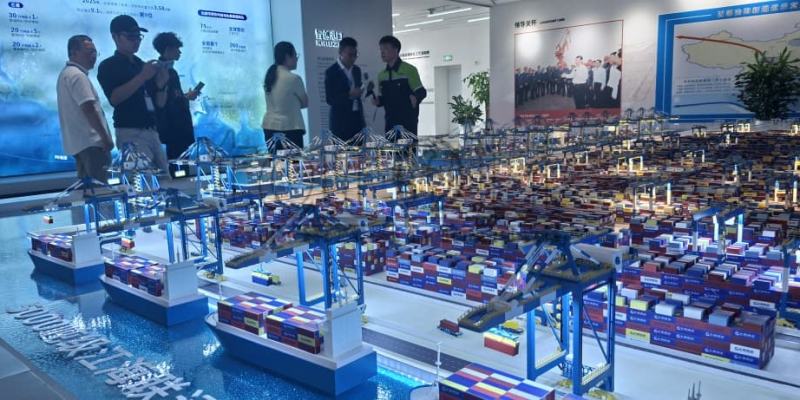
During the port tour, journalists received briefings on how terminal upgrades, automation, and AI are accelerating cargo handling, container movements, and overall turnaround times.
Li Chaofei, general manager of the Nanning Branch of Shanghai New Haifeng Container Transportation Co., Ltd., emphasized the profound impact of AI on maritime logistics.

“We have applied artificial intelligence in our operations, including the loading and unloading process and the transfer of containers from the container yard to container trucks,” Li told the ASEAN delegation.
According to Li, automation has boosted operational efficiency by 20% to 30%, drastically cutting vessel dwell times. These technological advancements have also driven a 20% reduction in overall berthing and operational expenditures.
Connecting China with ASEAN
As a cornerstone of the New International Land-Sea Trade Corridor, Qinzhou Port seamlessly merges rail and maritime freight to link inland western China with global trade networks.
Li noted that his company’s shipping routes serve key ASEAN markets, including Vietnam, Thailand, Cambodia, Malaysia, Indonesia, The Philippines, Brunei Darussalam.
A prime example is the maritime route from Qinzhou Port to Sihanoukville Port in Cambodia, which takes roughly five days. This represents a greater than 50% reduction in transit time, alongside lower shipping cost, compared to traditional shipping pathways through Guangdong Province. The carrier’s network also services multiple Philippine ports, including Manila, Subic, Iloilo, and Davao.
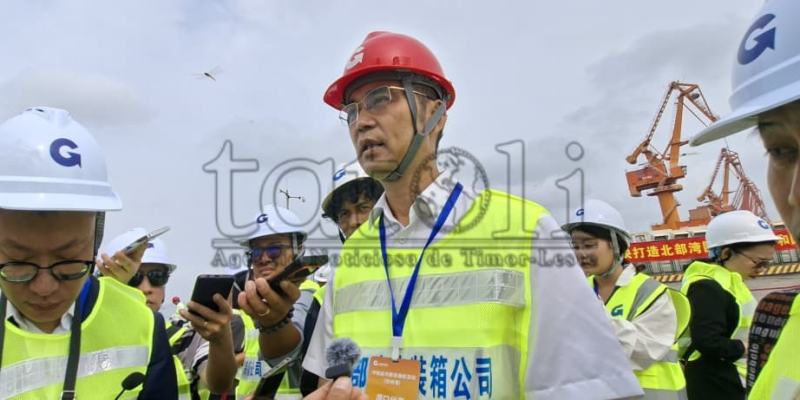
Ling Guohua, operations department manager for Guangxi Beibu Gulf International Container Terminal Co., Ltd., stressed that the port’s growth relies on a dual approach: cutting-edge technology and streamlined bureaucratic procedures.
“For Beibu Gulf Port, we are making efforts to upgrade hardware facilities while simplifying procedures, so that vessels arriving at the terminal can enter quickly and also depart quickly,” Ling explained.
The terminal features deep-water berths capable of accommodating 100,000-ton vessels, a water depth of approximately 15.1 meters, and an annual capacity of around 700,000 TEUs. Designed to support a river-sea multimodal transport network, the facility handles diverse commodities ranging from light industrial goods and vehicle parts to essential minerals.
Automated container terminal
Highlighted as a flagship infrastructure project under the New International Land-Sea Trade Corridor, the Qinzhou Automated Container Terminal boasts a 1,302-meter shoreline. It features two automated berths equipped to handle vessels of 100,000 and 200,000 tons, pushing total terminal handling capacity to roughly 2.6 million TEUs.
The facility’s architecture integrates AI, big data analytics, automated cranes, and horizontal transport systems to maximize throughput and minimize human intervention.
From smart ports to new energy
Following the port tour, the ASEAN press corps visited Guangxi CNGR New Energy Technology Co., Ltd., located within the China-Malaysia Qinzhou Industrial Park (CMQIP). Founded in February 2021, the firm operates as a subsidiary of CNGR Advanced Material Co., Ltd., specializing in advanced new energy materials.
Established in March 2012, CMQIP stands as a landmark cross-border economic cooperation project. Developed alongside the Malaysia-China Kuantan Industrial Park under the “Two Countries, Twin Parks” framework, CMQIP aims to foster a maritime economic cluster and serve as a model demonstration zone for China-ASEAN collaboration.
After a midday break, the delegation concluded its field visits with a tour of the Madao Water Control Project on the Pinglu Canal.
The day’s events provided ASEAN journalists with a comprehensive look at how Guangxi is harmonizing smart logistics, green energy manufacturing, and regional partnerships to tighten economic ties between China and Southeast Asia.
Following their engagements in Qinzhou, the delegation returned to Nanning to resume the remainder of their Guangxi program.
Journalist: Cidalia Fátima
Editor: Rafael Ximenes de A. Belo